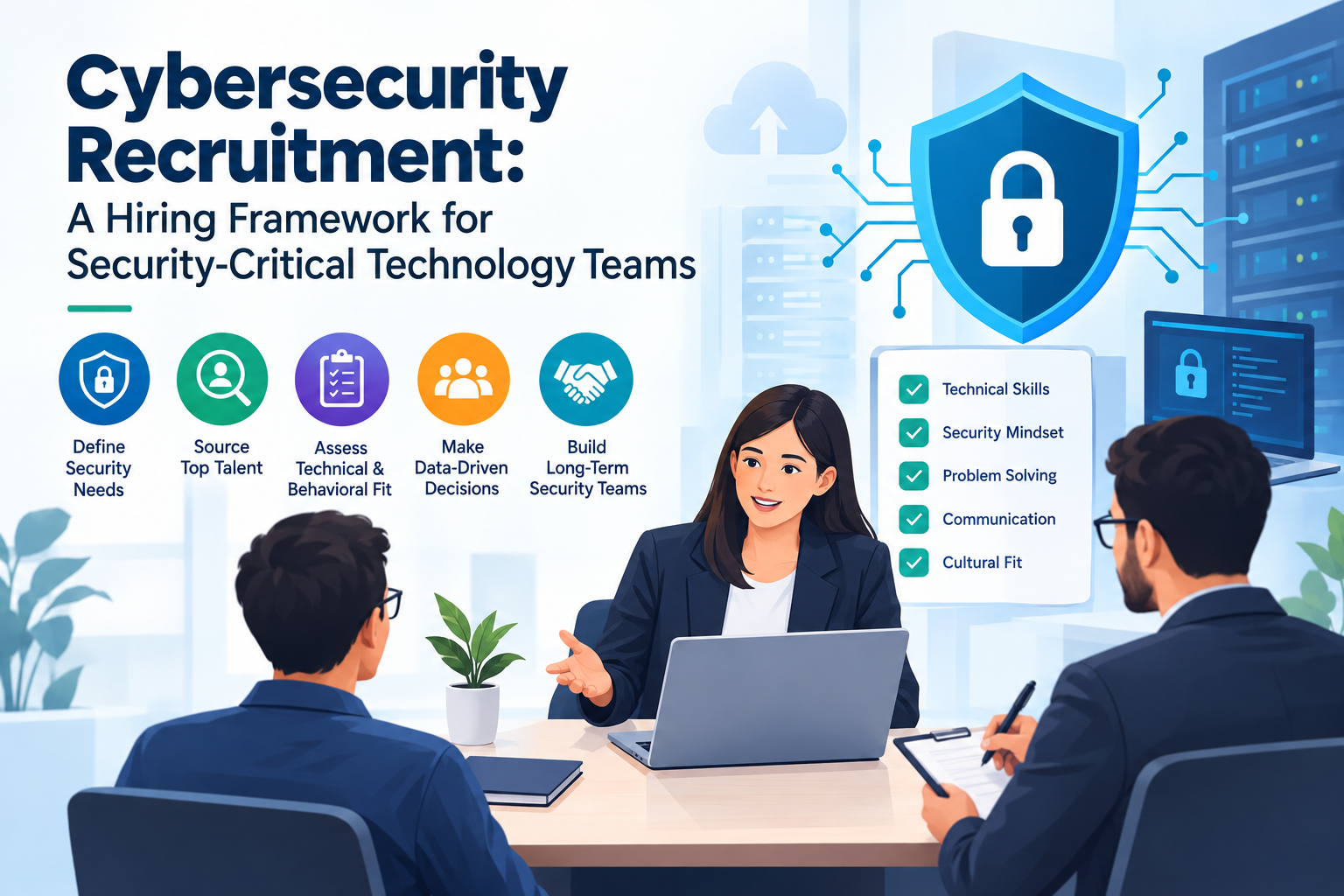
Cybersecurity Recruitment: A Hiring Framework for Security-Critical Technology Teams
Security teams are often asked to cover a wide range of responsibilities. Application security, cloud security, identity, threat detection, compliance, vulnerability management, incident response, and security architecture each require different skills. One generalist may be valuable in an early-stage company, but a security-critical technology environment needs a deliberate hiring plan.
This guide provides a practical framework for cybersecurity recruitment. It explains the main security roles, the skills to evaluate, how to assess organizational readiness, which interview questions to ask, and how to compare internal hiring with a specialist team or external delivery partner.
Key TakeawaysStart with your threat exposure, technology environment, regulatory obligations, and business priorities before writing a job description.Match the role to the security outcome: secure code, cloud controls, threat detection, compliance, or incident response.Evaluate candidates through realistic scenarios and evidence of operational work, not certifications alone.Define access, ownership, escalation, documentation, and ongoing support before a security engagement begins.
What Is Cybersecurity Recruitment?
Cybersecurity recruitment is the process of identifying, evaluating, and hiring people who can protect an organization's systems, applications, infrastructure, data, and operations.
A complete recruitment strategy should answer four questions:
1.
What are we protecting? Applications, cloud infrastructure, identities, data, endpoints, products, or business operations.
2.
What are the most likely and most damaging threats? Unauthorized access, software vulnerabilities, misconfiguration, fraud, ransomware, insider risk, supply-chain compromise, or data leakage.
3.
What capability is missing? Prevention, detection, governance, response, architecture, secure development, or security leadership.
4.
What evidence will show that the hire is succeeding? Fewer critical vulnerabilities, faster detection, stronger control coverage, improved audit readiness, or reduced incident impact.
The NIST Cybersecurity Framework 2.0 provides a common structure for managing cybersecurity risk across organizations . Its functions—Govern, Identify, Protect, Detect, Respond, and Recover—can help hiring managers map business needs to security capabilities.
A job description should reflect this context. “Responsible for cybersecurity” is too broad to guide recruitment or performance measurement. A better description might focus on improving cloud identity controls, reducing application vulnerabilities, building a security monitoring program, or leading incident response readiness.
1. Application Security and Product Security Roles
Application security professionals help development teams prevent, identify, and remediate vulnerabilities throughout the software lifecycle. Product security teams extend that responsibility to the applications, APIs, platforms, and services that customers use.
Typical responsibilities
•
Threat modeling new features and architectures.
•
Reviewing application and API designs.
•
Integrating security checks into CI/CD pipelines.
•
Performing code review, vulnerability analysis, and penetration-testing coordination.
•
Managing software composition and dependency risk.
•
Defining secure coding standards and developer guidance.
•
Supporting vulnerability disclosure and remediation processes.
•
Helping product teams balance security, usability, and delivery speed.
The NIST Secure Software Development Framework describes fundamental practices for producing more secure software and reducing vulnerabilities in released products . Candidates should be able to explain how security becomes part of development rather than a final-stage approval gate.
Skills to evaluate
Look for experience with secure software design, common web and API vulnerabilities, authentication and authorization, secrets management, dependency risk, code review, security testing, and developer enablement.
Strong candidates can explain how they prioritize findings. They do not treat every scanner result as equally urgent. They consider exploitability, exposure, affected assets, business impact, compensating controls, and remediation effort.
Interview questions
•
How would you introduce threat modeling into an existing product-development process?
•
How do you prevent security testing from becoming a late-stage bottleneck?
•
How would you prioritize five high-severity findings across different applications?
•
What would you do if a critical vulnerability cannot be fixed before release?
•
How do you measure whether an application-security program is improving?
For organizations building secure digital products, Witqualis product development services may be relevant when application delivery and security need to be planned together.
2. Cloud Security and Infrastructure Roles
Cloud security professionals protect the infrastructure, identities, workloads, networks, data stores, and deployment processes used by an organization.
Cloud environments can change quickly. Developers may create resources through infrastructure as code, teams may use multiple cloud providers, and applications may rely on managed services with different security responsibilities. A cloud-security hire must understand both technical controls and how teams actually deliver software.
Typical responsibilities
•
Designing identity and access management controls.
•
Enforcing least privilege and separation of duties.
•
Securing networks, containers, workloads, and storage.
•
Managing cloud configuration and posture monitoring.
•
Protecting secrets, keys, certificates, and service accounts.
•
Defining logging, monitoring, backup, and recovery requirements.
•
Reviewing infrastructure as code and deployment pipelines.
•
Supporting cloud architecture reviews and migration projects.
Skills to evaluate
Assess practical knowledge of the cloud platforms your organization uses, identity architecture, network segmentation, workload security, encryption, key management, logging, infrastructure as code, container security, and incident investigation.
Do not evaluate cloud security only through service-name recall. Ask candidates to reason through access and failure scenarios. A strong candidate can identify overly broad permissions, public exposure, missing logs, insecure trust relationships, and weak recovery arrangements.
Interview questions
•
How would you review a cloud account with too many administrator permissions?
•
What signals would indicate that a storage service is exposed incorrectly?
•
How would you secure a workload that needs access to sensitive data?
•
Which logs are essential for investigating unauthorized cloud activity?
•
How would you balance developer speed with guardrails in a platform team?
A cloud-security role should collaborate closely with engineering. Controls that developers cannot understand or operate consistently will not reduce risk for long.
3. Threat Detection and Security Operations Roles
Threat-detection and security-operations professionals help identify suspicious activity and determine whether it represents a security incident.
Depending on the organization, this capability may include security analysts, detection engineers, threat hunters, security-information-and-event-management specialists, and security-operations leaders.
Typical responsibilities
•
Designing and tuning detection rules.
•
Monitoring alerts from identity, endpoint, network, cloud, and application sources.
•
Investigating suspicious behavior and correlating evidence.
•
Conducting threat hunting and developing hypotheses.
•
Maintaining playbooks and escalation procedures.
•
Reducing false positives and improving analyst efficiency.
•
Tracking detection coverage against important attack paths.
•
Communicating risk and recommended action to stakeholders.
Skills to evaluate
Look for knowledge of authentication events, endpoint and network telemetry, cloud logs, common attacker behavior, detection logic, investigation methods, scripting, and evidence handling.
The candidate should understand that more alerts do not necessarily mean better security. Detection quality depends on signal, context, triage speed, coverage, and the ability to act on findings.
Interview questions
•
How would you investigate an unusual administrator login?
•
How do you decide whether a detection rule is useful?
•
How would you reduce alert fatigue without losing important signals?
•
What evidence would you preserve during an investigation?
•
How would you measure detection coverage and response quality?
Ask for examples of a detection they created or improved. The candidate should be able to explain the behavior it targets, the data source, expected false positives, and the response action.
4. Compliance, Governance, and Risk Roles
Security compliance professionals help organizations understand requirements, establish controls, collect evidence, manage risk, and communicate with auditors, customers, and regulators.
Compliance is not a substitute for security. A mature program connects obligations to real technical and operational controls. The person responsible should be able to translate policy into practical activities for engineering, IT, product, finance, and leadership teams.
Typical responsibilities
•
Mapping business and regulatory requirements to controls.
•
Maintaining security policies and standards.
•
Coordinating risk assessments and control reviews.
•
Preparing audit evidence and responding to findings.
•
Managing vendor and third-party risk.
•
Tracking exceptions, remediation, and risk acceptance.
•
Supporting privacy, business continuity, and security awareness programs.
•
Reporting security posture to leadership.
Skills to evaluate
Look for experience with the frameworks and requirements relevant to your industry, evidence management, risk analysis, policy writing, control testing, vendor assessment, and stakeholder communication.
A strong candidate can distinguish between a control that exists on paper and one that operates effectively. They also know how to document exceptions without turning the program into a collection of unowned risks.
Interview questions
•
How would you build a control inventory for a growing technology company?
•
How do you validate that a control is operating effectively?
•
How would you handle a business request for a security exception?
•
What evidence should engineering teams retain for an audit?
•
How do you communicate unresolved risk to executives?
Governance becomes especially important when teams deploy AI and machine-learning systems. If your security role will support those workloads, review Witqualis AI development services and ensure candidates understand data access, model-provider risk, prompt or input handling, and AI-specific monitoring.
5. Incident Response and Security Engineering Roles
Incident-response professionals prepare for, coordinate, investigate, and contain security incidents. They help organizations move from uncertainty to controlled action when systems or data may be compromised.
CISA recommends that organizations maintain clear and executable incident-response plans . A response plan that exists only as a document is not enough. Teams need defined roles, escalation paths, access, communication procedures, technical playbooks, and practice.
Typical responsibilities
•
Developing and testing incident-response plans.
•
Triage, containment, eradication, and recovery support.
•
Coordinating forensic analysis and evidence preservation.
•
Managing communication with executives, legal teams, customers, and providers.
•
Conducting post-incident reviews.
•
Improving controls based on lessons learned.
•
Running tabletop exercises and technical simulations.
•
Coordinating vulnerability or breach notification processes when required.
Skills to evaluate
Assess practical investigation experience, incident command, digital forensics, log analysis, malware or intrusion analysis where relevant, communications, decision-making under pressure, and familiarity with legal and regulatory escalation.
Ask candidates to explain what they would do in the first hour of an incident. The answer should include confirming facts, protecting evidence, limiting impact, assigning roles, establishing communication, and avoiding actions that destroy useful evidence.
Interview questions
•
What would you do if you suspected an administrator account had been compromised?
•
How would you decide whether to isolate a production system?
•
Who should be notified, and how would you manage uncertainty in the update?
•
How would you preserve evidence while restoring service?
•
What should change after the incident is closed?
Incident response is not only a technical function. It requires judgment, communication, discipline, and the ability to work with incomplete information.
How to Decide Which Security Role to Hire First
The first hire should address the organization's highest-risk gap, not the role that is easiest to describe.
Use these signals as a starting point:
•
Building or modernizing products: Start with application security or product security.
•
Moving workloads to the cloud: Prioritize cloud security and identity expertise.
•
Receiving too many untriaged alerts: Hire detection engineering or security-operations capability.
•
Preparing for audits or customer security reviews: Add governance and compliance expertise.
•
Experiencing or fearing a serious incident: Establish incident-response leadership and technical readiness.
•
Managing several security domains without ownership: Consider a security architect or security lead.
Some organizations need one versatile security engineer first. Others need a coordinated team or fractional security leadership. The right choice depends on the size of the environment, threat profile, compliance obligations, and internal engineering capacity.
Cybersecurity Recruitment Readiness Checklist
Before opening a role or starting an external search, document the following.
Business and risk context
•
Which products, systems, and data are most important?
•
What would cause the greatest operational, financial, legal, or reputational harm?
•
Which threats are most relevant to the organization?
•
Which risks are already accepted, transferred, mitigated, or unresolved?
Technology environment
•
Which cloud platforms, applications, identity providers, endpoints, and security tools are in use?
•
How are software and infrastructure changes deployed?
•
What telemetry is available today?
•
Are environments centralized, distributed, or multi-cloud?
•
Which systems are owned by third parties?
Role design
•
What will the person own during the first 90 days?
•
Which decisions can the person make independently?
•
Which teams must collaborate with the role?
•
What is the on-call or incident-response expectation?
•
What skills are essential and what can be developed later?
Operating model
•
Who approves security exceptions?
•
Who leads during an incident?
•
How are vulnerabilities prioritized and tracked?
•
How are findings reported to leadership?
•
How will success be measured?
Without this preparation, hiring teams often create broad job descriptions and evaluate candidates inconsistently.
How to Evaluate Cybersecurity Candidates
Review evidence, not only credentials
Certifications can show structured learning, but they do not prove that a candidate can secure your environment. Ask for examples of systems protected, vulnerabilities reduced, incidents investigated, controls implemented, or processes improved.
Respect confidentiality. Candidates should be able to explain their contribution without sharing sensitive information from a previous employer.
Use scenario-based interviews
Security work is highly contextual. Scenario questions reveal how candidates prioritize, communicate, and make decisions under uncertainty.
Good scenarios include a public cloud resource, a suspicious login, a critical application vulnerability, a failed audit control, a ransomware warning, or a vendor with inadequate security evidence. Ask the candidate to state assumptions, gather information, choose an action, explain trade-offs, and define follow-up steps.
Include technical and non-technical interviewers
Security candidates should meet representatives from engineering, IT, product, legal or compliance, and leadership where appropriate. This helps assess whether they can work across the organization rather than operate as an isolated control function.
Test communication and judgment
Ask the candidate to explain a serious security risk to an executive who has five minutes. Then ask the same person to explain the remediation to a developer. The content should change in level and emphasis, but the recommendation should remain accurate.
Hiring Internally vs. Using a Specialist Partner
Internal security hiring
Internal hiring offers direct ownership and deeper organizational context. It is often the right choice for a long-term security function, sensitive operations, or environments that need continuous involvement.
However, internal recruitment may take time, and one hire may not cover application, cloud, detection, compliance, and response needs simultaneously.
Dedicated security specialists
A dedicated team can provide a focused combination of expertise for a defined period. This approach is useful when a company needs to improve security while building internal capability, deliver a major platform project, or prepare for an assessment.
External security and technology partner
An external partner can provide architecture, implementation, testing, and advisory support. This is useful when security work is closely connected to product development, cloud migration, AI, or machine-learning delivery.
For example, machine-learning systems introduce data, model, pipeline, access, and monitoring considerations. Review Witqualis machine-learning development services alongside your security requirements rather than evaluating security as a separate late-stage task.
If you need guidance on security strategy, risk prioritization, or an implementation roadmap, Witqualis AI consulting services may be relevant for AI-enabled environments and technology programs.
Cybersecurity Recruitment Scorecard
Use a consistent scorecard to compare candidates, agencies, or specialist teams.
Evaluation area
What to assess
Evidence to request
Risk understanding
Can the person connect controls to business impact?
Risk scenario, first-90-days plan
Technical depth
Does the candidate understand the relevant systems and attack paths?
Architecture review, technical scenario
Role fit
Does experience match application, cloud, detection, compliance, or response needs?
Comparable project examples
Operational maturity
Can the person run repeatable processes and respond under pressure?
Playbook, incident example, runbook
Communication
Can they explain risk to technical and executive audiences?
Short verbal risk briefing
Collaboration
Can they work with engineering, product, IT, legal, and leadership?
Cross-functional references
Measurement
Can they define meaningful security outcomes?
Metrics and reporting example
Ownership
Will they document systems and transfer knowledge?
Handover plan, documentation sample
Set a minimum threshold for critical capabilities. Do not allow a strong communication score to conceal a major gap in the technical role, or a strong technical score to conceal an inability to collaborate during incidents.
Common Cybersecurity Recruitment Mistakes
Hiring for a generic security title
Titles such as “security engineer” or “cybersecurity specialist” can cover very different responsibilities. Define the environment, outcomes, authority, and working relationships first.
Treating compliance as complete security
Compliance evidence can be useful, but it does not guarantee that applications, identities, or infrastructure are secure. Hire people who can connect documentation to operating controls and real risk reduction.
Relying on certifications alone
Certifications matter for some roles and regulated environments. They should supplement, not replace, scenario evaluation and evidence of practical work.
Ignoring incident-response readiness
Every organization needs to know what happens when prevention fails. Even a small company should define escalation, access, communication, backup, and recovery responsibilities.
Adding security at the end of product development
Security review is more effective when it starts during architecture and design. Late findings are more expensive to fix and more likely to create delivery conflict.
Failing to define access and ownership for external support
External specialists may need privileged access. Define how access is approved, monitored, limited, reviewed, and removed. Clarify ownership of configurations, reports, playbooks, code, and documentation.
Frequently Asked Questions
What is cybersecurity recruitment?
Cybersecurity recruitment is the process of hiring people who protect applications, infrastructure, identities, data, products, and operations from security threats. It includes defining the required capability, sourcing candidates, evaluating technical and operational skills, and establishing responsibilities after hiring.
Which cybersecurity role should a growing company hire first?
It depends on the company's most important assets and risk gaps. A product company may need application security. A cloud-first company may need cloud and identity expertise. A company with weak visibility may need detection and response capability. Start with a risk assessment rather than selecting a role based only on industry convention.
What skills are most important in a cybersecurity hire?
The most important skills depend on the role, but practical technical depth, risk-based prioritization, communication, collaboration, incident judgment, documentation, and continuous learning are broadly valuable. Candidates should understand how their work affects business operations.
Are cybersecurity certifications necessary?
Certifications can demonstrate knowledge and may be required for certain roles or contracts. They are not a complete measure of ability. Combine credential review with realistic scenarios, project evidence, references, and technical assessment.
How can an external cybersecurity team work with internal developers?
Define ownership, access, communication channels, security requirements, escalation paths, acceptance criteria, and handover responsibilities. The security team should help developers ship more securely rather than acting only as a final approval gate.
How should cybersecurity performance be measured?
Metrics should reflect risk and outcomes. Depending on the role, this may include critical vulnerability remediation time, coverage of threat detections, incident response time, control effectiveness, secure design reviews completed, reduction in excessive access, audit findings, or recovery-test results.
Conclusion: Build Security Capability Around Real Risk
Effective cybersecurity recruitment begins with a clear understanding of what your organization must protect and how threats could affect the business. From there, define the missing capability, whether it is application security, cloud security, threat detection, compliance, incident response, architecture, or security leadership.
Evaluate candidates through realistic scenarios, production evidence, technical discussions, and cross-functional interviews. Look for people who can prioritize risk, communicate clearly, work with engineering teams, and improve security operations over time.
Whether you hire internally, assemble a dedicated team, or work with a specialist partner, define access, ownership, escalation, documentation, and support before the work begins. Security becomes durable when it is integrated into product delivery and daily operations—not when it exists only as a policy or late-stage review.
To discuss security-conscious technology delivery, visit the Witqualis website and explore its product and AI capabilities.