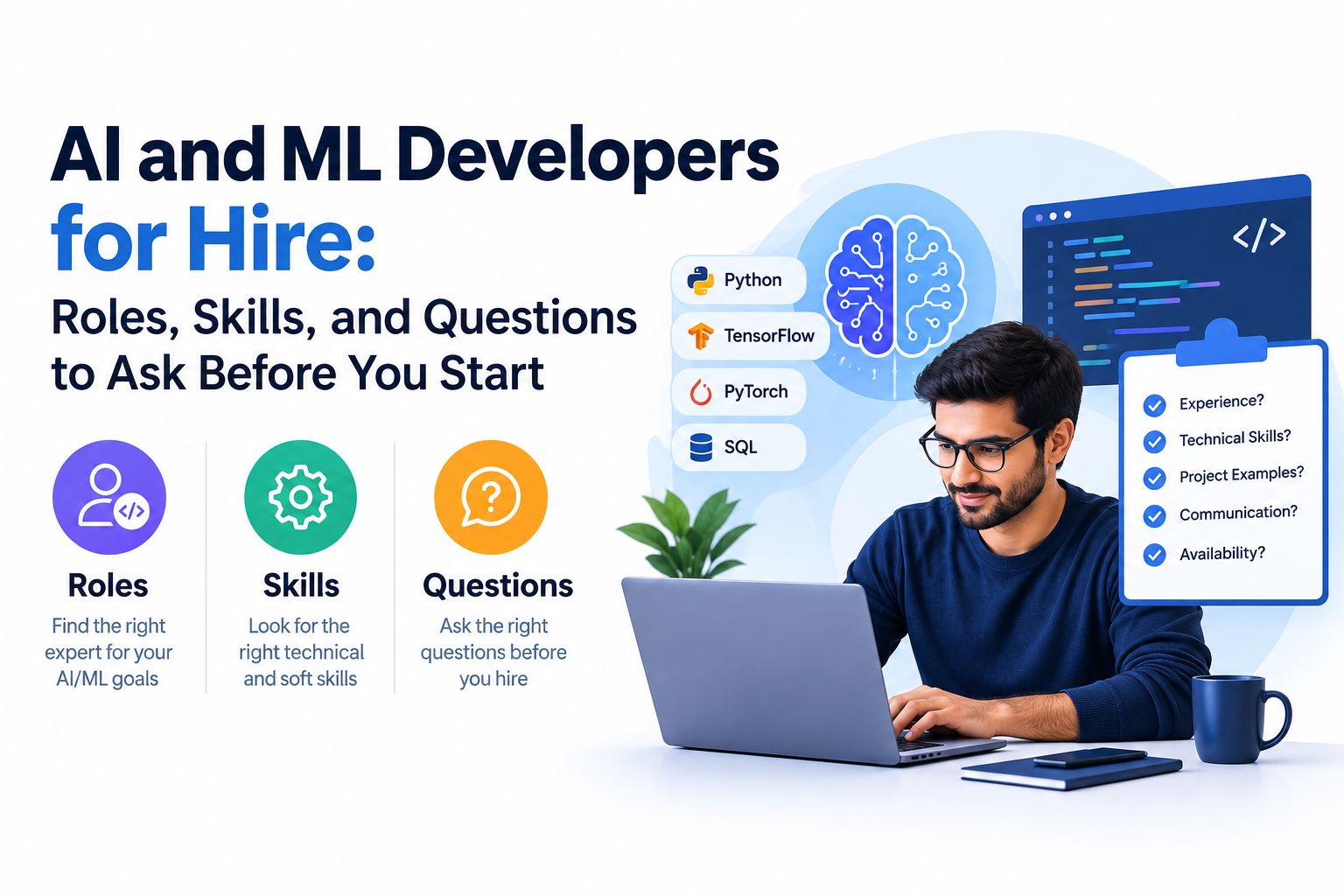
AI and ML Developers for Hire: Roles, Skills, and Questions to Ask Before You Start
The right team depends on what you are building. A predictive analytics system may need a data scientist and machine learning engineer. A generative AI assistant may need an AI product engineer, retrieval specialist, backend developer, and security reviewer. A regulated or customer-facing product may also require strong governance, quality assurance, and human oversight.
This guide explains the main AI and machine-learning roles, the skills to evaluate, how to determine whether your organization is ready to hire, and the questions to ask before starting an engagement.
Key Takeaways•
Hire for the business outcome and system requirements, not for a generic “AI expert” title.
•
Distinguish between data science, machine-learning engineering, AI product engineering, and MLOps responsibilities.
•
Assess data access, product scope, security, evaluation criteria, and internal ownership before development begins.
•
Require evidence of production delivery, testing, monitoring, documentation, and collaboration—not only impressive demos.
Which AI and ML Roles Do You Need?
The first hiring decision is deciding which capabilities your project actually needs. Titles vary between companies, but the responsibilities below provide a useful starting point.
1. Machine Learning Engineer
A machine learning engineer turns models and data science experiments into reliable software systems. The role typically includes data pipelines, feature processing, model training, inference services, APIs, performance optimization, testing, and integration with the wider product.
Hire a machine learning engineer when you need to:
•
Build and deploy predictive or classification models.
•
Connect models to production data and application workflows.
•
Improve inference speed, reliability, or cost.
•
Create repeatable training and deployment processes.
•
Translate experimental code into maintainable services.
Evaluate whether the candidate can explain the full path from raw data to production prediction. Strong candidates discuss data validation, versioning, reproducibility, monitoring, failure handling, and rollback—not only algorithms.
2. Data Scientist
A data scientist investigates business questions through data analysis, statistics, experimentation, and modeling. Depending on the organization, the role may focus on business insights, predictive modeling, causal analysis, experimentation, or a combination of these areas.
Hire a data scientist when you need to:
•
Determine whether a problem is predictable or measurable.
•
Explore patterns and relationships in business data.
•
Define target variables, features, and evaluation methods.
•
Build forecasting, recommendation, segmentation, or risk models.
•
Design experiments and interpret their results.
A data scientist should understand the limitations of the data and communicate uncertainty clearly. Ask how they would deal with missing values, biased samples, data leakage, changing behavior, and a model that performs well in testing but poorly in practice.
3. AI Product Engineer
An AI product engineer builds user-facing features that use AI. This role combines software engineering, AI integration, product judgment, and user-experience thinking.
AI product engineers may work on:
•
Conversational assistants and copilots.
•
Retrieval-augmented generation systems.
•
Document extraction and summarization.
•
AI search and recommendation experiences.
•
Tool-using agents and workflow automation.
•
Voice, vision, or multimodal features.
They should know how to connect models to applications while managing latency, cost, permissions, structured outputs, fallbacks, and user feedback. For generative AI, ask how they evaluate factuality, retrieval quality, prompt injection resistance, refusal behavior, and human review.
An AI product engineer is often the right early hire for a business that wants to validate a user-facing AI feature quickly. However, more complex products may still require dedicated data, infrastructure, security, or MLOps expertise.
4. MLOps Engineer
MLOps is the set of practices and technical capabilities used to build, deploy, evaluate, monitor, and operate machine-learning systems reliably. Google describes MLOps as applying DevOps principles to ML systems, including continuous delivery and automation . AWS similarly describes MLOps as practices that automate and simplify ML workflows and deployments .
An MLOps engineer may own:
•
Training and inference pipelines.
•
Model and dataset versioning.
•
Continuous integration and delivery for ML systems.
•
Infrastructure and environment management.
•
Monitoring for drift, quality, latency, availability, and cost.
•
Model registry and approval workflows.
•
Reproducibility, rollback, and incident response.
You may not need a full-time MLOps specialist for an early prototype. You do need an MLOps plan before a model becomes business-critical. Without one, teams often struggle to reproduce results, identify performance degradation, or deploy updates safely.
5. AI or ML Architect
An AI architect defines how models, data, applications, cloud services, identity, security, and operational systems fit together. This role is especially valuable for enterprise projects involving multiple business systems, sensitive information, or several AI use cases.
An architect should help answer questions such as:
•
Which workloads should use machine learning, generative AI, rules, or search?
•
Which data should be processed in real time and which can be processed in batches?
•
How will access permissions flow into the AI system?
•
Which components should be managed services, custom services, or internal platforms?
•
How will the organization control cost and provider dependency?
•
How can the design support future models and changing requirements?
For smaller projects, these responsibilities may be shared by a senior ML engineer or technical lead. The important point is that architecture decisions should be explicit rather than accidental.
What Skills Should You Look for in AI and ML Developers?
The best candidates combine technical depth with practical product judgment. The exact skills depend on the role, but the following areas are important across most AI engagements.
Technical foundations
Look for an appropriate understanding of:
•
Python and relevant software-engineering practices.
•
SQL, data modeling, and data quality checks.
•
Statistics, probability, optimization, and experimentation.
•
Supervised and unsupervised learning.
•
Model training, validation, and feature engineering.
•
APIs, databases, cloud infrastructure, and version control.
•
Testing, observability, CI/CD, and secure deployment.
Not every AI developer needs to be a research scientist. However, every production contributor should understand how their work behaves inside a larger system.
Generative AI skills
For large-language-model and generative AI work, evaluate experience with:
•
Prompt and instruction design.
•
Embeddings and vector search.
•
Retrieval-augmented generation.
•
Structured outputs and tool calling.
•
Model routing and fallback strategies.
•
Context management and conversation state.
•
Evaluation datasets and automated testing.
•
Prompt injection and sensitive-data protection.
•
Token, latency, and inference-cost management.
Ask candidates to explain a design that uses a model only where it adds value. A mature approach often combines a model with deterministic validation, business rules, permissions, and human approval.
Production and operational skills
A model that works in a notebook is not necessarily ready for customers or employees. Look for experience with:
•
Reproducible training and deployment.
•
Model and data versioning.
•
Monitoring and alerting.
•
Performance and cost optimization.
•
Security reviews and access control.
•
Failure handling and rollback.
•
Documentation and handover.
•
Incident investigation.
Request examples of systems the candidate has operated after launch. Ask what failed, how the team detected it, and what was changed afterward. Real production experience often reveals more than a polished portfolio.
Collaboration and communication
AI work crosses product, engineering, data, security, legal, and operations. Developers must be able to explain trade-offs to people who do not work with models every day.
Evaluate whether candidates can:
•
Turn an ambiguous goal into a testable problem.
•
Explain uncertainty without overpromising.
•
Identify when data is insufficient.
•
Document assumptions and limitations.
•
Work with domain experts and end users.
•
Accept feedback and change direction when evidence requires it.
How Do You Know Whether Your Organization Is Ready to Hire?
Hiring should not begin with a job title. First assess whether the organization has enough clarity, access, and support to use the capability effectively.
Define the business outcome
Write down what should improve and how you will measure it. Examples include reducing manual processing time, increasing forecast accuracy, improving support resolution, increasing conversion, or helping employees find trusted information faster.
Avoid success criteria such as “launch an AI chatbot.” That describes an output, not a business result.
Identify the users and workflow
Document who will use the system, what they do today, where delays or errors occur, and how the AI will change the workflow. A useful AI feature must fit into real work. It should not force users to copy information between disconnected tools or trust an unexplained output.
Assess data access and quality
Confirm that the relevant data exists, can be accessed legally and technically, and is usable for the intended purpose. Identify owners for data, security, compliance, and domain knowledge.
For generative AI, list the documents, systems, policies, and knowledge sources the system may need. For predictive ML, identify historical outcomes, labels, features, and the time period that represents future use.
Establish a technical environment
Decide where code, data, models, secrets, logs, and deployments will live. Define development, staging, and production access. If you are hiring external developers, decide how they will collaborate with internal teams and how access will be granted and removed.
Assign internal ownership
Someone inside the organization must own the product outcome. That person may be a product manager, engineering leader, operations owner, or business sponsor. External developers can accelerate delivery, but they cannot replace internal accountability for priorities, policy, adoption, and risk decisions.
If you need help turning the idea into a deliverable product, explore Witqualis product development services before finalizing the team structure.
Should You Hire Individuals, a Dedicated Team, or an AI Development Partner?
The right hiring model depends on speed, complexity, internal capability, and how much ownership you want to retain.
Hire individual specialists
Individual contractors or employees can work well when you already have product leadership, engineering management, cloud infrastructure, security, and data support. This model gives you direct control, but you are responsible for assembling the right combination of skills.
Hire a dedicated AI and ML team
A dedicated team may include a product lead, AI product engineer, ML engineer, data scientist, and MLOps or cloud specialist. This can be effective when you need focused delivery but want to maintain a close relationship with the team and retain ownership of the product.
Work with an AI development partner
An external partner may be more suitable when you need discovery, architecture, design, engineering, integration, testing, and deployment as one coordinated engagement. This can reduce the time required to build a team, but you should still verify who will do the work and how handover will operate.
A practical approach is to start with a paid discovery or technical assessment. The output should include a prioritized use case, data-readiness findings, recommended architecture, delivery plan, risks, and an estimate for the next stage.
Review AI development services and AI consulting services when you need both strategic guidance and implementation support.
Questions to Ask Before You Hire AI and ML Developers
Use these questions during interviews, vendor evaluations, and discovery calls.
Questions about experience
•
What production AI or ML systems have you delivered?
•
What was your specific responsibility on each project?
•
Which parts are still operating today?
•
Can you describe a model or AI feature that performed poorly after launch?
•
How did you monitor and improve it?
Questions about problem framing
•
How would you determine whether this problem needs AI?
•
What information would you need before proposing a solution?
•
Which assumptions could make the project fail?
•
What would you build first to test value?
•
Which requirements would you deliberately leave out of the first release?
Questions about data
•
How would you assess data quality and coverage?
•
What happens when labels are incomplete or inconsistent?
•
How will you prevent data leakage?
•
How will sensitive data be protected?
•
How will new data be incorporated and validated?
Questions about model and architecture choices
•
Why would you choose this model or approach over alternatives?
•
What can be deterministic instead of model-driven?
•
How will you manage cost, latency, and provider dependency?
•
How will the system handle low confidence or unsupported requests?
•
How can we change models without rebuilding the entire product?
Questions about evaluation and safety
•
What does success mean for model quality?
•
What test dataset will you use?
•
How will you evaluate edge cases and failure modes?
•
How will users report incorrect or harmful outputs?
•
What human approval is required before an AI action is executed?
•
How will you test prompt injection, unauthorized access, and data leakage?
Questions about delivery and ownership
•
Who will be on the team and how much time will each person contribute?
•
What will be delivered at the end of discovery, prototype, and production phases?
•
Who owns the source code, prompts, datasets, model configurations, and cloud accounts?
•
What documentation and training will be provided?
•
Who will maintain the system after launch?
•
What support response times apply to production incidents?
Strong candidates will not answer every question with certainty before discovery. They should instead explain what they need to investigate, what assumptions they are making, and how they will reduce uncertainty.
How to Evaluate a Candidate or Team in Practice
Interviews are useful, but work samples and structured discussions provide stronger evidence.
Use a realistic technical exercise
Give the candidate a small, anonymized version of your real problem. Ask for a short design note rather than a large unpaid build. The note should describe the data, architecture, evaluation plan, security risks, and first implementation milestone.
Evaluate reasoning, not only code. A thoughtful candidate may identify that the problem is underspecified or that the available data cannot support the requested outcome.
Review an architecture walkthrough
Ask the candidate or agency to walk through a previous system. Focus on data flow, model choice, permissions, deployment, testing, monitoring, and operational ownership. Ask follow-up questions about trade-offs and failures.
Check communication with non-technical stakeholders
Ask the candidate to explain a model limitation or AI risk in plain language. The goal is not presentation polish. You want to know whether the person can create shared understanding before a technical decision becomes expensive.
Speak with references when possible
Ask references whether the team met commitments, communicated risks early, documented the work, responded to production issues, and left the client with enough ownership to continue.
Common Hiring Mistakes to Avoid
Hiring for an impressive title
“AI architect,” “prompt engineer,” and “ML expert” can describe very different abilities. Focus on responsibilities, evidence, and the specific problems the person has solved.
Treating a demo as proof of production capability
A demo may use clean data, a narrow prompt, manual intervention, and no security controls. Ask what would be needed to turn it into a monitored, maintainable product.
Hiring only for model knowledge
A technically excellent model developer may not know how to build APIs, secure data, operate deployments, or design a usable product. Match the team to the whole system.
Ignoring domain expertise
Domain experts can identify edge cases, define acceptable outputs, and judge whether a prediction or generated answer is useful. Include them in discovery and evaluation.
Leaving ownership and handover until the end
Clarify access, repositories, documentation, models, data, and deployment responsibilities before the work begins. This protects continuity if the team changes.
Measuring activity instead of outcomes
The number of prompts, models, features, or experiments does not prove business value. Agree on measurable outcomes and review them at each milestone.
A Practical Hiring Scorecard
Use a simple scorecard to compare candidates or agencies consistently.
Area
What to evaluate
Evidence to request
Problem framing
Can the candidate convert a business goal into a testable AI problem?
Case discussion or discovery brief
Data
Can they assess quality, access, labels, privacy, and bias?
Data-readiness plan
AI and ML
Do they understand appropriate models, training, retrieval, and evaluation?
Technical design or code sample
Software engineering
Can they build maintainable, secure services?
Repository walkthrough or architecture review
MLOps
Can they deploy, monitor, version, and roll back systems?
Pipeline diagram or runbook
Product thinking
Can they design for user trust, feedback, and workflow fit?
Prototype or product case study
Communication
Can they explain uncertainty and trade-offs clearly?
Stakeholder interview
Ownership
Will they document and transfer the system properly?
Handover checklist and contract terms
Weight each category according to the project. For a prototype, problem framing and experimentation may matter most. For a customer-facing product, security, product design, evaluation, and operations should carry greater weight.
Frequently Asked Questions
What is the difference between an AI developer and an ML engineer?
An AI developer often focuses on integrating AI capabilities into software products, including generative AI, assistants, search, automation, or multimodal features. An ML engineer typically focuses more on training, deploying, and operating machine-learning models and data pipelines. The responsibilities overlap, so review the person's actual project experience rather than relying only on the title.
Do I need a data scientist for a generative AI project?
Not every generative AI project needs a dedicated data scientist. A small application may need an AI product engineer, backend developer, UX designer, and security review. A data scientist becomes more important when the project includes forecasting, experimentation, custom evaluation, statistical analysis, or model training based on proprietary data.
When should I hire an MLOps engineer?
Consider MLOps expertise when a model must run reliably in production, be retrained regularly, serve many users, meet strict latency or uptime requirements, or operate under strong governance. For an early prototype, these responsibilities may be handled by an experienced ML engineer or cloud engineer, but they should still be planned.
How long does it take to hire AI and ML developers?
The timeline varies with specialization, location, seniority, project complexity, and hiring model. A discovery engagement or dedicated external team can often begin faster than recruiting several full-time specialists. Before choosing speed, confirm that the team has the skills and availability required for your actual delivery stage.
What should be included in an AI developer contract?
Define scope, deliverables, acceptance criteria, access controls, confidentiality, data handling, intellectual-property ownership, repository and account ownership, model-provider responsibilities, documentation, testing, support, maintenance, and exit or handover terms. Include a process for changing scope as data and evaluation findings become clearer.
Conclusion: Hire for the Whole AI System
The best AI and ML developers for hire are not necessarily the people with the most impressive titles or the longest list of tools. They are the people who can understand a business problem, work honestly with imperfect data, select an appropriate technical approach, build reliable software, evaluate real-world behavior, and communicate limitations clearly.
Start by defining the outcome you want. Then determine whether you need a data scientist, machine learning engineer, AI product engineer, MLOps specialist, architect, or a coordinated team. Assess candidates through realistic work samples, architecture discussions, references, and clear ownership terms.
AI creates business value when it becomes dependable part of a workflow. Choose developers who can help you move from an experiment to a secure, measurable, maintainable product.
To discuss your AI hiring or delivery requirements, visit the Witqualis website or explore its machine learning development services.