Published 2026-09-22·Updated 2026-09-22·6 min read
How to Choose a Mobile App Development Agency for iOS, Android, or Cross-Platform Products
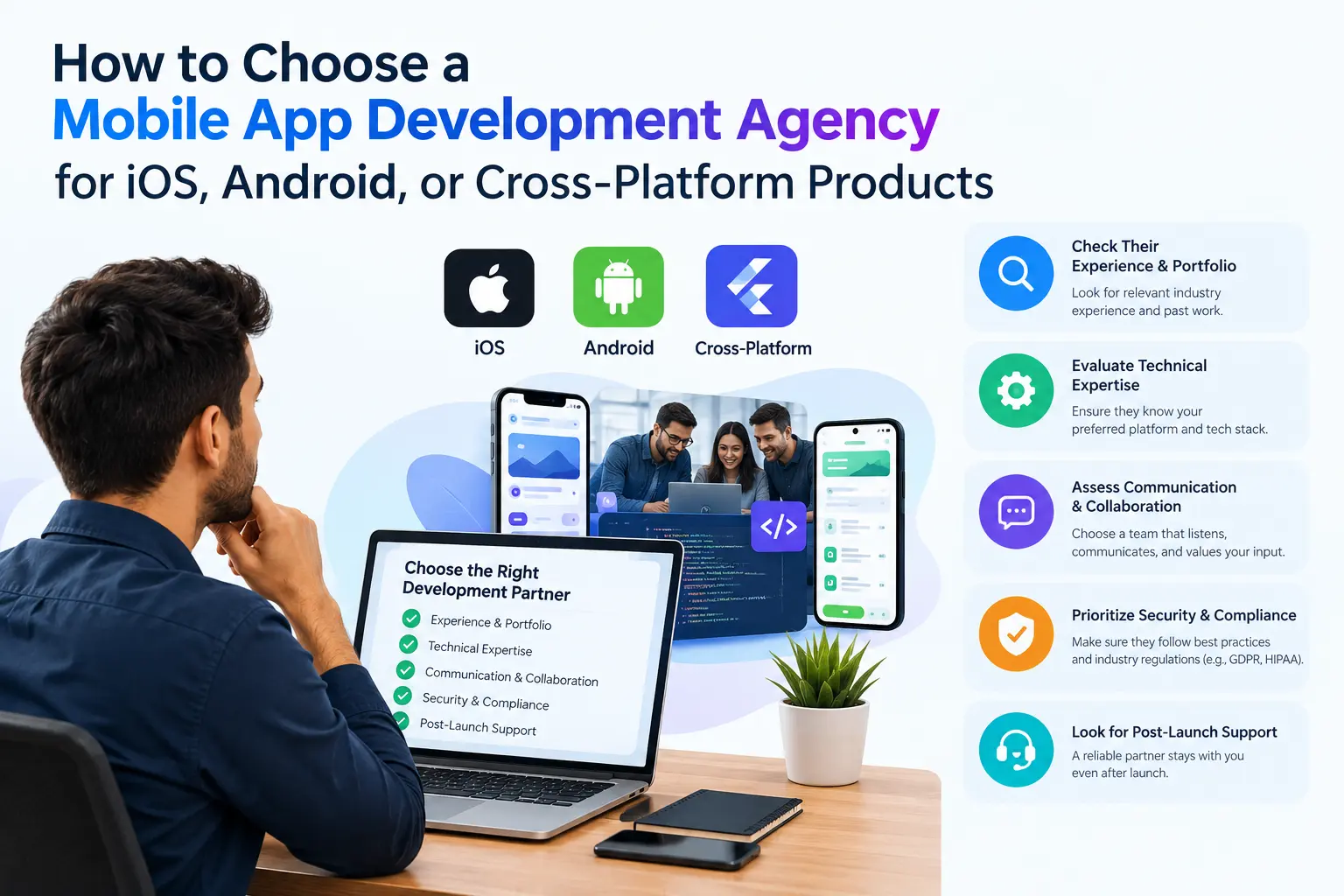
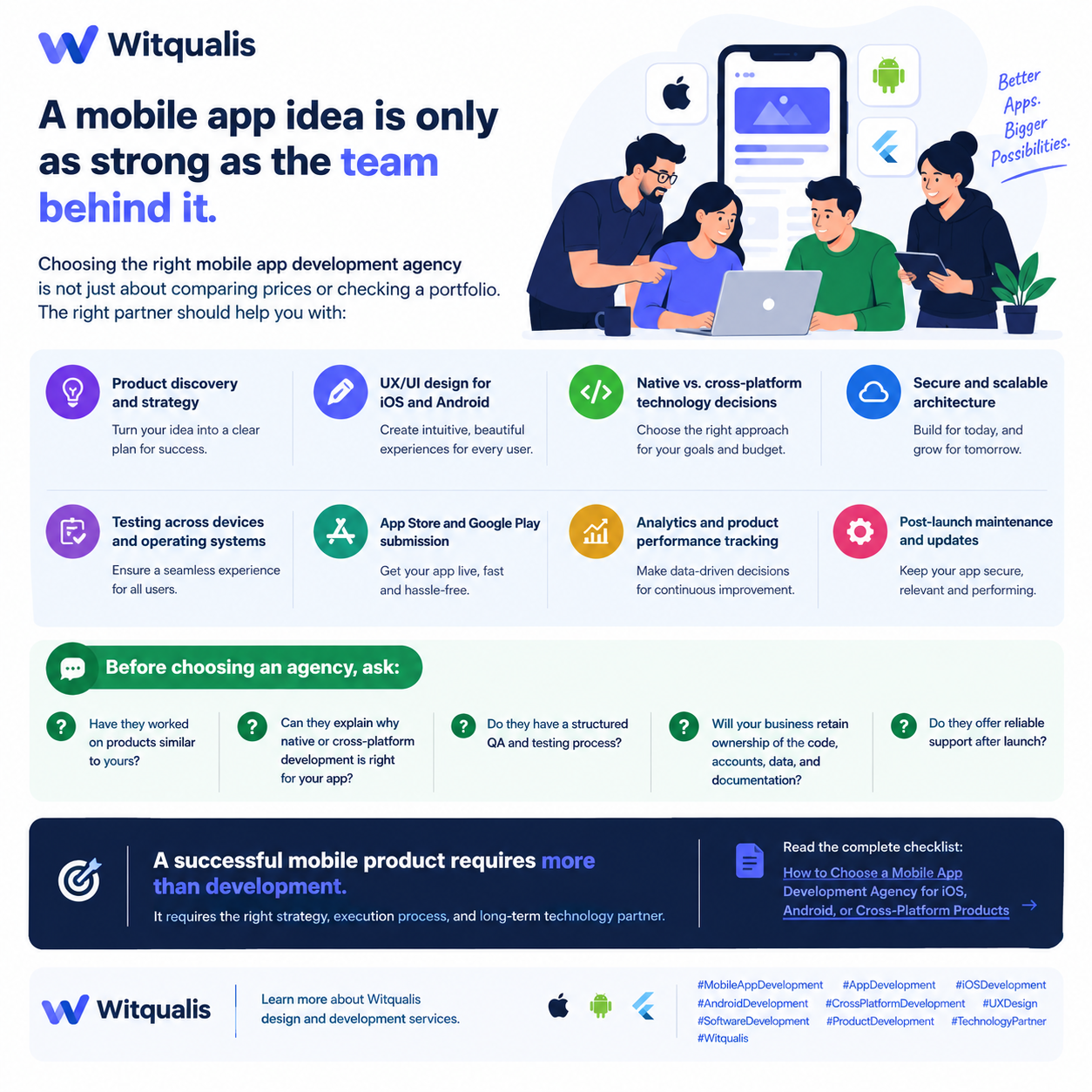
Choosing a mobile app development agency is not simply a matter of comparing hourly rates or reviewing a portfolio. The right partner should help you turn a business objective into a usable product, select an appropriate technical approach, validate quality before launch, and support the app after it reaches customers.
That distinction matters because mobile development includes more than writing code. It covers product discovery, user experience, platform decisions, security, integrations, testing, store compliance, analytics, release management, and continuous improvement. An agency that is strong in only one of these areas can still create avoidable risk for your product.
Written by Witqualis Engineering TeamReviewed by Witqualis Technical Team
This guide gives you a practical way to evaluate agencies for native iOS, native Android, or cross-platform products. It explains what to ask, what evidence to request, and which warning signs should make you slow down before signing a contract.
Key Takeaways
• Choose an agency that can connect product goals to technical decisions, not one that only supplies developers.
• Ask for evidence of discovery, UX, QA, release, analytics, and maintenance capabilities before comparing prices.
• Select native or cross-platform development according to product requirements, device capabilities, team constraints, and long-term ownership.
• Make post-launch support, documentation, analytics access, and source-code ownership explicit in the agreement.
1. Start with the Product Problem, Not the Technology
The best mobile app development agency will first clarify what the product must achieve. Before discussing Swift, Kotlin, Flutter, or React Native, the agency should understand your users, business model, success metrics, integrations, compliance requirements, and launch constraints.
During an initial discovery phase, expect the agency to ask questions such as:
• Who will use the product, and what problem are they trying to solve?
• Which user journeys are essential for the first release?
• What business outcome defines success: revenue, adoption, operational efficiency, retention, or another measure?
• Will the app need payments, location, camera access, Bluetooth, biometric authentication, offline functionality, or background processing?
• Which systems must it connect to, such as a customer relationship management platform, enterprise resource planning system, identity provider, or custom backend?
• What are the security, privacy, accessibility, and regulatory requirements?
• What must be available at launch, and what can wait for a later version?
A credible agency should convert these answers into a documented scope, prioritized requirements, user flows, technical risks, and a delivery plan. If an agency provides a confident quote before understanding these factors, the estimate may be based on assumptions rather than evidence.
If your product is part of a larger business transformation, review the agency's enterprise software development solutions to assess whether it can work across mobile, backend, and internal systems rather than treating the app as an isolated interface.
2. Evaluate the Agency's Discovery and UX Process
A strong mobile product starts with a clear experience design. Ask the agency to explain how it moves from research to wireframes, prototypes, visual design, and implementation.
The process should include enough validation to reveal usability problems before development becomes expensive. Depending on the product, this may include stakeholder interviews, user research, information architecture, low-fidelity wireframes, clickable prototypes, usability testing, and design-system definition.
Look for evidence that the agency can design for the specific platform rather than merely shrink a desktop interface. Apple's Human Interface Guidelines provide platform-specific design guidance for Apple products . Android also publishes app-quality guidance that covers expectations for a consistent and usable experience . The agency should be able to explain how it will respect those conventions while maintaining a coherent brand identity.
Ask to see:
1. A sample discovery plan with activities, outputs, and decision points.
2. A user-flow or prototype from a comparable project.
3. An explanation of how accessibility is considered in design and implementation.
4. The process for handling design feedback and approval.
5. The ownership and reuse terms for design files, components, icons, and other product assets.
Do not judge UX capability only by visual polish. A good design process makes important tasks easy to find, reduces unnecessary steps, handles errors clearly, and accounts for different screen sizes, input methods, network conditions, and user abilities.
For a closer look at the people who may contribute to your project, visit the Witqualis team.
3. Choose Native or Cross-Platform for the Product's Requirements
There is no universally correct answer between native and cross-platform development. The appropriate choice depends on the product's technical requirements, user experience expectations, delivery goals, and long-term operating model.
Native development
Native development uses the platform's primary tools and languages, such as Swift or Objective-C for iOS and Kotlin or Java for Android. It can be a strong fit when the product requires deep platform integration, advanced graphics, highly specific performance characteristics, or a platform-specific experience.
Native development may also make sense when iOS and Android products have substantially different workflows or when each platform will be managed by a dedicated engineering team.
Cross-platform development
Cross-platform development allows a team to share part of the codebase across iOS and Android. Frameworks such as Flutter describe this approach as building multi-platform applications from a single codebase . React Native similarly supports development for Android and iOS using React .
This approach can reduce duplicated implementation work and help a team deliver feature parity more efficiently. It is not, however, a guarantee of lower cost or faster delivery. Platform-specific code may still be required for hardware integrations, permissions, notifications, performance-sensitive features, or specialized user experiences.
Questions to ask before deciding
Ask the agency to provide a written decision record that covers:
• The product capabilities that influence the technology choice.
• Which parts of the codebase will be shared and which will be platform-specific.
• How the chosen approach will handle native integrations and future operating-system changes.
• The expected performance and testing strategy on representative devices.
• The skills required to maintain the product after handover.
• How the decision affects delivery time, risk, and total cost of ownership.
The important test is not whether the agency prefers a particular framework. It is whether the agency can explain the trade-offs in terms of your product.
4. Inspect the Technical Architecture and Security Plan
A mobile app is one part of a larger system. Before selecting an agency, understand how it plans to structure the app, backend services, data storage, authentication, integrations, monitoring, and deployment environments.
Request a high-level architecture diagram and ask the agency to explain it in plain language. The diagram should show the app's communication with backend services, third-party systems, databases, identity providers, analytics platforms, and notification services.
You should also ask how the agency will address:
• Authentication, authorization, session management, and account recovery.
• Encryption in transit and at rest.
• Secure storage of tokens and sensitive information on the device.
• Secrets management across development, staging, and production.
• Input validation and protection against common application vulnerabilities.
• Logging, monitoring, crash reporting, and incident response.
• Data retention, deletion, consent, and privacy requirements.
• Offline behavior and synchronization conflicts.
• Backup, disaster recovery, and business continuity for backend services.
Do not accept the phrase “security is built in” as a complete answer. Ask what is tested, who reviews it, how findings are recorded, and when remediation occurs. Also confirm that the agency will provide architecture documentation and operational runbooks, not just application binaries.
If your app needs artificial intelligence features, evaluate the agency's AI development capabilities separately. Ask how model selection, prompt or workflow design, data handling, evaluation, monitoring, and fallback behavior will be managed.
5. Make QA a Delivery Responsibility, Not a Final Inspection
Quality assurance should begin during discovery and continue through every release. An agency that leaves testing until the end is more likely to discover expensive defects when schedules are least flexible.
Ask for a test strategy that combines several layers:
•
Unit testing for small, isolated pieces of business logic.
• Integration testing for APIs, authentication, databases, payments, and external services.
• User-interface testing for critical flows such as onboarding, search, checkout, and account recovery.
• Device and operating-system testing across representative screen sizes, versions, and manufacturers.
• Performance testing for startup time, network behavior, memory use, battery impact, and heavy workloads.
• Accessibility testing using platform tools and, where appropriate, assistive technologies.
• Security testing for authentication, authorization, data exposure, and common attack paths.
• Regression testing before each release to protect existing functionality.
The agency should define what “done” means for a feature. A useful definition includes implemented behavior, design approval, automated tests, manual verification, analytics instrumentation, accessibility checks, and documentation where applicable.
Request examples of defect reports, test plans, release checklists, and quality dashboards. You do not need confidential client information; anonymized examples are sufficient to show whether the agency has a repeatable process.
6. Confirm That the Agency Can Manage Store Release
A mobile product is not finished when the code is merged. It must be configured, signed, documented, submitted, reviewed, and released through the relevant stores.
Apple's App Review Guidelines describe requirements and review considerations for apps distributed through the App Store . The Android quality guidance provides recommendations intended to help teams build high-quality experiences and improve their chances of being featured on Google Play . Store requirements can change, so release planning should include an owner who monitors platform updates.
Before signing, clarify whether the agency will handle:
• Developer-account setup and access management.
• Certificates, signing keys, provisioning profiles, and secure credential storage.
• App identifiers, bundle IDs, package names, and environment configuration.
• Store listings, screenshots, descriptions, privacy disclosures, and age ratings.
• Beta distribution through TestFlight, Google Play testing tracks, or an equivalent process.
• Store submission, review responses, rejection remediation, and resubmission.
• Production rollout, staged release, rollback, and hotfix procedures.
Create the developer accounts under your organization's ownership whenever possible. The agency can receive the access it needs without becoming the owner of the product's identity, signing assets, billing relationship, or store presence.
7. Require Analytics and Feedback Loops from the First Release
Analytics should be designed with the product, not added after launch. Without reliable event tracking, you may know how many people installed the app but not where they abandon an important flow or which feature creates value.
Start with a measurement plan that connects business goals to events and metrics. For example, a subscription product may track account creation, trial activation, onboarding completion, plan selection, payment success, cancellation, and renewal. A field-service app may focus on job acceptance, route completion, form submission, synchronization success, and time saved.
Ask the agency to document:
• The events, properties, and naming conventions to be implemented.
• Which metrics are product, marketing, operational, or technical indicators.
• How consent and privacy requirements affect data collection.
• Who owns the analytics accounts and configuration.
• How crash, performance, and usage data will be reviewed together.
• How insights will feed the product roadmap and experimentation process.
A capable agency should also plan for feedback beyond analytics. This may include in-app feedback, support-ticket analysis, usability sessions, app-store review monitoring, and interviews with high-value users.
8. Define Maintenance, Ownership, and Handover Before Development
Mobile operating systems, devices, libraries, and store policies change continuously. Post-launch support is therefore part of the product, not an optional add-on.
Your agreement should define the agency's responsibilities for operating-system updates, dependency upgrades, security patches, crash fixes, performance issues, store changes, and emergency support. It should also identify response times, severity levels, support hours, release cadence, and the boundary between maintenance and new feature development.
Clarify ownership of:
• Source code and repositories.
• Design files and design-system components.
• Cloud accounts, domains, developer accounts, and analytics properties.
• CI/CD configuration, infrastructure definitions, and deployment scripts.
• Documentation, test suites, environment variables, and operational runbooks.
• Third-party subscriptions and licenses.
• Data, models, prompts, and evaluation assets when AI features are included.
Ask for a handover plan before the project begins. It should include repository access, architecture documentation, setup instructions, release procedures, known issues, dependency inventories, and training for your internal team.
If you need to supplement your existing team rather than outsource the entire product, compare the agency's hire dedicated technology talent option with a full project engagement. The right model depends on how much product ownership and delivery management you want to retain internally.
9. Compare Agencies with a Consistent Scorecard
A scorecard prevents a polished sales presentation from outweighing practical evidence. Use the same questions and scoring scale for every candidate.
Score each area according to your product's risk. For example, a consumer app with complex animations may weight UX and performance more heavily. A regulated enterprise app may give greater weight to security, auditability, access controls, and operational support.
10. Watch for These Warning Signs
Some risks are visible before the contract is signed. Proceed carefully if an agency:
• Promises an exact launch date without a discovery phase or documented assumptions.
• Shows only generic portfolio screens and cannot explain its role in the work.
• Treats native and cross-platform development as interchangeable without discussing trade-offs.
• Has no clear answer about automated testing, device coverage, accessibility, or release ownership.
• Requests that the agency own your developer accounts, repositories, analytics properties, or cloud infrastructure.
• Avoids explaining who will actually work on the project after the sales process.
• Provides a low initial quote but leaves backend work, QA, store submission, analytics, and maintenance undefined.
• Cannot describe what happens when a store rejects the app or a production release fails.
A lower price can be reasonable when the scope is narrower and the assumptions are explicit. It becomes dangerous when important work is simply absent from the proposal.
Frequently Asked Questions
How much does it cost to hire a mobile app development agency?
The cost depends on product scope, platform count, integrations, design depth, backend requirements, security needs, testing coverage, and post-launch support. Ask agencies to separate discovery, design, development, QA, release, and maintenance so you can compare like with like. A transparent estimate should state assumptions, exclusions, milestones, and the process for handling scope changes.
Should a startup choose native or cross-platform development?
A startup should choose based on its first release requirements and its ability to maintain the product. Cross-platform development may be efficient when the iOS and Android experiences are similar and the product does not depend heavily on platform-specific capabilities. Native development may be preferable when performance, hardware integration, or a distinct platform experience is central to the value proposition.
What should be included in a mobile app development contract?
The contract should define scope, deliverables, milestones, acceptance criteria, change control, security responsibilities, intellectual-property ownership, account ownership, documentation, warranty terms, support levels, maintenance pricing, and exit or handover requirements. It should also identify the people responsible for product, design, engineering, QA, and release decisions.
How can I tell whether an agency has real mobile experience?
Ask for comparable case studies and request a technical walkthrough of one project. The agency should be able to discuss product constraints, architecture, testing, release, analytics, and post-launch outcomes. Screenshots alone do not demonstrate delivery capability.
Should I hire one agency for both the app and backend?
A single partner can simplify coordination when the app depends on custom APIs, identity, payments, data workflows, or enterprise systems. However, you should still verify that the agency has genuine backend and operational expertise. The key question is whether one team can own the complete product outcome without creating a technology bottleneck.
Conclusion: Choose the Partner That Reduces Product Risk
The best mobile app development agency is not necessarily the largest or the least expensive. It is the partner that can explain the product decisions behind its recommendations, show evidence of disciplined delivery, and remain accountable after launch.
Use discovery to test how the agency thinks. Review UX work to see how it turns requirements into usable flows. Require a clear native-versus-cross-platform rationale. Inspect the architecture, security plan, QA process, store-release experience, analytics approach, and maintenance model. Finally, protect your long-term position by retaining ownership of code, accounts, data, documentation, and deployment assets.
If you are evaluating a partner for a new mobile product or a larger digital initiative, contact Witqualis to discuss your discovery, design, engineering, and product-delivery needs.