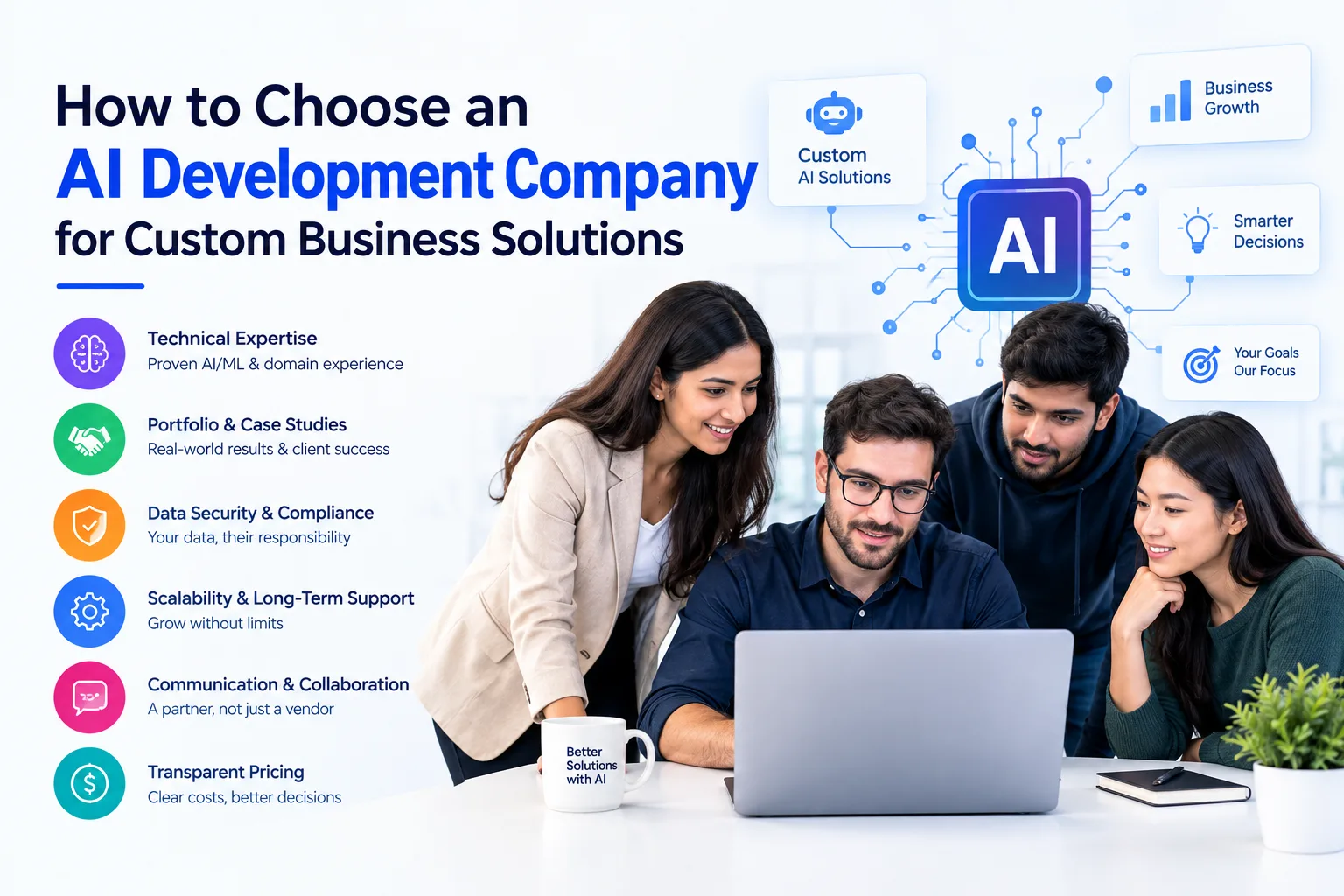
How to Choose an AI Development Company for Custom Business Solutions
Artificial intelligence can improve customer service, automate repetitive work, support decision-making, and create new digital products. But the outcome depends less on adding an AI model than on choosing the right business problem, data, architecture, controls, and delivery partner.
That is why selecting an AI development company requires a different evaluation process from selecting a general software vendor. An AI partner must be able to connect strategy with engineering. It should understand your workflows, assess data quality, choose an appropriate model approach, build reliable integrations, test real-world behavior, and support the system after launch.
This guide explains how to evaluate an AI development company for a custom business solution. It covers discovery, use-case selection, data readiness, model choice, security, responsible AI, implementation, measurement, and long-term maintenance.
Strategic angle: A buyer-focused checklist for evaluating an AI partner across discovery, data readiness, custom model and generative AI capabilities, security, responsible AI, integration, testing, deployment, analytics, and maintenance.
The topic is useful for business leaders who are comparing AI vendors, planning a proof of concept, or deciding whether to build an AI capability internally or work with an external partner.
1. Begin with the Business Problem, Not the AI Model
The right AI development company should first understand what you want to improve. A vague goal such as “use AI to transform our business” is not enough to define a reliable solution.
Start by describing the workflow, user, decision, or customer experience that needs improvement. Then define the current cost or limitation and the result you want to achieve.
Common business use cases include:
• Automating document classification, extraction, and data entry.
• Giving employees a natural-language interface to internal knowledge.
• Supporting customer-service teams with response suggestions and case summaries.
• Predicting demand, churn, fraud, equipment failure, or operational delays.
• Personalizing recommendations, search results, or content.
• Extracting insights from contracts, reports, tickets, or other unstructured data.
• Embedding intelligent features into an existing web or mobile product.
A credible partner should help you narrow the opportunity into a testable use case. It should identify the users, inputs, outputs, workflow changes, success metrics, and risks. It should also tell you when AI is not the best solution. A rules-based workflow, search system, process redesign, or conventional software feature may be more reliable for some problems.
Ask the agency to produce a discovery document that includes:
1. The business problem and affected users.
2. The proposed AI capability and why it is appropriate.
3. The data required to operate the system.
4. The expected benefits and measurable success criteria.
5. Key risks, assumptions, dependencies, and exclusions.
6. A recommendation for prototype, pilot, or production development.
An agency that moves directly from a broad idea to a model recommendation may be optimizing for a demo rather than a durable product.
For larger transformation programs, review enterprise software development solutions alongside AI capability. Many enterprise AI initiatives depend on identity, permissions, workflows, databases, APIs, and existing business systems.
2. Check Whether the Agency Can Assess Data Readiness
AI quality depends on more than model selection. The agency must understand whether your data is available, accurate, representative, legally usable, and structured for the intended task.
During evaluation, ask how the agency will assess:
• Where the relevant data is stored.
• Who owns and can access it.
• Whether the data is complete and consistent.
• Whether labels or historical outcomes exist for predictive use cases.
• Whether documents require OCR, classification, chunking, or metadata extraction.
• How sensitive information will be masked or protected.
• Whether the data represents the users and situations the system will encounter.
• How data quality will be monitored after launch.
For generative AI, ask how the agency will determine whether the system needs retrieval-augmented generation, fine-tuning, prompt engineering, tool use, structured outputs, or a combination of approaches. A retrieval-augmented system can connect a model to approved business information without retraining the model on every document. That does not remove the need for access control, source quality, evaluation, and privacy safeguards.
Request a data-readiness assessment before committing to a large build. It should identify missing data, cleansing requirements, integration work, labeling effort, and the limitations that could affect accuracy.
A strong AI development company will not hide data constraints. It will make them visible early so you can choose a realistic scope.
3. Evaluate Model Selection and Technical Judgment
The agency should be able to explain why a particular model architecture is appropriate for your use case. The answer should include capability, cost, latency, privacy, reliability, deployment environment, and maintenance requirements.
Depending on the problem, the solution may use:
• A traditional machine-learning model for forecasting or classification.
• A large language model for text generation, summarization, extraction, or conversational interaction.
• A vision model for images, video, or scanned documents.
• Speech recognition or text-to-speech for voice workflows.
• Embeddings and vector search for semantic retrieval.
• A workflow that combines multiple models with deterministic business rules.
• A smaller or specialized model for lower latency, lower cost, or private deployment.
Do not accept “we use the latest model” as a technical strategy. Models change quickly, and the most capable model is not automatically the best production choice. The agency should explain how it will compare candidate models against a defined evaluation set.
Ask these questions:
• Which parts of the solution require probabilistic AI and which can remain deterministic?
• How will the agency handle model changes or provider outages?
• Can the architecture switch models without rewriting the entire product?
• How will prompts, retrieval settings, tools, and model versions be managed?
• What are the expected response time and cost per transaction?
• Can the solution run in your preferred cloud, region, or private environment?
• What happens when the model is uncertain or produces an unusable answer?
The best AI architecture is usually a system, not a single API call. It includes data preparation, instructions, retrieval, permissions, validation, logging, human review, and fallback behavior.
4. Review Security, Privacy, and Responsible AI Practices
AI systems introduce risks that ordinary software projects may not address fully. Sensitive information may pass through models, generated outputs may influence decisions, and model behavior may change when inputs or providers change.
A responsible AI development company should provide a risk assessment that covers:
• Personal, confidential, regulated, or commercially sensitive data.
• Data retention by model providers and third-party platforms.
• Access controls for users, administrators, developers, and support staff.
• Prompt injection, data leakage, unsafe tool use, and unauthorized actions.
• Bias, unfair outcomes, harmful content, and inappropriate recommendations.
• Explainability requirements for decisions that affect people.
• Human review and escalation for high-impact workflows.
• Audit logs, incident response, and change management.
The NIST AI Risk Management Framework organizes trustworthy AI work around governing, mapping, measuring, and managing risks . Microsoft's responsible AI principles emphasize fairness, reliability and safety, privacy and security, inclusiveness, transparency, and accountability . These frameworks are useful reference points when asking an agency to explain its controls.
Ask for concrete evidence rather than broad assurances. Useful evidence may include a risk register, data-flow diagram, access-control design, red-team test plan, evaluation report, human-review workflow, and incident-response procedure.
For sensitive use cases, confirm who can see prompts, uploaded documents, generated outputs, logs, and evaluation data. Also clarify whether your data is used to train a third-party provider's models and what contractual protections apply.
5. Test the AI System with Realistic Evaluation Criteria
A polished prototype can hide serious production problems. Before selecting an agency, ask how it will evaluate the system on representative inputs and failure cases.
Evaluation should cover more than whether an answer sounds fluent. Depending on the use case, you may need to measure:
• Accuracy against verified answers or labels.
• Completeness of extracted fields or summaries.
• Factuality and citation quality.
• Relevance of retrieved information.
• Consistency across repeated or slightly varied inputs.
• Refusal behavior for unsafe, unauthorized, or unsupported requests.
• Latency and availability.
• Cost per request or workflow.
• Human acceptance, correction rate, and time saved.
• Performance across languages, user groups, document types, and edge cases.
Ask the agency to define a golden evaluation set before development is considered complete. The set should include typical examples, difficult examples, known failure modes, and cases where the correct behavior is to ask for clarification or decline to answer.
A good evaluation report should show both strengths and weaknesses. If a vendor presents only a high-level accuracy claim without explaining the test data, baseline, thresholds, or limitations, you do not yet have enough evidence for a buying decision.
The agency should also explain how production feedback will improve the system. This may involve reviewing low-confidence outputs, sampling interactions, updating retrieval sources, improving prompts, labeling new examples, or retraining a model when appropriate.
6. Confirm Integration and Product-Delivery Capability
AI becomes valuable when people can use it inside an existing workflow. A standalone chatbot or notebook may demonstrate capability, but production value usually requires integration with the systems your teams already use.
Ask whether the agency can connect AI features to:
• Customer relationship management systems.
• Enterprise resource planning platforms.
• Document repositories and knowledge bases.
• Customer-support and ticketing systems.
• Identity providers and role-based access controls.
• Payment, logistics, or workflow platforms.
• Web and mobile applications.
• Data warehouses, analytics platforms, and reporting tools.
The integration plan should define what data is read, what actions the AI can initiate, which permissions apply, and how every action is logged. If the AI can update records, send messages, trigger workflows, or make recommendations, require explicit boundaries and approval paths.
This is where product design matters. Users need to understand what the AI can do, what information it used, when it may be wrong, and how to correct it. The Witqualis design team can be relevant when AI must be turned into a clear, usable experience rather than exposed as a raw model interface.
7. Ask About Deployment, Monitoring, and Operations
An AI system needs production operations just as much as any other software product. In some cases, it needs more monitoring because output quality can degrade without causing a conventional application error.
Your potential partner should explain how it will manage:
• Development, staging, and production environments.
• Model and prompt versioning.
• Secure deployment and secrets management.
• Logging and observability without exposing sensitive data.
• Latency, uptime, token or inference usage, and cost monitoring.
• Drift in data, user behavior, or model performance.
• Alerts for harmful, low-confidence, or anomalous outputs.
• Rollback procedures for a model, prompt, data source, or release.
• Provider outages and fallback behavior.
• Periodic review of evaluation results and business impact.
Ask to see an example monitoring dashboard or operating runbook, even if it is anonymized. The agency should identify who receives alerts, who can pause the system, and how incidents are documented.
A production AI system should have a controlled change process. A prompt change, retrieval-source update, model upgrade, or access-policy change can affect behavior. Each material change should be evaluated before it reaches all users.
8. Compare an AI Development Company with a Consistent Scorecard
Use the same evaluation criteria for every candidate. This makes it easier to compare a confident sales presentation with actual delivery capability.
9. Understand the Engagement Model and Team Structure
AI projects can fail when the people who sell the work are different from the people who deliver it. Ask who will be involved at each stage and how decisions will be made.
Clarify whether the team includes:
•
A product or business analyst.
•
A UX or service designer.
•
An AI or machine-learning engineer.
•
A backend and integration engineer.
•
A security or cloud specialist.
•
A quality engineer.
•
A delivery manager.
•
A subject-matter expert who understands your domain.
Ask for the expected allocation of each role, not only job titles. A specialist who appears on a proposal for one meeting may not provide enough support for a complex production system.
Also compare delivery models. A fixed-scope proof of concept, a discovery sprint, a dedicated team, and a full product engagement each suit different situations. If you want to retain more internal ownership, review a dedicated technology talent model. If you need a partner to own discovery through delivery, ask for a complete product plan.
You can also review the Witqualis team to understand the range of skills and roles available for a technology engagement.
10. Define Ownership, Documentation, and Maintenance Before Signing
AI projects create more than source code. They may include prompts, evaluation datasets, retrieval indexes, labels, model configurations, infrastructure definitions, dashboards, and operational procedures.
Your agreement should state who owns and can access:
• Application source code and repositories.
• Data, labels, evaluation sets, and generated artifacts.
• Prompts, system instructions, tools, workflows, and configurations.
• Model accounts, cloud environments, vector stores, and monitoring platforms.
• Analytics properties, logs, dashboards, and alerting rules.
• Documentation, test suites, architecture diagrams, and runbooks.
• Third-party subscriptions, licenses, and provider accounts.
Define maintenance responsibilities for model updates, provider changes, security patches, data-source changes, performance degradation, new regulations, and incident response. Also define support levels, response times, release approval, and exit or handover procedures.
The solution should not become impossible to operate without the original agency. Require enough documentation and training for your team to understand the system, review changes, manage access, and make informed decisions about future development.
Frequently Asked Questions
Q1. What does an AI development company do?
Ans. An AI development company helps organizations identify valuable AI use cases, assess data, design AI-enabled products, select models and architecture, build integrations, evaluate performance, deploy systems, and provide ongoing support. The exact services vary, so confirm whether the agency handles strategy, design, engineering, security, testing, deployment, and maintenance.
Q2. How much does custom AI development cost?
Ans. The cost depends on the use case, data condition, integration complexity, model approach, security requirements, user count, evaluation depth, and support model. A discovery phase or proof of concept can provide a more reliable estimate than a quote based only on a short description. Ask for separate costs for discovery, prototype, production build, infrastructure, model usage, and maintenance.
Q3. Should we build an AI solution internally or hire an external company?
Ans. An external AI development company can accelerate delivery when you lack specialized skills, need to validate an opportunity quickly, or require experience integrating AI into production systems. Internal development may be appropriate when AI is central to your long-term competitive advantage and you can support product, data, engineering, security, and operations roles. A hybrid model is often practical: an external partner helps establish the first system while the internal team gains ownership.
Q4. What is the difference between an AI proof of concept and a production AI product?
Ans. A proof of concept demonstrates that a technical idea may work on a limited set of examples. A production product must also meet requirements for security, privacy, reliability, integration, monitoring, user experience, evaluation, support, and cost control. Treating a successful demo as a finished product is a common source of AI project risk.
Q5. How do we protect confidential information in an AI project?
Ans. Start with a data-flow and threat assessment. Identify what information enters the system, where it is stored, which providers process it, who can access it, how long it is retained, and whether it is used for model training. Use appropriate access controls, encryption, data minimization, contractual protections, logging, and human review. Your agency should document these controls rather than relying on general assurances.
Conclusion: Choose the AI Partner That Can Operate What It Builds
The right AI development company will not begin by promising a chatbot, a model, or an impressive demo. It will begin by understanding the business problem and determining whether AI is the right tool.
During evaluation, look for evidence of disciplined discovery, data assessment, model selection, responsible AI, security, product design, integration, testing, deployment, monitoring, and maintenance. Ask how the solution will behave when the data is incomplete, the model is uncertain, the provider is unavailable, or a user challenges an output.
Most importantly, choose a partner that can help you move from experimentation to dependable operation. A successful AI system is measurable, governed, integrated into real work, and designed to improve over time.
To discuss a custom AI opportunity, explore Witqualis AI development services and connect with the team about your product, data, and delivery goals.