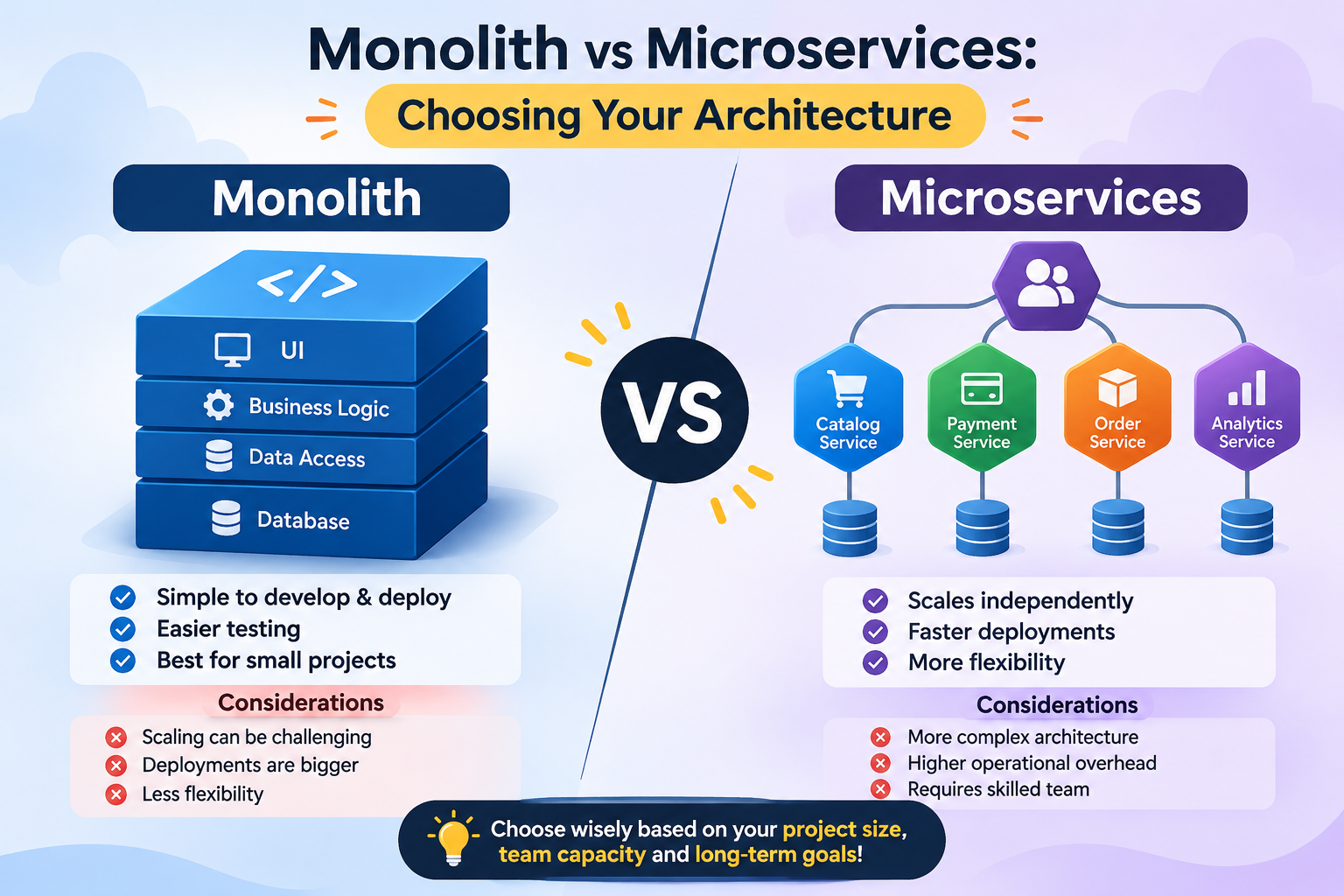
Monolith vs. Microservices: Which Architecture Is Right for Your Growing Product?
When a software product starts to grow, teams often ask whether they should keep a monolithic architecture or move to microservices. The question matters, but there is no architecture that is automatically right for every product. The best choice depends on the product’s needs, the team’s ability to operate the system, and the problems the architecture is expected to solve.
A monolith can be a sound choice for a new product and remain suitable as it grows. Microservices can help when teams need to develop and scale parts of a system independently, but they also introduce more infrastructure and operational work. This guide explains the differences and offers a practical way to decide.
What is a monolithic architecture?
A monolithic application is built and deployed as one primary unit. Its features may be organized into separate modules or layers, but the application typically shares a codebase and release process. A change in one area may require building and deploying the application as a whole.
A monolith is not necessarily poorly designed. A well-structured monolith can have clear internal boundaries, consistent testing, and a straightforward deployment process. A modular monolith keeps related responsibilities separated inside one application, which can make the system easier to maintain without introducing the operational complexity of distributed services.
What is a microservices architecture?
Microservices split an application into smaller services that communicate over defined interfaces. Each service is responsible for a specific capability, such as billing, search, or notifications. Services can often be developed, deployed, and scaled independently, provided the team has designed and operates those boundaries effectively.
That independence comes with additional responsibilities. The system must handle service-to-service communication, network failures, monitoring across components, data consistency, deployment coordination, and security between services. A microservices system may give teams more flexibility, but it also requires mature engineering practices and operational support.
Monolith vs. microservices: the practical trade-offs
Development and deployment
A monolith can be easier to build, test, and deploy when the product and team are small. Developers can often run the application locally without coordinating a large number of services. As the codebase grows, however, build times, release coordination, or interactions between modules may become harder to manage.
Microservices can let teams release individual services independently. This is useful when services have clear boundaries and teams can own them end to end. If boundaries are unclear, a single feature may require coordinated changes across many services, adding more process rather than less.
Scaling and performance
A monolithic application can often be scaled by adding resources to the application’s runtime. This may be sufficient when most of the product has similar traffic and resource needs. It can become inefficient if one capability requires substantially more resources than the rest of the application.
Microservices allow selected services to scale separately. That can be useful when traffic or processing demand varies significantly between product areas. It is not an automatic performance improvement: network calls, data access patterns, and service coordination can introduce latency and new failure modes. Measure the actual bottleneck before changing architecture.
Reliability and troubleshooting
A monolith has fewer moving parts, which can make local development and troubleshooting more direct. A problem in one module can still affect the whole application, so strong testing, monitoring, and fault handling remain important.
In a microservices architecture, an issue may be isolated to one service, but identifying the cause can require tracing requests across multiple services. Teams need consistent logs, metrics, distributed tracing, alerting, and clear service ownership to understand how a failure affects the wider product.
Data and consistency
A monolith may use a shared database, making some transactions simpler to manage. As the application grows, teams still need to keep data access organized and avoid tightly coupling every feature to the same tables.
Microservices usually work best when each service has clear responsibility for its data. This can reduce direct coupling, but it makes cross-service transactions and reporting more complex. Teams may need to design for eventual consistency, asynchronous processing, or explicit workflows rather than assuming every update happens in one database transaction.
Team structure and operating effort
A monolith can fit a small team that shares responsibility for the product. A microservices architecture is more likely to help when teams have the people and processes to own distinct services, including deployment, monitoring, security, and on-call response.
If the same small group must manage many services, the operational load may outweigh the benefits of independent deployment. Architecture decisions should account for the team that will maintain the system, not just the developers building the first version.
When a monolith may be the better choice
A monolith is often a practical option when a product is new, the domain is still changing, or the team needs to validate a product idea before investing in complex infrastructure. Keeping the system in one deployable application can make it easier to change features while the team learns which capabilities matter most.
It may also be suitable when the team is small, traffic patterns are not yet differentiated, or deployment and operations need to remain simple. A modular monolith can preserve clear boundaries and make future changes easier without requiring the business to adopt distributed systems before it has a need for them.
When microservices may make sense
Microservices are worth evaluating when distinct product capabilities need to scale independently, teams are blocked by a shared release process, or a specific service needs a different technology or reliability profile. These conditions are strongest when the capabilities have stable boundaries and the organization can assign clear ownership to the services.
The decision should also account for operational readiness. Teams need automated deployment, service-level monitoring, secure communication, incident response practices, and the ability to test changes across service boundaries. Without these foundations, splitting an application can make delivery and troubleshooting harder.
Signs your product may need architectural change
Architecture work is worth considering when a specific, recurring constraint is affecting delivery or reliability. Examples include one component consuming disproportionate resources, unrelated product changes repeatedly blocking each other’s releases, or teams needing clearer ownership of separate product capabilities.
Before splitting services, check whether the problem can be addressed inside the existing architecture. Better module boundaries, improved database indexing, caching, background jobs, or a more reliable deployment pipeline may resolve the issue with less change. An architecture migration should solve a demonstrated problem, not simply follow a trend.
How to move from a monolith toward microservices
A migration does not need to begin with a full rewrite. Start by identifying one capability with a clear boundary and a measurable reason to separate it. Map its data, dependencies, user impact, and operational requirements before deciding how it should communicate with the rest of the application.
Then define how the new service will be deployed, monitored, secured, and supported. Move the capability gradually, maintain compatibility while both parts operate, and test failure scenarios such as timeouts or unavailable dependencies. Review the outcome against the original problem before choosing another service to extract.
This incremental approach helps teams learn where the boundaries work and what operational effort the new architecture requires. It also avoids committing the entire product to a distributed design before the first migration has demonstrated value.
Common architecture mistakes to avoid
One common mistake is adopting microservices because the application has become large, without identifying which part of the system needs to change. Size alone does not determine whether a distributed architecture will help. The team should identify a concrete constraint and compare the expected benefit with the added complexity.
Another mistake is splitting services around technical layers rather than business capabilities. If every user request must pass through many services to complete one feature, the architecture may be distributed but still tightly coupled. Clear ownership and carefully designed interfaces matter more than the number of services.
A third mistake is underestimating the cost of operating distributed systems. Deployment automation, monitoring, security, documentation, and incident response are part of the architecture. They need to be considered in both the project plan and ongoing ownership model.