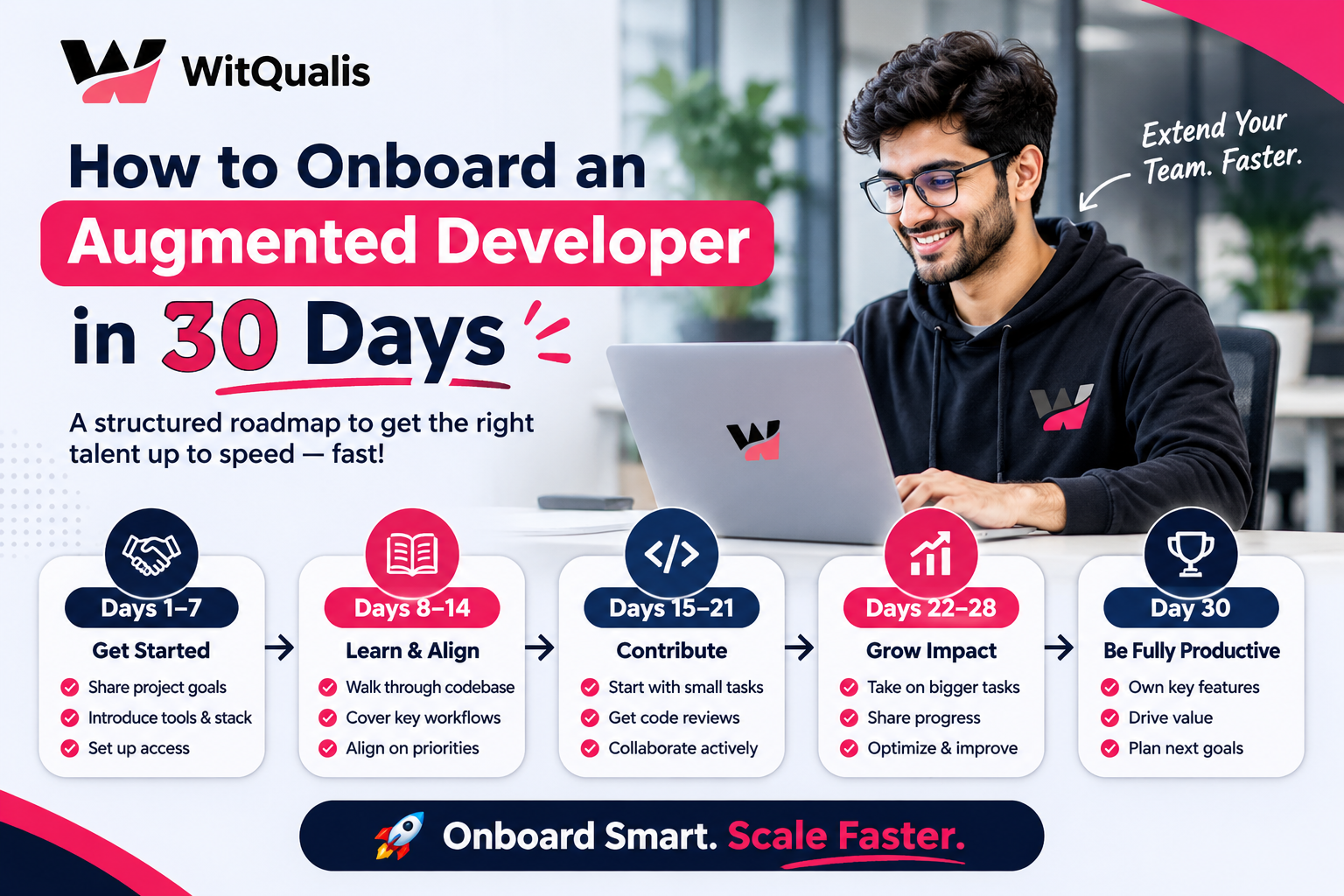
How to Onboard an Augmented Developer: A 30-Day Plan for Engineering Teams
Adding an experienced developer through staff augmentation can increase your team’s capacity, but a fast start depends on more than technical skills. The developer needs to understand your product, codebase, team practices, and security expectations before they can contribute confidently.
A clear onboarding process helps both the client team and the developer use the first month well. It reduces avoidable delays, clarifies who makes decisions, and gives the new team member a realistic path from orientation to meaningful work. This guide outlines a practical 30-day approach for onboarding an augmented developer into an existing software team.
Before the First Day: Prepare the Landing
Good onboarding begins before the developer joins the first meeting. Assign an internal point of contact, confirm access requirements, and prepare the essentials they will need to understand the product and begin work. This includes repository permissions, development environment instructions, communication channels, coding standards, and the current sprint or backlog context.
The team should also agree on the developer’s initial responsibilities. A role description such as “backend developer” is not enough on its own. Identify the product area, the first expected outcomes, the people they will collaborate with, and who can answer technical and product questions. This preparation helps avoid spending the first week waiting for access or trying to discover ownership informally.
Security and access should be handled deliberately. Grant only the permissions required for the work, explain how credentials and customer data must be protected, and clarify any rules for local development, code sharing, or production access. Make sure confidentiality, intellectual property, and repository expectations are covered through the appropriate engagement processes before work begins.
Days 1–3: Build Context and Make the Developer Welcome
The first few days should focus on helping the developer understand the environment rather than measuring output. Introduce the product, its users, the business goals behind the current roadmap, and the technical principles the team follows. A short walkthrough of the system architecture can help the developer see how their area connects to the wider product.
Pair the developer with an engineer or technical lead who can explain how the codebase is organized and how the team makes decisions. Provide a working development environment and have the developer run the application and tests. These simple steps often reveal missing setup instructions or undocumented dependencies that would otherwise slow down later work.
The manager or product owner should explain how priorities are set and how questions are raised. The developer should know where to find tickets, design specifications, acceptance criteria, and technical documentation. They should also understand the team’s meeting rhythm, code review process, and preferred communication channels.
Days 4–10: Start with a Bounded First Contribution
After the initial orientation, assign a small, well-scoped task that touches the real codebase without carrying unnecessary delivery risk. The task should be meaningful enough to introduce the team’s engineering standards, but limited enough that the developer can complete it with timely guidance.
Use the first code review as a coaching opportunity. Explain the team’s expectations for tests, naming, documentation, error handling, and maintainability. Encourage the developer to ask questions early when requirements or system behavior are unclear. A quick discussion before implementation can prevent rework and help the developer learn how the team approaches trade-offs.
During this period, the internal lead should check whether access, documentation, and decision-making are working as expected. If the developer is repeatedly blocked by missing context or slow approvals, address those issues as part of onboarding rather than treating every delay as an individual performance problem.
Days 11–20: Expand Ownership Gradually
Once the developer has completed an initial contribution and received feedback, increase the scope of work gradually. Assign related tasks within the same product area so the developer can build familiarity with its design and dependencies. Explain how the work will be tested and released, and involve the developer in the relevant planning and review discussions.
Regular one-to-one check-ins can help surface questions that may not appear in a stand-up or ticket thread. Ask which parts of the codebase are still unclear, whether the goals feel well-defined, and where the developer is waiting on decisions or access. Give specific feedback on both technical contributions and collaboration so expectations remain visible on both sides.
The internal team should continue to own product priorities and important architectural decisions. At the same time, the augmented developer should be encouraged to share observations and propose improvements. A successful collaboration is not limited to completing assigned tickets; it also helps the team make better-informed engineering decisions.
Days 21–30: Review Progress and Set the Next Goals
By the final part of the first month, the developer should have a clearer understanding of the product area, engineering workflow, and delivery expectations. Review the work completed, the quality of collaboration, and any recurring blockers. Discuss whether the original responsibilities still match the team’s needs or should be adjusted as the roadmap develops.
Use evidence from the work rather than relying on activity alone. Look at whether tasks are moving through the team’s workflow, whether code reviews are constructive, whether requirements are clear, and whether avoidable rework is decreasing. The purpose is to improve collaboration and identify constraints, not to compare developers using a single productivity number.
Agree on the next set of outcomes together. These might include taking responsibility for a specific service or feature area, contributing to a larger release, improving test coverage, or documenting a recurring process. Clear next steps help the developer move from onboarding into steady collaboration with the wider team.
Common Onboarding Problems to Avoid
One common problem is assigning work before the developer understands the product context. A technically clear ticket can still be difficult to complete when the user need, system behavior, or acceptance criteria are missing. Explain why the work matters and who can clarify open questions.
Another problem is treating onboarding as a one-time meeting. New developers often discover important details only after they begin using the codebase and tools. Keep documentation available, make time for questions, and update instructions when a setup step or ownership path is unclear.
A third problem is leaving the developer outside the team’s normal workflow. If they cannot see relevant discussions, attend planning, or participate in code reviews, they will have less context and may feel like a disconnected contractor. Integrate them into the working process while keeping access and responsibilities appropriate to the role.
Finally, avoid assuming that a remote or augmented team member will infer expectations that have never been documented. Explain working hours, response-time expectations, escalation routes, review standards, and how decisions are recorded. Clear agreements support trust and reduce misunderstandings.
Make Onboarding a Shared Responsibility
The staffing partner can help match a developer to the required technology and experience, but onboarding works best when the client team also provides product context, access, feedback, and clear ownership. Technical fit gets the engagement started; day-to-day collaboration helps the developer contribute to the product.
At Witqualis, staff augmentation is designed to add pre-vetted developers to a client’s existing engineering workflow. If your team is planning to bring in external software talent, explore Witqualis staff augmentation and engineering services or talk to the team about your requirements. For a broader overview of the model, read the practical guide to staff augmentation.