Staff Augmentation: A Practical Guide to Scaling Your Engineering Team
When a product roadmap accelerates, engineering capacity can become the biggest constraint. Your internal team may have the product knowledge, but not enough developers to deliver every feature, fix technical debt and maintain production systems at the same time. Hiring full-time engineers can solve the problem, but recruitment, onboarding and specialized skill requirements often make the process slow.
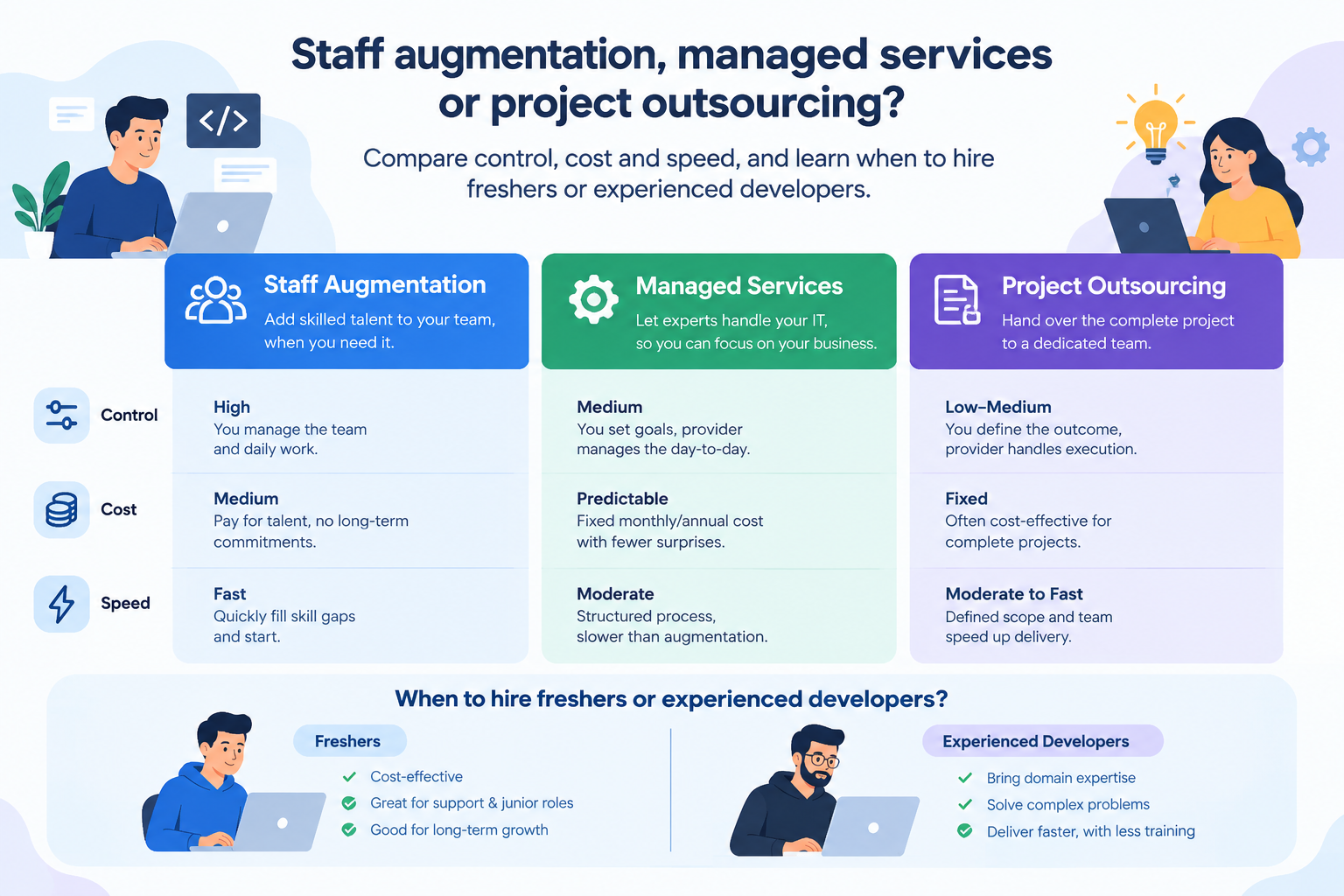
Staff augmentation offers another way to add capacity. Instead of outsourcing the entire project, you bring pre-vetted external developers into your existing team. They work with your processes, tools and leadership while you retain control over priorities, code and delivery.
This guide explains how staff augmentation works, when to use it, how it compares with outsourcing and what to evaluate before choosing a technology partner.
Key takeaways•
Staff augmentation adds external specialists to your existing engineering team while you retain project control.
•
It is useful when you need to close a skill gap, increase delivery capacity or respond to a short-term roadmap change.
•
The best results depend on stack-specific matching, clear ownership, direct communication and measurable onboarding.
•
A trial sprint can help you evaluate technical fit before committing to a longer engagement.
What Is Staff Augmentation?
Staff augmentation is a flexible hiring model in which an organization adds external professionals to its internal team for a defined period or project requirement. The augmented developers work alongside in-house employees and follow the client’s product roadmap, development practices and communication systems.
In a software development context, an augmented team member may contribute to frontend development, backend engineering, mobile apps, cloud infrastructure, DevOps, quality assurance, AI or technical leadership. The client generally defines the work, manages priorities and reviews the output. The staffing partner helps source, screen and support the specialist.
This model is different from handing an entire project to an external vendor. The external engineer becomes an extension of the client’s team rather than working as a separate delivery unit with limited visibility.
How Does IT Staff Augmentation Work?
A typical IT staff augmentation engagement follows six stages.
1. Define the team requirement
The process begins with a clear understanding of the delivery problem. You may need a senior React developer for a product launch, a Kubernetes specialist for a cloud migration or an AI engineer to build a retrieval-augmented generation system.
The requirement should describe the responsibilities, technology stack, seniority, working hours, expected duration and level of collaboration with the internal team.
2. Match specialists to the stack
A reliable provider should match engineers to the actual framework and architecture instead of presenting generalists who need extensive ramp-up time. Relevant experience may include Next.js, TypeScript, Python, PyTorch, Kubernetes, Go microservices, AWS or another stack used by your team.
The objective is not simply to find an available developer. It is to find someone who can understand the codebase, communicate clearly and contribute within the team’s existing development process.
3. Review technical fit
Technical screening may include coding exercises, system design discussions, communication assessment and a review of prior project experience. The client should have enough information to assess whether the proposed developer fits the technical and collaboration requirements.
4. Onboard into the existing workflow
Strong onboarding covers the product context as well as the codebase. The developer needs to understand who uses the product, which constraints matter and how technical decisions are made.
5. Deliver inside the client team
The augmented engineer works on agreed tickets, pull requests and deliverables. The client’s engineering leaders remain involved in prioritization, review and feedback. This provides visibility into the work and makes the external specialist part of the delivery rhythm.
6. Scale, change or conclude the engagement
As the roadmap changes, the team can add another role, reduce capacity or conclude the engagement according to the agreed terms. This flexibility is one of the main reasons businesses consider staff augmentation.
When Should You Use Staff Augmentation?
Staff augmentation is most useful when you have a defined delivery need but do not want to make an immediate permanent hire or outsource control of the project.
You need a specialist skill quickly
A project may require expertise that is difficult to source internally. Examples include machine learning engineering, cloud security, data engineering, mobile performance optimization or legacy system modernization.
Adding a specialist can help your core team address the bottleneck without changing the ownership of the product.
Your roadmap has increased temporarily
Product launches, migrations and major releases often create temporary demand. A flexible engineering team can provide additional capacity during the high-workload period and scale down after the milestone.
You need to modernize a legacy system
Legacy modernization often requires experience with both the old and new architecture. An external engineer can help decompose a monolith, introduce modern APIs, improve test coverage or move workloads toward a cloud-native design while internal leaders retain product and domain ownership.
You are building an AI capability
AI projects often need a combination of application engineering, data preparation, model integration, evaluation and infrastructure. A staff augmentation partner can help fill specific capability gaps while your internal team decides how AI should fit into the product.
You want to test a new team structure
An augmented engagement can help you evaluate a new technology or delivery model before making a larger hiring commitment. A short, well-defined sprint provides a practical test of code quality, communication and velocity.
Staff Augmentation vs Outsourcing
Both models can help organizations access external talent, but they provide different levels of control.
Consideration
Staff augmentation
Project outsourcing
Team structure
External specialists join the internal team
External vendor operates a separate delivery team
Daily priorities
Usually managed by the client
Usually managed by the vendor or through a delivery contract
Technical visibility
Direct access to tickets, commits and pull requests
Visibility depends on the vendor’s process and reporting
Flexibility
Roles and capacity can change with the roadmap
Scope changes may require a new estimate or change request
Product knowledge
Builds inside the client team
May remain concentrated within the vendor team
Best fit
Skill gaps, capacity increases and collaborative delivery
A defined project that can be delegated end to end
Neither model is universally better. Staff augmentation is often the better fit when you already have product leadership and need more engineering capacity. Outsourcing may be more suitable when you want a partner to own the full delivery of a defined project.
Benefits of Software Development Staff Augmentation
More control over delivery
Your internal team retains control of priorities, architecture decisions and acceptance criteria. External developers contribute within the same workflow instead of operating behind a separate delivery process.
Access to specialized experience
A specialist can contribute knowledge that your current team does not need to hire permanently. This is especially relevant for short-term architecture work, cloud migration, AI development or a specific framework.
Flexible team capacity
You can adjust the team as the roadmap evolves. The engagement can be designed around a single role, a small group of developers or a complete dedicated squad.
Lower hiring friction
The staffing partner manages much of the sourcing and initial screening process. Your team can focus on evaluating technical fit and collaboration rather than starting the search from zero.
Faster integration with existing systems
When developers work directly inside your repositories, tickets and review process, knowledge is created where the product is already being built. This can reduce the handover gap that appears when an external team works separately.
What to Look for in a Staff Augmentation Partner
Choosing a provider should be based on delivery quality, not only the number of available profiles.
Stack-specific matching
Ask how the provider matches developers to your technology stack. A useful shortlist should explain relevant experience with your frameworks, architecture and type of product.
Transparent technical screening
Understand the screening process. It should evaluate technical reasoning, hands-on ability and communication. For senior roles, ask how system design and decision-making are assessed.
Direct engineering visibility
You should know how you will collaborate with the developers. Direct access to standups, pull requests, sprint tickets and code reviews creates accountability and reduces communication gaps.
Secure delivery practices
For proprietary products, review NDA terms, workspace access, repository permissions, credential handling and the treatment of source code. The agreement should clearly define intellectual property ownership.
Flexible engagement terms
Your roadmap may change. Ask whether the team can scale, change roles or wind down under clearly agreed terms. Flexibility should be documented rather than assumed.
A practical evaluation option
A trial sprint on your real codebase or sprint board can reveal more than a profile or interview alone. It gives your team a way to assess velocity, communication and code quality in a realistic setting.
How to Make Staff Augmentation Successful
The client plays an important role in the success of the engagement. The following practices create a stronger working environment.
Define outcomes, not only job titles
“Senior backend developer” is not a complete requirement. Explain the outcome you need, such as reducing API latency, completing a payment integration or separating a legacy service.
Provide a clear technical starting point
Share repository access, architecture documentation, coding standards, local setup instructions and the first set of prioritized tickets. Remove avoidable uncertainty before the first sprint begins.
Assign an internal owner
An engineering manager or technical lead should own priorities, answer questions and provide feedback. External developers integrate faster when there is a clear decision-maker.
Use the same quality standards
Augmented engineers should follow the same testing, code review, security and documentation standards as internal developers. This keeps the codebase consistent and protects long-term maintainability.
Measure progress in useful ways
Track completed outcomes, review quality, defect trends, cycle time and collaboration. Do not measure the engagement only by the number of tickets closed.
Build knowledge transfer into the work
Documentation, design notes and code reviews help ensure that knowledge remains with the product team. This is valuable whether the engagement lasts three months or several years.
How Witqualis Supports Staff Augmentation
Witqualis provides staff augmentation and software development support for web, mobile, cloud and AI projects. The company states that its developers are vetted before being placed on client engagements and matched to specific technology stacks rather than assigned as generalists.
Its delivery model includes direct engineering visibility through commits, standups, sprint tickets and pull requests. Engagements can also be structured to scale up, change roles or wind down as the roadmap evolves, subject to the agreed contract terms.
For confidential projects, Witqualis describes NDA-backed engagements, secure workspace provisioning and direct commits to client GitHub or GitLab repositories. The company also offers a trial sprint so clients can assess developer velocity, communication and code quality before a longer commitment.
Witqualis supports dedicated developers and squads across full-stack software engineering, AI, cloud and related technology projects. Its website describes both dedicated full-lifecycle sprint delivery and specialized staff augmentation engagements.
Questions to Ask Before Starting an Engagement
Before selecting a partner, ask:
1.
Which roles and technology stacks can you support?
2.
How are developers technically screened?
3.
Who manages day-to-day priorities?
4.
Will engineers work in our repositories and project tools?
5.
How are security, NDA and intellectual property handled?
6.
Can we begin with a trial sprint?
7.
How quickly can the engagement start?
8.
What happens if the role or team composition changes?
9.
How will communication and delivery quality be measured?
10.
What support is available if the first match is not suitable?
Clear answers to these questions reduce risk and help both teams establish realistic expectations.
Final Thoughts
Staff augmentation is not simply a way to add more people to a project. It is a delivery model for organizations that need additional engineering capacity while retaining control over product decisions, technical quality and day-to-day collaboration.
The right engagement starts with a specific problem, a realistic role definition and a provider that can match developers to your actual stack. It should also include transparent communication, secure delivery practices and a practical way to evaluate fit.
If your team needs additional support for a software, cloud, mobile or AI roadmap, Witqualis can help you explore the right staffing model. New engagements can begin with a trial sprint, allowing your team to assess the working relationship before making a longer commitment.
Ready to strengthen your engineering team?
Discuss your staffing requirement with Witqualis.
Frequently Asked Questions
Is staff augmentation the same as hiring freelancers?
No. Freelancers may work independently on a short-term assignment, while staff augmentation is usually a structured engagement in which external developers join an organization’s engineering workflow. A professional provider may also support screening, contracts, security, communication and team continuity.
Who manages augmented developers?
In most staff augmentation models, the client manages the developer’s day-to-day priorities and technical direction. The provider may support administration, coordination, performance feedback and replacement processes. These responsibilities should be documented before the engagement begins.
Can staff augmentation support remote engineering teams?
Yes. Distributed developers can collaborate through repositories, project-management tools, code reviews, documentation and video meetings. Overlapping working hours and clear communication routines are important when teams work across regions.
Is staff augmentation suitable for startups?
It can be suitable for startups that need to build a product, add a specialist or increase capacity without committing immediately to a larger permanent team. The model works best when the startup has clear product priorities and someone who can guide engineering work.
What is the best way to start?
Begin with a defined requirement and a short discovery conversation. Explain the product stage, technology stack, team structure, delivery goal and expected timeline. A trial sprint can then help both sides evaluate fit using real work.
New Section Heading
Section Sub-heading
New Section Heading