Staff Augmentation vs. Managed Services vs. Project Outsourcing: Which Model Fits You?
Why the model you pick matters
Staff augmentation adds external engineers to your team, managed services hands an ongoing function to a vendor, and project outsourcing gives a vendor a defined scope to deliver. Picking the wrong one is expensive: you either lose control of your roadmap, pay for a team you do not need, or get a product that does not match what you had in mind.
Most companies searching for staff augmentation are really asking one question: how much control do we want to keep, and how much do we want to hand over? This guide compares all three models on control, cost, speed and risk. It also covers a question that decides the budget in many engagements: should you hire a fresher or an experienced developer?
What is staff augmentation?
Staff augmentation means adding skilled external professionals to your in-house team for as long as you need them. They work inside your processes, tools and sprints, and you manage their day-to-day work. The vendor handles sourcing, vetting, payroll and compliance.
It suits teams that already know what to build but lack hands or a specific skill. Typical cases are a product launch that needs extra engineers, a missing AI or cloud specialist, or a backlog that is growing faster than your hiring.
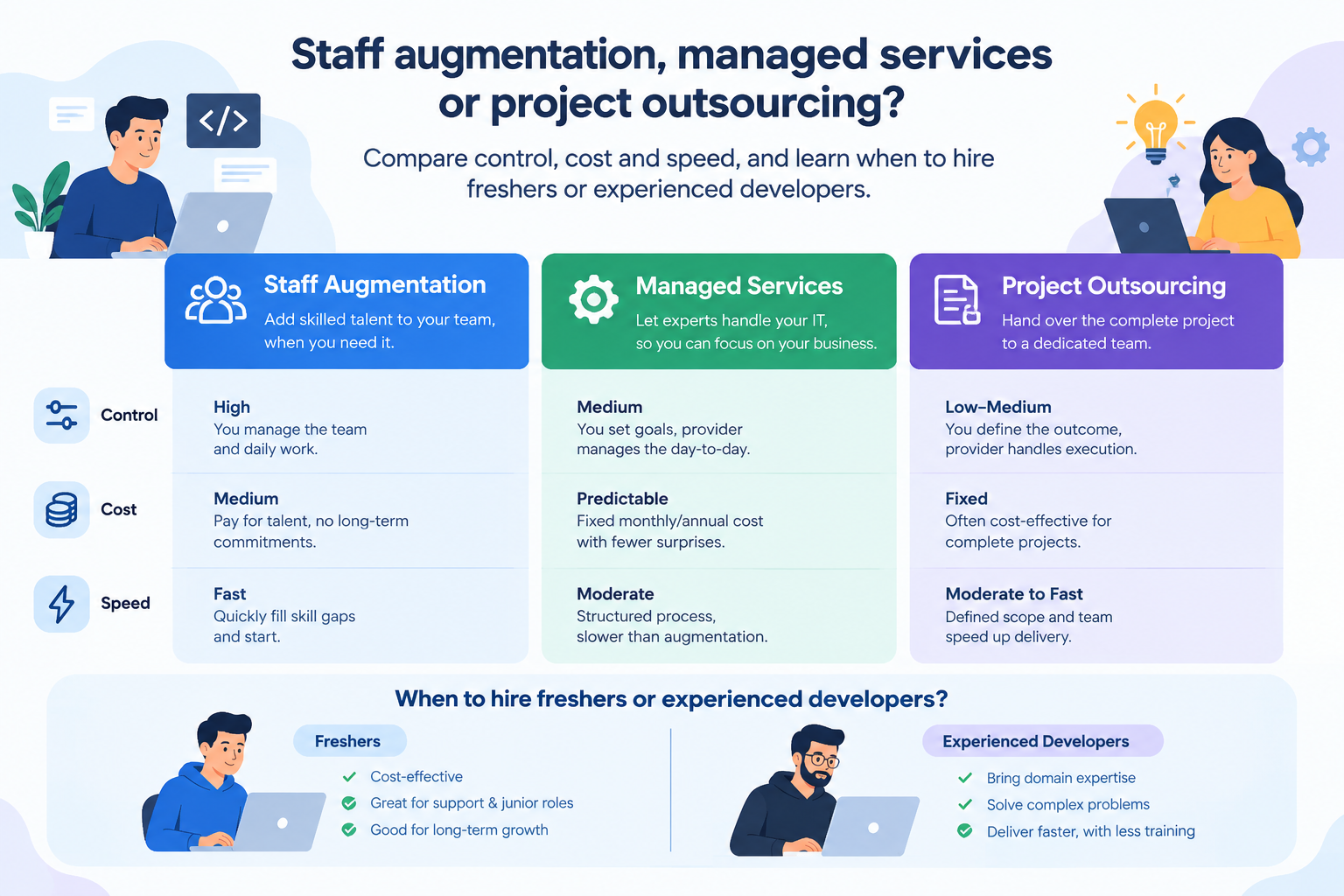
• Control : high. You set priorities, review code and run stand-ups.
• Speed: fast. Pre-vetted engineers can start in days rather than the months a full hiring cycle takes.
• Flexibility: scale up or down as the roadmap changes.
• Best for: teams with strong technical leadership and a clear backlog.
If you want to see how this works in practice, read about WitQualis staff augmentation services or browse the engineers you can hire as dedicated developers, including React JS developers, Node.js developers, Python developers and AI and ML developers.
What are managed services?
Managed services transfer responsibility for an ongoing function to a vendor. Instead of lending you people, the vendor owns the outcome: uptime, support response times, security patching or release pipelines, measured against a service-level agreement (SLA).
This model fits work that is continuous and well defined, such as cloud operations, DevOps, application maintenance or 24/7 support. You pay a predictable monthly fee and stop managing the people involved.
• Control: low to medium. You agree on outcomes and reporting, not on who does what each day.
• Speed: moderate. Onboarding takes time because the vendor must learn your environment.
• Cost: predictable, usually a fixed monthly or tiered fee.
• Best for: stable systems that need constant care but not your best engineers' attention.
What is project outsourcing?
Project outsourcing hands a complete project to a vendor with a fixed scope, timeline and price. The vendor assembles the team, manages delivery and hands over the finished product, for example a mobile app, a website or an internal tool.
It works well when requirements are stable and you have no in-house team to manage the work. It works poorly when the scope is likely to change, because every change request affects cost and schedule.
• Control: low. You review milestones rather than daily work.
• Speed: depends on scope clarity; a vague brief causes delays.
• Cost: fixed or milestone-based, which makes budgeting easier but changes costlier.
• Best for: one-off builds such as web development or app development projects with a clear specification.
Staff augmentation vs. managed services vs. project outsourcing
Staff augmentation keeps control with you, managed services moves ongoing responsibility to the vendor, and project outsourcing moves a whole build to the vendor.
A practical rule: if you have a senior engineer who can spare time to mentor, a fresher is good value for well-scoped tasks. If you have no one to guide them, or the deadline is tight, an experienced developer is cheaper in the end because there is less rework.
A balanced pod often works best: one or two experienced developers who lead and review, plus a fresher for routine tasks. WitQualis offers pre-vetted engineers and a 7-day trial sprint, so you can test the fit before committing. See the available dedicated developers to match skills and seniority to your project.
How to choose the right model
Start with three questions: do you have technical leadership, is your scope fixed, and is the work a build or a continuing duty?
1. You have a team and a backlog, but need more capacity or a rare skill. Choose staff augmentation. You keep control and add people quickly.
2. You need a system run, monitored and supported around the clock. Choose managed services and agree on clear SLAs.
3. You have a clear specification and no team to build it. Choose project outsourcing, and invest in a detailed scope before signing.
4. Your needs change often, or you are building a product that will keep evolving, Choose staff augmentation, or a dedicated team, because fixed-scope contracts slow down changing requirements.
The models are not exclusive. A company might outsource an initial enterprise software build, then use staff augmentation to keep developing it and managed services to run it. To see how similar work has been delivered, browse the WitQualis portfolio or read more guides on the WitQualis blog.
Conclusion
Choose staff augmentation when you want speed and control, managed services when you want reliable operations without managing people, and project outsourcing when you have a fixed scope and no team to deliver it. Whichever you pick, match seniority to the task and define success before the work starts.
Ready to add skilled engineers to your team? Talk to the WitQualis team about staff augmentation, or learn more about WitQualis.