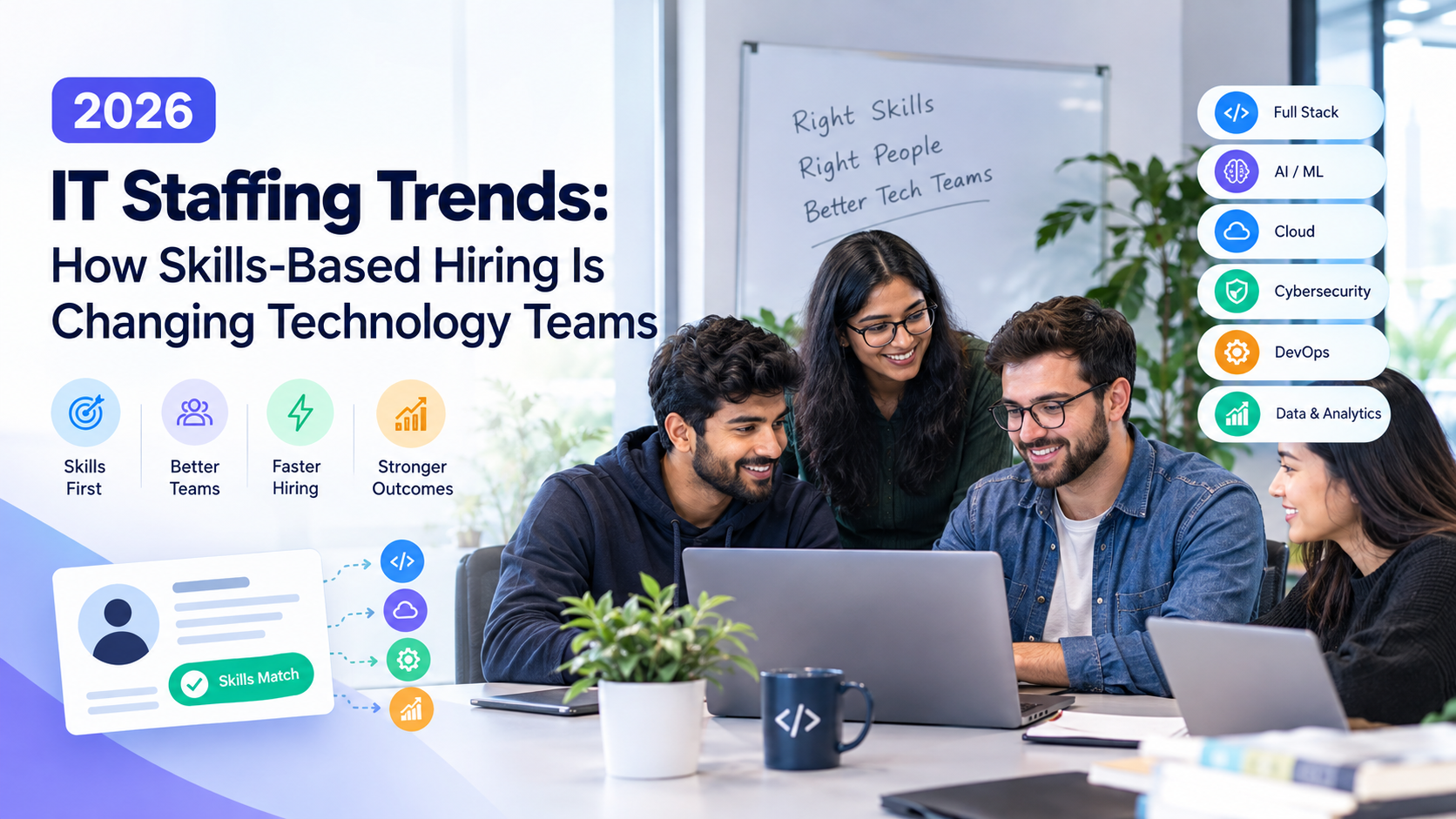
Technology hiring is changing from a role-first process to a skills-first process. Companies are no longer looking only for someone who matches a job title such as software developer, cloud engineer, or IT project manager. They are looking for people who have the specific capabilities required to solve a business problem.
This shift is one of the most important IT staffing trends for 2026. Artificial intelligence, cloud platforms, cybersecurity, data engineering, DevOps, and software development continue to evolve quickly. A job description written around a fixed list of tools can become outdated before the hiring process is complete.
For technology leaders, the new question is not simply, “Who can fill this role?” It is, “Which skills does this project need now, and how can we build a team that continues to adapt?”
Skills-based hiring, flexible engineering teams, and IT staff augmentation are becoming practical responses to this challenge. These models help businesses access the right capabilities while maintaining the flexibility to adjust as technology priorities change.
What are the biggest IT staffing trends in 2026?
The IT staffing market is being shaped by the speed of technological change. Businesses need to adopt new tools, but they also need people who can connect those tools to real products, systems, customers, and business outcomes.
The most important trends include skills-based hiring, rising demand for AI and data capability, continued cybersecurity pressure, flexible team structures, and a stronger focus on learning and adaptability.
These trends are connected. When skills change quickly, companies need a workforce strategy that can respond faster than traditional hiring cycles. They also need a way to identify which skills should be developed internally and which skills should be accessed through external specialists.
1. Skills-based hiring is becoming more important
Skills-based hiring focuses on the capabilities required to perform the work rather than relying only on job titles, degrees, years of experience, or previous employers.
For example, a company hiring for an AI product may need someone who can work with model APIs, data pipelines, prompt design, evaluation, security, and cloud deployment. The title “software engineer” does not explain whether a candidate has those skills. A skills-based process looks deeper into the technical and practical requirements of the project.
The World Economic Forum has argued that skills-based hiring can help organisations prepare for roles that may not exist yet. Its reporting notes that technical skills can change quickly, while human capabilities such as adaptability and collaboration remain important for long-term success.
This is particularly relevant in IT staffing. A candidate may not have used every tool in a company’s stack, but may have the problem-solving ability, learning speed, system design experience, and communication skills needed to become productive quickly.
Skills-based hiring does not mean ignoring experience. It means evaluating experience more accurately. A strong hiring process should connect a candidate’s practical evidence to the work the business needs to complete.
2. AI and data skills are moving across technology roles
AI is no longer limited to specialist research teams. It is appearing in customer service, search, analytics, software products, internal automation, marketing technology, and business operations.
As a result, AI-related skills are becoming relevant to more technology roles. A full-stack developer may need to integrate a language model into a product. A data engineer may need to prepare information for machine learning workflows. A cloud engineer may need to support AI workloads. A product manager may need to understand model limitations and evaluation.
The World Economic Forum’s Future of Jobs Report 2025 identifies AI and big data as the fastest-growing skills, followed by networks and cybersecurity and technological literacy. The report also places AI and machine learning specialists, big data specialists, and software and application developers among the fastest-growing technology-related roles.
This does not mean every employee must become an AI researcher. It means organisations need to understand which AI skills are required for each project. Some teams may need AI application developers, while others may only need engineers who understand APIs, data privacy, automation, and responsible implementation.
Companies that define their AI needs clearly can avoid two common mistakes. The first is hiring for AI terminology without identifying a real business problem. The second is expecting a general software team to deliver advanced AI work without providing the necessary data, evaluation, and deployment expertise.
3. Cybersecurity talent remains a strategic priority
Cybersecurity is becoming part of every technology team’s responsibility. Security cannot be treated as a final review after an application has already been built and deployed.
Businesses need professionals who can work across application security, cloud security, identity management, infrastructure, incident response, data protection, and secure software development. They also need developers who understand secure coding, access controls, secrets management, dependency risks, and privacy requirements.
The demand for cybersecurity skills is connected to the growth of cloud services, remote work, APIs, connected systems, and AI applications. Every new integration can introduce additional access, data, and operational risk.
Many organisations do not need a large permanent security team for every initiative. They may need a security specialist during a cloud migration, application review, compliance project, or platform launch. Flexible staffing can help bring in the right expertise at the right stage while internal teams continue to build their security capability.
4. Companies are building flexible technology teams
Technology demand rarely stays constant. A business may need additional developers during a product launch, cloud engineers during a migration, QA specialists before a release, and AI professionals during a new automation initiative.
A fixed workforce model can make these changes difficult. If every new requirement leads to a permanent hiring process, the organisation may move too slowly. If the business relies only on contractors without internal ownership, it may lose important product and technical knowledge.
Flexible technology teams provide a middle path. Permanent employees can own the long-term product, architecture, and business context. External specialists can add capacity or expertise for a defined project phase.
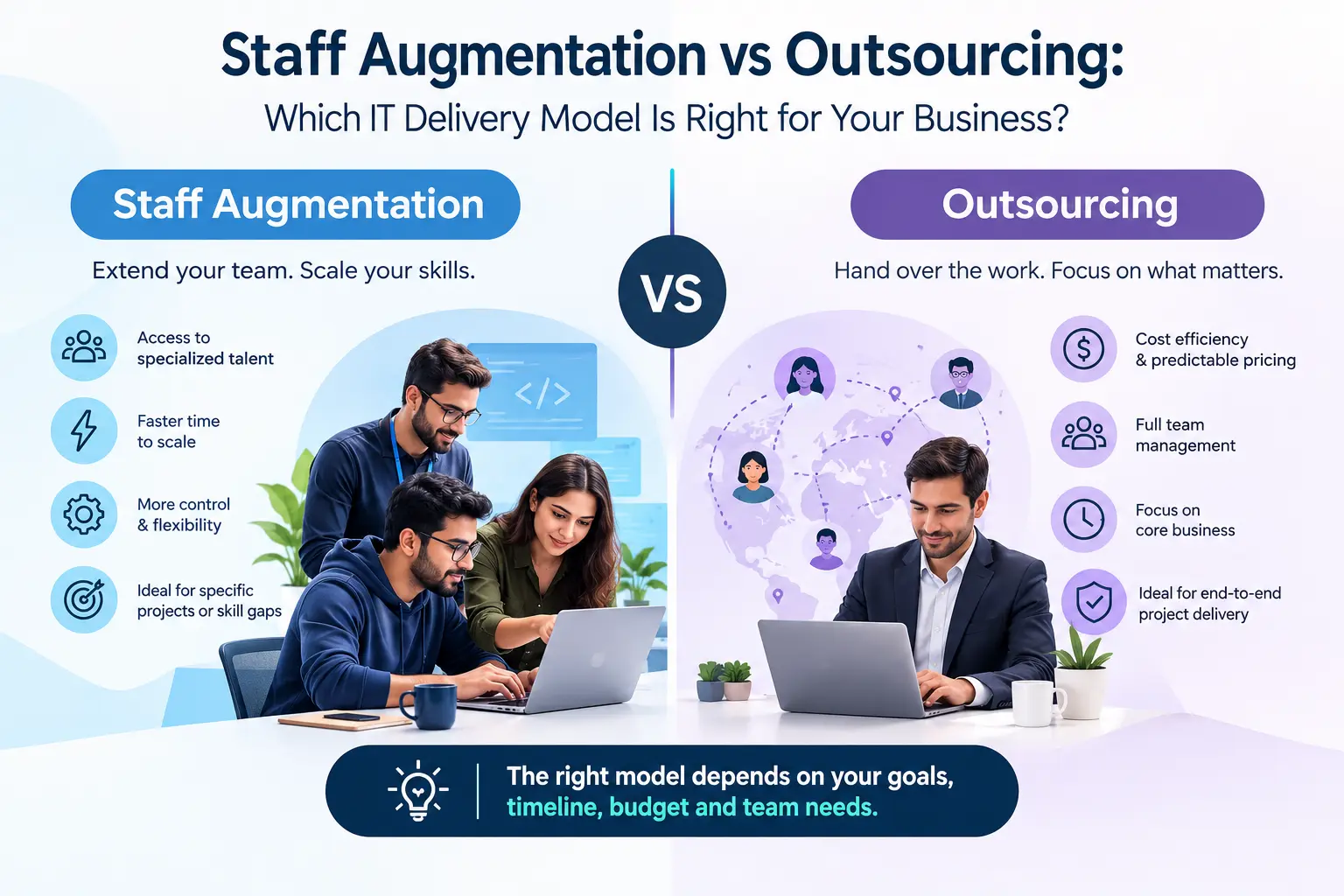
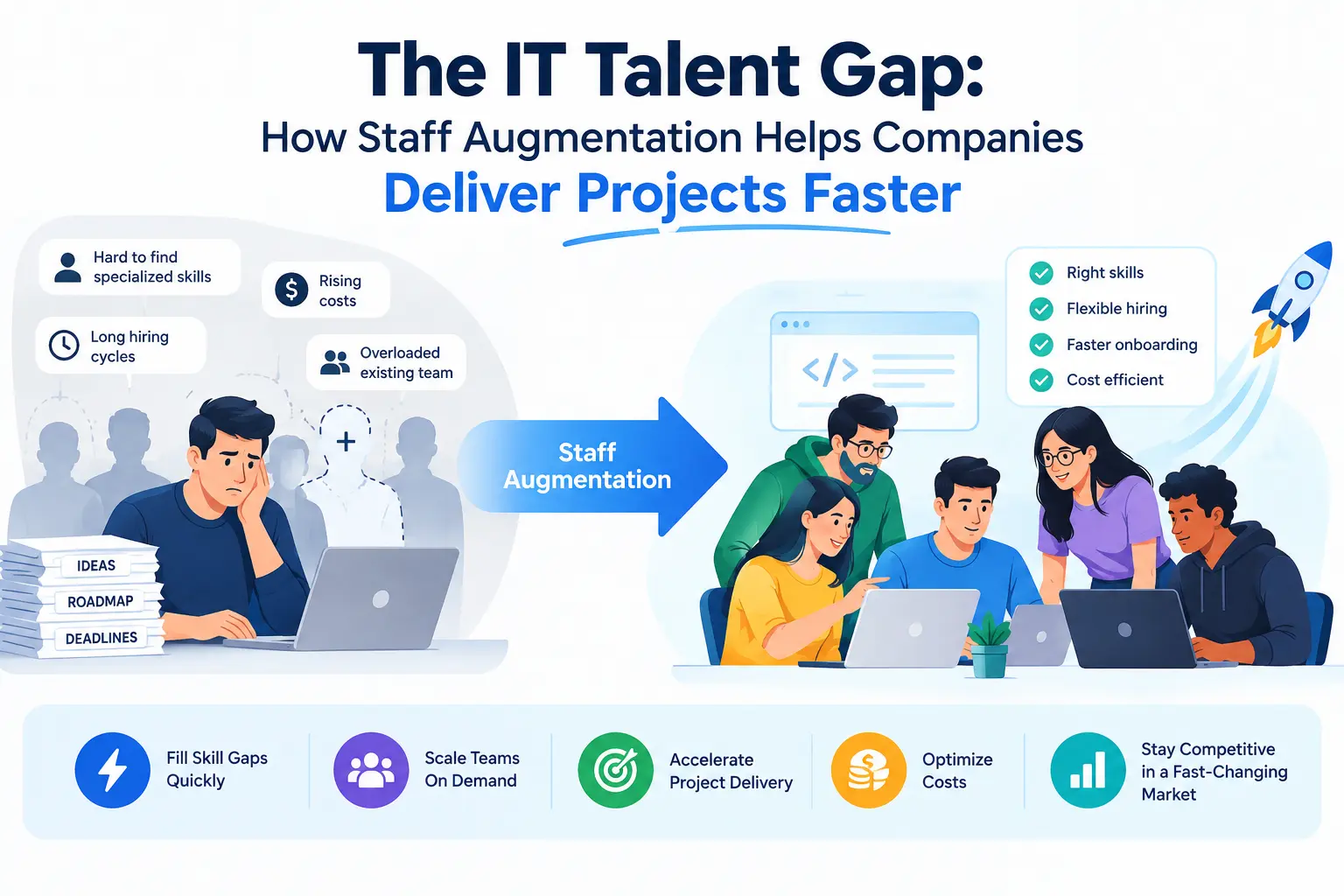
This is one reason IT staff augmentation is becoming a useful part of workforce planning. Staff augmentation allows external developers and technical specialists to work within the client’s existing team, tools, and delivery process. The business can scale specific capabilities without rebuilding its entire organisation for every new project.
5. Staff augmentation is shifting from emergency hiring to workforce strategy
Staff augmentation was once viewed mainly as a short-term response to a sudden hiring problem. In 2026, many companies are treating it as part of a broader workforce strategy.
The model can support product launches, cloud modernisation, AI integration, platform engineering, QA automation, data projects, and ongoing software development. It gives companies another way to manage the gap between long-term hiring plans and immediate delivery requirements.
A strategic approach begins by identifying the skills the internal team already has. The company can then determine which skills should be developed through training, which should be hired permanently, and which should be accessed through an external partner.
This approach is more effective than simply asking for “more developers.” A project may need a senior backend engineer, a DevOps specialist, a QA automation professional, or an AI integration engineer. The more specific the requirement, the easier it becomes to match the right talent and measure the result.
6. Upskilling and reskilling are becoming essential
Hiring alone cannot solve the technology skills challenge. Tools and technical requirements change too quickly for organisations to rely only on external recruitment.
Internal employees need opportunities to learn new platforms, frameworks, security practices, and AI capabilities. A developer may move into AI application development. A systems administrator may expand into cloud operations. A QA professional may learn automation and performance testing.
The goal is not to turn every employee into an expert in every technology. The goal is to build a workforce that can learn, collaborate, and move into new areas when business priorities change.
The World Economic Forum has highlighted reskilling and upskilling as important responses to changing workforce requirements. Skills-based workforce planning makes this easier because it gives the organisation a clearer view of the capabilities it already has and the skills it needs to develop.
External staff can support this process when they collaborate openly with internal teams. Documentation, code reviews, architecture sessions, and knowledge transfer can help the organisation retain value after the engagement ends.
7. Technical hiring is becoming more evidence-based
A résumé can show where someone worked, but it may not show how they solve problems. Technology companies are increasingly using practical assessments, system design discussions, code reviews, portfolio evidence, technical interviews, and work-sample exercises to evaluate candidates.
This is especially important for AI, cloud, data, cybersecurity, and DevOps roles. Candidates may list similar tools but have very different levels of production experience.
Evidence-based hiring also improves staff augmentation. A provider should be able to explain how technical professionals are assessed before they are introduced to a client. The assessment should reflect the actual work, seniority, communication requirements, and technology stack involved.
The process should remain fair and relevant. A test that measures trivia may not predict how well someone will collaborate or deliver in a real project. Practical evaluation should focus on problem-solving, technical judgement, communication, and the ability to produce maintainable work.
8. Human skills are becoming more valuable, not less
Technology skills are important, but they are only one part of successful delivery. Engineers also need to communicate clearly, understand business context, document decisions, work through ambiguity, and collaborate with people from different functions.
This matters even more when teams use AI tools. AI can generate code, analysis, or documentation, but people still need to decide whether the output is correct, safe, useful, and aligned with the product.
The most effective technology professionals combine technical depth with curiosity, critical thinking, ownership, and the ability to learn. These capabilities help them adapt when a framework changes, a requirement shifts, or a project encounters an unexpected problem.
For employers, this means hiring should not focus only on tool familiarity. The process should also examine how candidates reason, communicate, learn, and respond to feedback.
9. Remote and distributed staffing requires stronger processes
Remote and distributed teams are now a normal part of technology delivery. They can give businesses access to a wider talent pool, but they also require clearer communication and documentation.
A distributed team needs agreed working hours, response expectations, project tools, meeting routines, code review standards, and escalation processes. Without these practices, distance can create delays even when the technical talent is strong.
Staff augmentation partners can support distributed delivery when they provide clear communication, time-zone overlap, technical accountability, and consistent engagement management. The client should still make sure that external professionals are integrated into the same delivery rhythm as internal employees.
Remote staffing should be evaluated on outcomes rather than online presence. Completed milestones, code quality, reliability, documentation, and collaboration provide better evidence than the number of hours someone appears available.
10. Hiring managers are looking for outcomes, not only headcount
Traditional workforce planning often measures how many people are hired. Modern technology planning is increasingly focused on what those people enable the business to deliver.
A team may be successful because it launches a product, reduces deployment failures, improves application performance, automates testing, strengthens security, or shortens the time required to resolve incidents.
This changes how businesses should define staffing requirements. Instead of asking for three developers, a company might define the outcome as completing a new customer portal, migrating a service to the cloud, or improving release reliability.
The staffing model can then be selected around the outcome. Permanent hiring may be right for a long-term capability. Staff augmentation may be suitable for additional delivery capacity. Outsourcing may be appropriate when a provider can own a clearly defined project.
How can businesses respond to IT staffing trends in 2026?
Businesses should begin with a skills inventory. They need to understand what capabilities exist inside the organisation, where the gaps are, and which projects are likely to require new expertise.
Next, they should connect skills to business priorities. A company planning an AI initiative needs a different workforce plan from a company focused on cybersecurity, cloud migration, mobile development, or legacy modernisation.
The organisation should also create a balanced talent strategy. Permanent employees provide continuity and business context. Upskilling develops internal resilience. Flexible external specialists help the company respond when skills are needed quickly or only for a defined period.
Finally, leaders should improve how they evaluate technical talent. Skills-based hiring should include relevant work samples, technical discussions, communication assessment, and evidence of production experience. The goal is to find people who can contribute to the actual project rather than simply match a title.
How Witqualis supports modern IT staffing
Witqualis helps businesses access technical professionals through IT staff augmentation. Its service offering is positioned around software development, AI and machine learning, cloud, DevOps, data, mobile development, QA automation, and related technology capabilities.
This model can support companies that have internal product or engineering leadership but need additional capacity or specialist skills. External professionals can work within the client’s delivery process while the organisation retains control over priorities, product direction, and technical standards.
For businesses that need longer-term development capacity, Witqualis also provides dedicated developers and engineering talent. The right structure depends on the project scope, internal capabilities, security requirements, and expected duration.
A strong staffing engagement should begin with a clear skills brief. The business should explain the technology stack, the problem to be solved, the expected outcomes, the team structure, and the time required. This gives the staffing partner the information needed to recommend a relevant technical match.
Final thoughts
The biggest IT staffing trend for 2026 is the move toward skills-based, flexible, and adaptable technology teams.
Companies still need permanent employees and long-term internal capability. However, they also need a way to respond when a project requires a specialist skill that is not currently available. AI, cloud, cybersecurity, data, DevOps, and software development requirements can change faster than traditional hiring processes.
A balanced approach combines skills-based hiring, internal upskilling, permanent workforce planning, and IT staff augmentation. This gives businesses a better chance of accessing the capabilities they need while keeping control of product knowledge and long-term strategy.
The future of IT staffing is not only about hiring more people. It is about understanding the skills required for each business outcome and building a team that can learn, collaborate, and adapt as technology changes.
If your organisation needs flexible access to software developers, AI specialists, cloud engineers, QA professionals, or DevOps talent, explore Witqualis IT staff augmentation services or dedicated engineering talent.