Businesses often need additional technology expertise to launch products, modernise systems, improve applications, or complete digital transformation projects. The challenge is choosing the right way to access that expertise.
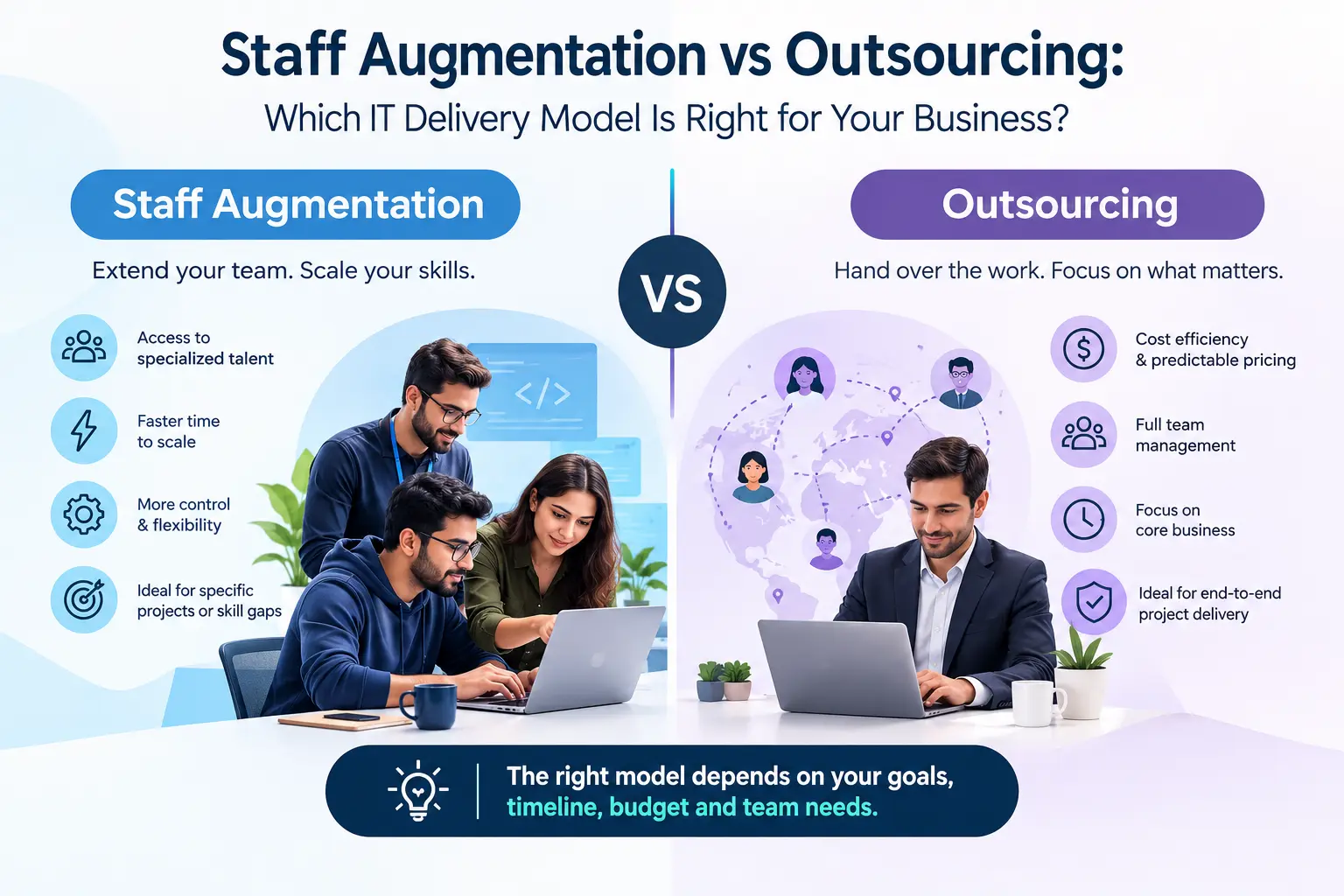
Two common options are staff augmentation and outsourcing. Both models allow a company to work with external technology professionals, but they are designed for different situations. Staff augmentation adds developers or specialists to an existing internal team. Outsourcing gives an external provider responsibility for a defined project, service, or business function.
The right choice depends on how much control the business wants to retain, how clearly the work can be defined, what skills are missing internally, and how much delivery responsibility it wants the technology partner to own.
What is staff augmentation?
Staff augmentation is an IT delivery model in which a company adds external developers, engineers, designers, testers, or technical specialists to its internal team for a specific period.
The augmented professionals work within the client’s existing environment. They may join the same stand-ups, use the same project management tools, contribute to the same repositories, and follow the same coding and review standards as internal employees.
The client normally controls the product roadmap, task priorities, architecture decisions, acceptance criteria, and day-to-day collaboration. The external provider supports the client by identifying suitable professionals, managing the engagement, and helping the new team members integrate successfully.
For example, a company may use staff augmentation to add a React developer during a product launch, a cloud engineer during a migration, or a QA automation specialist before a major release.
What is IT outsourcing?
IT outsourcing is a model in which a business gives an external provider responsibility for a defined project, service, or technology function.
The outsourcing provider may manage project planning, delivery schedules, technical execution, quality assurance, reporting, and team coordination. The client defines the desired outcome and remains involved in important decisions, but the provider owns more of the operational delivery than it would in a staff augmentation arrangement.
A business might outsource the development of a complete mobile application, the maintenance of a legacy platform, a testing function, a help desk, or a cloud operations service.
Outsourcing can be useful when an organisation does not want to build or manage an internal team for a particular function. It can also help when the scope is clear and the provider has the systems and expertise to deliver it independently.
2Staff augmentation vs outsourcing: the main difference
The main difference between staff augmentation and outsourcing is delivery ownership.
With staff augmentation, the external professional becomes an extension of the client’s team. The client remains closely involved in the work and manages the delivery process. With outsourcing, the provider owns more of the project or service and is responsible for coordinating the people and activities required to achieve the agreed outcome.
This difference affects control, communication, flexibility, accountability, onboarding, and the type of relationship required between the business and the technology partner.
Control and decision-making
Staff augmentation gives the client more direct control over day-to-day decisions. Internal product and engineering leaders can assign tasks, review code, change priorities, and guide the work as requirements evolve.
This model works well for companies that already have technical leadership but need more people to execute the roadmap. The client does not have to transfer product ownership to an external vendor.
Outsourcing gives the provider more responsibility for execution. This can reduce the management workload for the client, but it also means the business needs strong communication and governance processes to ensure that the external team’s decisions remain aligned with business goals.
A company should choose staff augmentation when it wants external capacity but wants to preserve close control over implementation. It should consider outsourcing when it prefers to define the outcome and allow a capable provider to manage more of the delivery process.
Team integration and communication
In staff augmentation, external professionals are expected to integrate into the client’s existing team. They may use the client’s communication channels, attend planning meetings, follow internal documentation practices, and participate in code reviews.
This creates a working relationship that is similar to adding new employees, although the engagement remains external. The model is especially useful when the work requires frequent collaboration with internal product managers, designers, architects, or engineers.
In outsourcing, communication often happens between the client’s representatives and the provider’s project or delivery manager. The provider may use its own internal processes and tools. This can be efficient when the project is well defined, but it may create more distance between the client and the people performing the work.
The best option depends on how closely the external professionals need to work with the internal team. A highly collaborative product initiative may benefit from staff augmentation, while a clearly scoped project may work well with outsourcing.
Flexibility and changing requirements
Staff augmentation is often more flexible when requirements are still developing. The client can change priorities, move developers between workstreams, or add specialists as new needs appear.
This flexibility is valuable in product development, where research, user feedback, technical discovery, and market conditions can influence the roadmap. The client can guide the augmented team as the project changes.
Outsourcing can also support changing requirements, but changes may require a formal review of scope, timelines, resources, and commercial terms. This is not necessarily a weakness. It helps protect both sides when the provider has committed to a specific deliverable, budget, or deadline.
A business should assess how stable the project scope is before choosing a model. Stable and clearly defined work may be suitable for outsourcing. Evolving work that requires constant internal collaboration may be better suited to staff augmentation.
Cost and commercial structure
The cost of staff augmentation and outsourcing depends on technology, seniority, geography, project complexity, duration, and commercial terms. It is not accurate to assume that one model is always cheaper.
Staff augmentation is commonly priced around the time or capacity of the professionals assigned to the client. The client may have more visibility into the team structure and can scale the number of people according to project needs.
Outsourcing is often priced around a project, milestone, service level, or ongoing operational scope. The provider may include project management, quality assurance, infrastructure, and delivery overhead in the commercial arrangement.
The correct comparison should consider the total operating cost. A lower hourly rate may not be valuable if the team requires extensive supervision, delivers poor quality, or causes rework. A higher project fee may be justified when the provider takes responsibility for complex delivery and reduces the client’s internal management burden.
Accountability and risk
In a staff augmentation model, the client usually remains responsible for managing priorities, assigning work, reviewing output, and coordinating delivery. This gives the client control, but it also requires time and technical leadership.
In an outsourcing model, the provider takes responsibility for more of the delivery process. This can reduce the client’s day-to-day workload, but the client must clearly define requirements, acceptance criteria, communication expectations, security obligations, and escalation procedures.
Neither model removes project risk. Staff augmentation does not automatically solve unclear requirements, weak leadership, or poor communication. Outsourcing does not guarantee success when the scope is incomplete or the provider lacks relevant experience.
The safest approach is to define accountability before work begins. Both parties should understand who owns product decisions, architecture, delivery planning, testing, security, documentation, and post-launch support.
When should you choose staff augmentation?
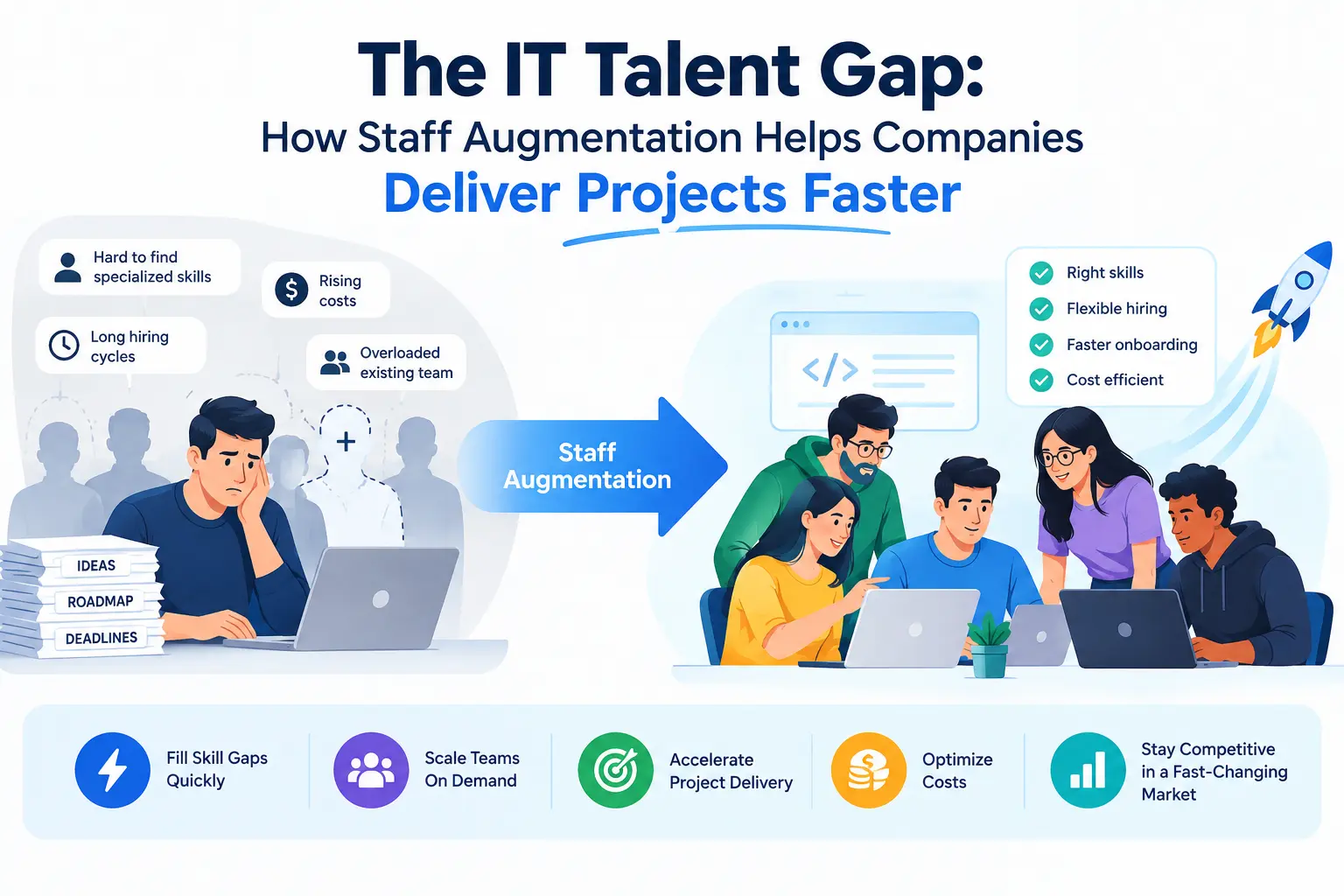
Staff augmentation is a strong choice when a company has internal technical leadership but lacks enough capacity to deliver its roadmap.
It is also useful when the business needs a specific specialist for a temporary requirement. A cloud migration, AI integration, security improvement, mobile release, or QA automation initiative may require expertise that does not justify a permanent hire.
Staff augmentation is suitable when external professionals need to work closely with internal employees. If the work involves daily collaboration, shared repositories, regular code reviews, and changing priorities, integrating the specialists into the existing team can be more efficient than managing a separate delivery organisation.
The model can also support a company that is still hiring permanent employees. The business can keep recruiting for long-term roles while using external professionals to maintain progress on urgent initiatives.
Explore
Witqualis IT staff augmentation services when your organisation needs additional software, AI, cloud, QA, data, mobile, or DevOps capacity.
When should you choose outsourcing?
Outsourcing may be a better choice when the work can be described through a clear scope, deliverables, timeline, and acceptance process.
It can suit a business that does not want to manage an additional technical team directly. If the organisation lacks internal delivery leadership for a particular function, an experienced provider may be able to manage planning, execution, testing, and reporting more independently.
Outsourcing can also work well for repeatable or specialised services. Application maintenance, managed testing, infrastructure support, help desk operations, and a complete project build may be suitable when the provider has a proven operating model.
The client should still retain appropriate oversight. Even when a provider owns delivery, the business needs clear governance, security reviews, service expectations, and a process for handling scope changes.
Can staff augmentation and outsourcing be used together?
Yes. Many companies use both models at different stages of the same technology programme.
A business may outsource the initial development of a platform while using augmented engineers to manage product integration and internal customisation. Another company may use staff augmentation for an active product team and outsource infrastructure monitoring or a specialised testing function.
A blended model can work when responsibilities are clearly separated. The client should document which team owns each workstream, how the teams communicate, who reviews code, and how dependencies are managed.
Without clear boundaries, a blended model can create confusion. Two external teams may assume that the other team owns testing, documentation, security, or production support. A written responsibility matrix can prevent these gaps.
How should you choose the right IT delivery model?
Begin by identifying the business problem rather than selecting a model based only on price. Ask whether the organisation needs people, a complete outcome, or an ongoing managed service.
Next, assess internal capability. If the company has product and engineering leaders who can manage the work, staff augmentation may provide the right balance of control and flexibility. If it lacks the capacity or expertise to manage delivery, outsourcing may reduce the operational burden.
Consider how stable the requirements are. A changing roadmap generally benefits from a flexible team model. A defined project with clear deliverables can be easier to outsource.
Review the security and intellectual property requirements before signing an agreement. Confirm how the provider will access systems, protect information, manage devices, handle production permissions, and transfer code or documentation at the end of the engagement.
Finally, examine proof of delivery. Ask for relevant experience, technical vetting details, client references, case studies, communication processes, replacement terms, and examples of work similar to your own requirements.
How Witqualis supports flexible IT delivery
Witqualis helps businesses access software development and technical talent through IT staff augmentation. Its service model is designed for organisations that need additional engineering capacity while keeping control of product priorities and internal workflows.
Businesses can use this model to support software development, AI and machine learning initiatives, cloud projects, DevOps, data engineering, QA automation, web applications, and mobile development. The right team structure depends on the company’s technology stack, project scope, security requirements, and expected duration.
For organisations that need a more continuous development capability, Witqualis also offers dedicated engineering talent. You can review the
dedicated developers and engineering teams available through Witqualis.
The most effective engagement begins with a clear conversation about the capability gap. The business should explain what is blocked, which skills are needed, how the team works, and what success should look like. This allows the provider to recommend a practical delivery structure rather than simply presenting a list of profiles.
Final thoughts
The choice between staff augmentation and outsourcing depends on the level of control, flexibility, and delivery responsibility your business needs.
Staff augmentation is usually the better option when you have internal leadership and want external developers or specialists to work directly inside your team. It helps businesses scale capacity, address skill gaps, and respond to changing priorities without creating a permanent hiring commitment for every requirement.
Outsourcing may be more suitable when you have a clearly defined project or service and want an external provider to manage more of the delivery process. It can reduce internal management effort when the scope, expectations, and governance model are clear.
There is no universal answer to the staff augmentation vs outsourcing question. The right model is the one that matches your project scope, technical leadership, security needs, delivery timeline, and preferred level of control.