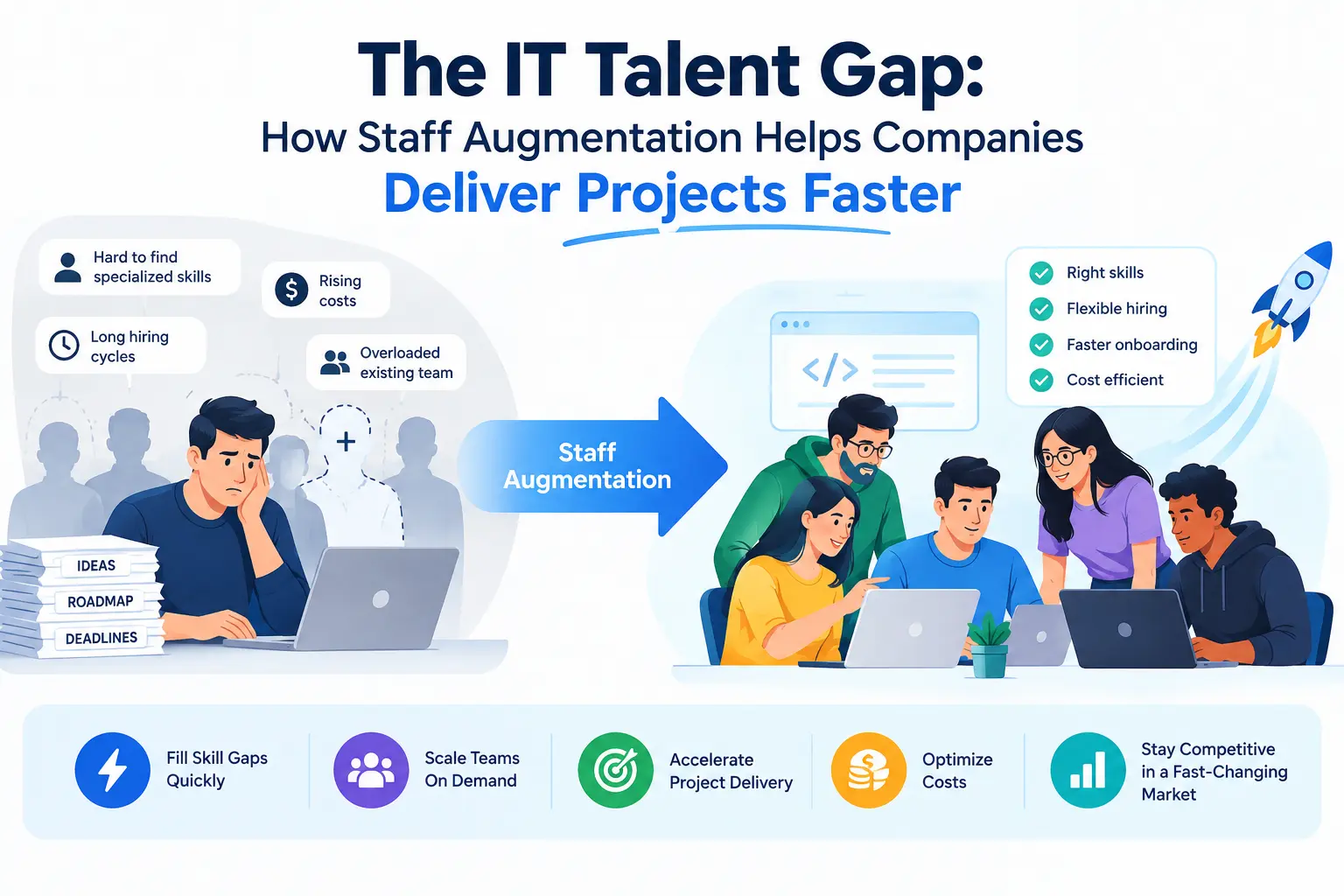
The IT Talent Gap: How Staff Augmentation Helps Companies Deliver Projects Faster
Technology companies are under constant pressure to deliver more. They need to launch products faster, modernise legacy systems, improve cybersecurity, adopt artificial intelligence, and respond to customer expectations. Yet many teams do not have enough skilled people to complete this work on schedule.
The result is an IT talent gap: the difference between the technical capabilities a company needs and the skills or capacity available inside its team. This gap can lead to delayed releases, overloaded developers, postponed platform upgrades, and missed business opportunities.
IT staff augmentation helps solve this problem by adding qualified technical professionals to an existing team for a defined period. Instead of waiting months to build a permanent team or handing the entire project to an outside vendor, a company can bring in developers, cloud engineers, QA specialists, AI professionals, or DevOps experts while keeping control of its product and delivery process.
What is the IT talent gap?
The IT talent gap is not simply a shortage of people who can write code. It is a shortage of the right skills, experience, seniority, and availability for a company’s current technology priorities.
For example, a business may have a strong general software team but still lack:
• A cloud engineer for a migration project
• A cybersecurity specialist for a risk-reduction initiative
• A data engineer for a new analytics platform
• A machine learning engineer for an AI product
• A QA automation specialist before a major release
• A senior backend developer for a high-volume system
• A DevOps engineer to improve deployment reliability
• A mobile developer for an urgent application launch
The gap may also be about capacity. A team can have the right skills but still be unable to take on another project because its developers are already committed to production support, bug fixes, technical debt, and existing roadmap work.
This distinction matters. Hiring a permanent employee may solve a long-term capability need, but it may not solve an immediate delivery bottleneck. Staff augmentation is designed for situations where a company needs additional expertise or capacity while its permanent hiring and workforce planning continue.
Why is the IT talent gap becoming a business problem?
The demand for technology work continues to grow across industries. The U.S. Bureau of Labor Statistics projects 10% employment growth for software developers, quality assurance analysts, and testers from 2025 to 2035—much faster than the average for all occupations. It also projects approximately 106,100 openings per year for these roles over the decade.
The World Economic Forum’s Future of Jobs Report 2025 identifies AI and big data, networks and cybersecurity, and technological literacy among the fastest-growing skills. It also lists AI and machine learning specialists, big data specialists, and software and application developers among the fastest-growing technology-related roles.
These trends create pressure for employers. Companies are competing for specialists while technology requirements are changing quickly. A role that was not needed last year may become important during a cloud migration, AI initiative, security programme, or platform modernisation project.
When an organisation cannot access the required talent, the cost is not limited to recruitment. The business may also experience:
• Missed product or release deadlines
• Slower response to customers
• Increased pressure on internal employees
• Higher risk of technical debt
• Delayed security and compliance work
• More production incidents caused by rushed delivery
• Lost revenue from postponed initiatives
A talent gap becomes a business problem when it prevents the organisation from executing its technology strategy.
Why do IT projects get delayed?
Project delays rarely have one cause. They usually result from several capacity, skills, and process issues occurring together.
#### 1. The project needs a specialist the team does not have
A project may depend on Kubernetes, a specific cloud platform, mobile development, data engineering, or AI integration. If the existing team has limited experience in that area, it must either learn while delivering or wait for a new hire.
Learning is valuable, but the learning curve can be difficult to absorb when a project already has a fixed deadline. A specialist can help the internal team make progress while also transferring knowledge through documentation and collaboration.
2. Permanent hiring takes longer than the roadmap
A permanent hire requires sourcing, screening, interviews, offer negotiations, notice periods, onboarding, and team integration. For strategic roles, this process is worthwhile. However, an urgent release or client commitment may not be able to wait for every step to finish.
The company may use staff augmentation as a temporary capacity solution while continuing its permanent recruitment process.
3. Existing teams are overloaded
Internal developers may be working on new features while also handling support, maintenance, security updates, and technical debt. Adding another priority without adding capacity can lead to context switching and lower quality.
An augmented engineer or team can own a defined workstream, allowing the internal team to protect critical priorities and focus on product decisions.
4. The scope changes during delivery
Technology projects often reveal new requirements after discovery begins. A product may need a different integration, an additional security layer, or a more scalable architecture than originally planned.
Flexible staffing allows a company to add a specialist when the requirement becomes clear instead of hiring a permanent role based on an assumption.
5. Quality assurance is added too late
When QA capacity is limited, testing is often pushed toward the end of the project. This can create a release bottleneck and allow defects to accumulate.
Adding QA automation or testing expertise earlier can help the team build quality into the delivery process rather than treating testing as a final checkpoint.