How AI Is Reshaping Staff Augmentation: Build Your AI Team Without the Hiring Wait
AI is easy to want and hard to staff
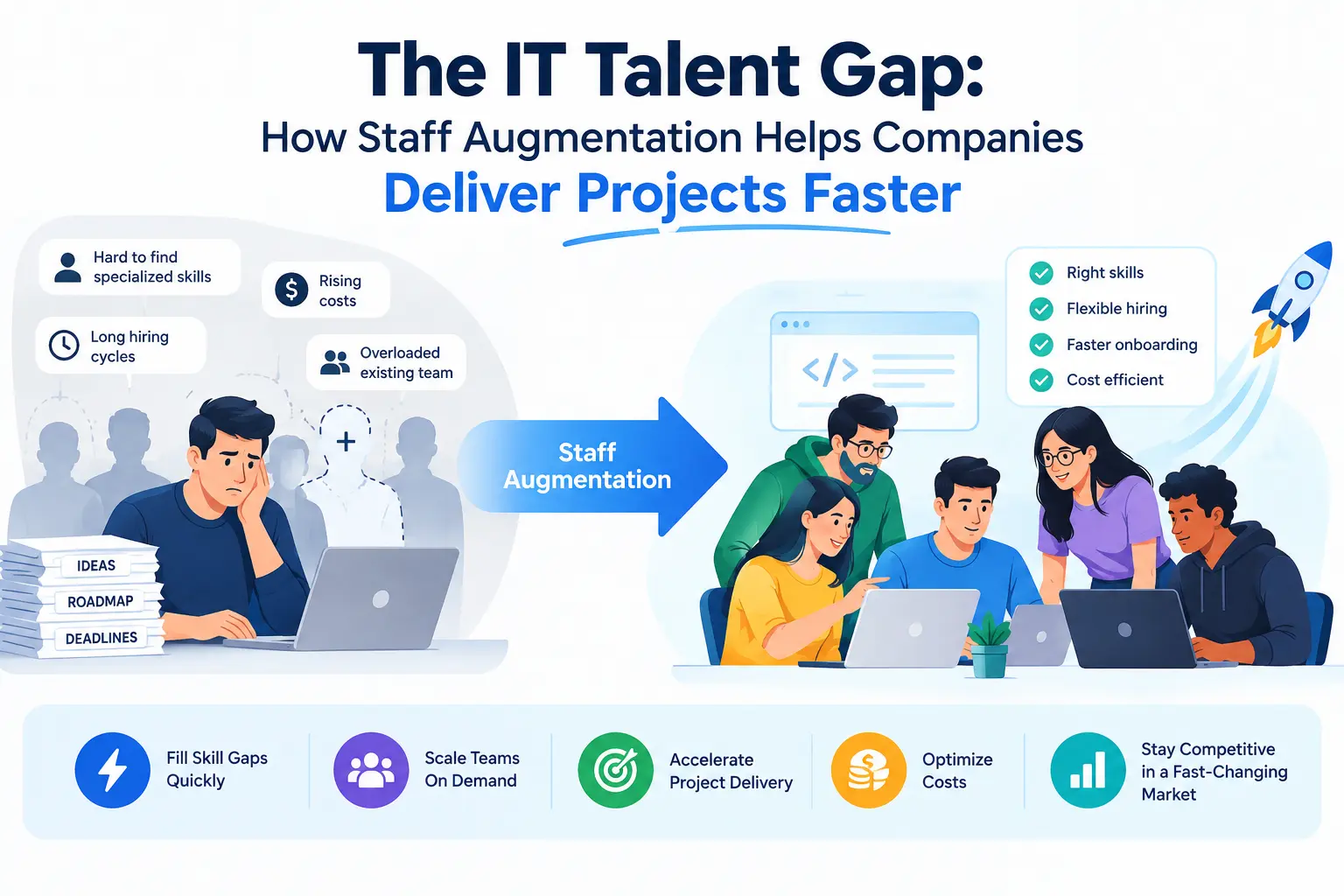
Every product roadmap now has an AI line on it: a support copilot, smarter search, document automation, a recommendation engine. The ideas are not the problem. The people are. Engineers who can take an LLM or a retrieval-augmented generation (RAG) pipeline from demo to production are scarce, expensive and usually already employed.
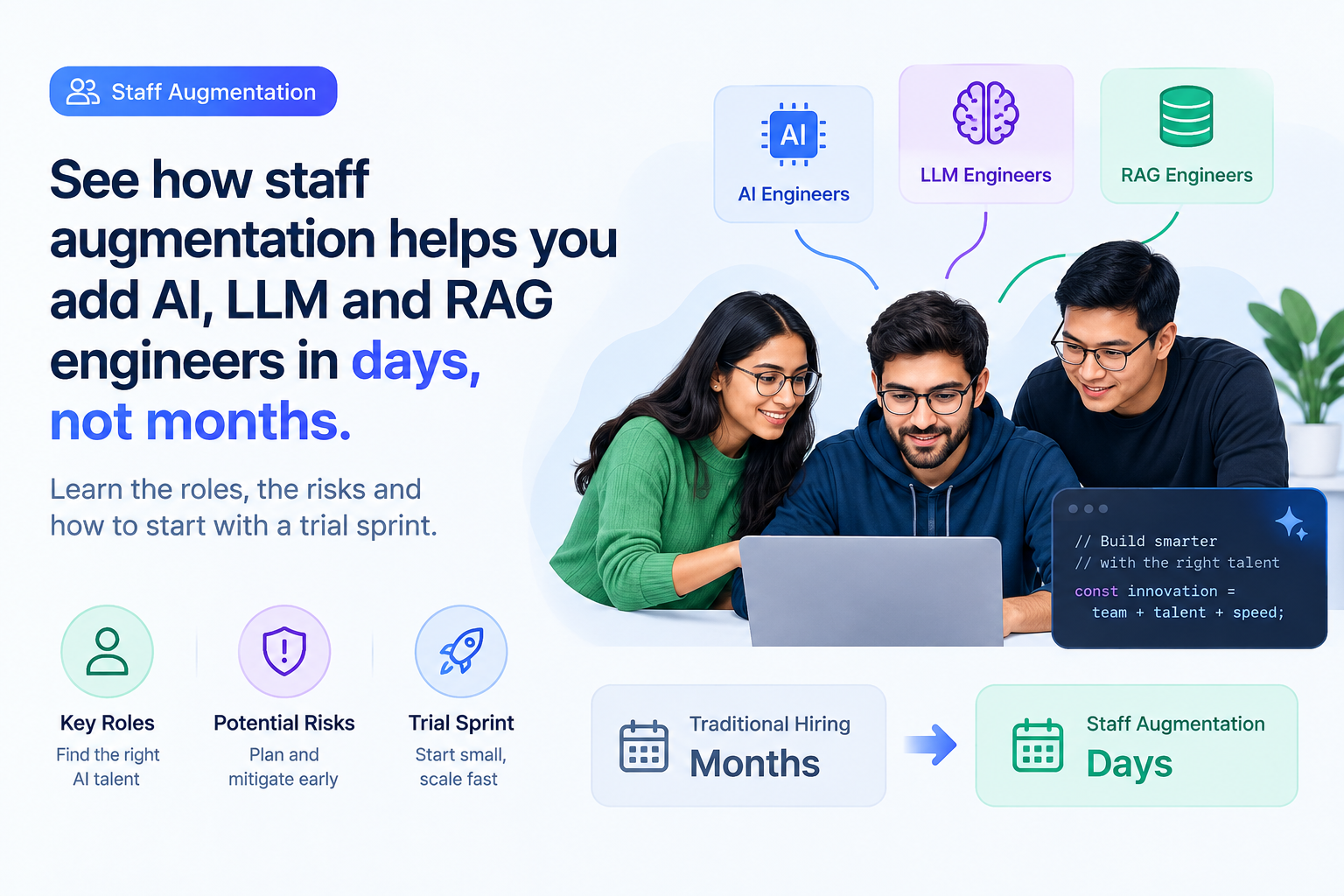
That is why staff augmentation has moved from a cost-saving tactic to a speed strategy. Instead of waiting a quarter to recruit one specialist, you add vetted engineers to your existing team, inside your own tools and sprints, and start shipping.
This guide explains why traditional hiring struggles with AI work, how staff augmentation closes the gap, which roles to add first, and how to avoid the mistakes that sink most AI projects.
Why traditional hiring struggles with AI projects
A permanent hire is the right choice for a long-term core team. For fast-moving AI work it has three weaknesses.
• It is slow. Posting a role, screening, interviewing, negotiating and waiting out a notice period can take two months or more for a senior engineer. In AI, tools and best practices can shift in that time.
• It is hard to judge. A résumé full of AI keywords says little about whether someone has shipped a RAG system that stays accurate under real traffic. You often find out after the hire.
• It is hard to reverse. If the project changes direction, a full-time hire is a fixed commitment, while the skills you need next quarter may be different.
These problems are not about effort. They come from using a slow, fixed process for work that moves quickly and needs proof of skill. If you are weighing options, our comparison of staff augmentation, managed services and project outsourcing covers when each model fits.
How staff augmentation closes the AI talent gap
With staff augmentation, a partner supplies pre-vetted engineers who join your team and work in your repositories, stand-ups and ticket boards. You keep direction and ownership. The partner removes the sourcing, screening and admin work.
For AI work, that brings four practical advantages:
1. Speed. Matched engineers can join in days, so a prototype does not wait on a hiring cycle.
2. Proven skill. A good partner tests candidates with live architecture and pair-coding sessions rather than keyword-matched résumés.
3. Flexibility. Add a machine learning engineer for a three-month build, then scale down or switch to a DevOps specialist for deployment.
4. Lower risk. A short trial on live tasks shows you the real quality of work before you commit to a longer engagement.
At WitQualis, staff augmentation works this way: senior engineers are embedded into your Slack, Jira and GitHub, commit to your repositories, and the code and IP belong to you under a signed contract. You can see the range of engineers on the hire developers page.
AI and technology roles you can add on demand
Most AI products need more than one kind of engineer. The table shows the roles teams add most often and what each one does.
Not sure which role you need first? Our AI consulting team can help scope the work, and our AI development, generative AI and machine learning pages show what we build.
A realistic path: from first call to trial sprint
Getting started should take days, not weeks. A typical WitQualis engagement runs like this:
1. Requirements call. You describe your stack, the seniority you need and the deliverables for the first sprint.
2. Candidate review. You interview the shortlisted engineer one to one and review their past code and architecture thinking.
3. Trial sprint. The engineer joins your Slack, Jira and GitHub and works on live tickets, for up to 7 days, so you judge by real output.
4. Scale or adjust. If it works, you continue with a monthly engagement or grow into a dedicated squad. If it does not, you adjust early.
The overlap with your working hours is 4 to 8 hours a day, so stand-ups and reviews happen live rather than by email.
##Five mistakes to avoid when augmenting an AI team
1. Starting without a clear problem. "Add AI" is not a goal. Define the user problem and a measurable result, such as faster support replies or fewer manual reviews.
2. Hiring only model builders. Models need data pipelines, APIs, interfaces and deployment. Without full-stack and DevOps support, prototypes stay prototypes.
3. Treating augmented engineers as outsiders. Give them the same access, context and standards as your own team. Isolated engineers deliver isolated work.
4. Ignoring data privacy. Decide early what data models can see, whether it must stay inside your environment, and who owns the code. Put it in the contract.
Conclusion
AI projects fail more often from a lack of the right people at the right time than from a lack of ideas. Staff augmentation lets you add proven engineers quickly, test them on real work and scale as the product matures.
Ready to build your AI team? Book a discovery call or contact WitQualis to start with a trial sprint. You can also learn more about us or browse our portfolio of delivered platforms.