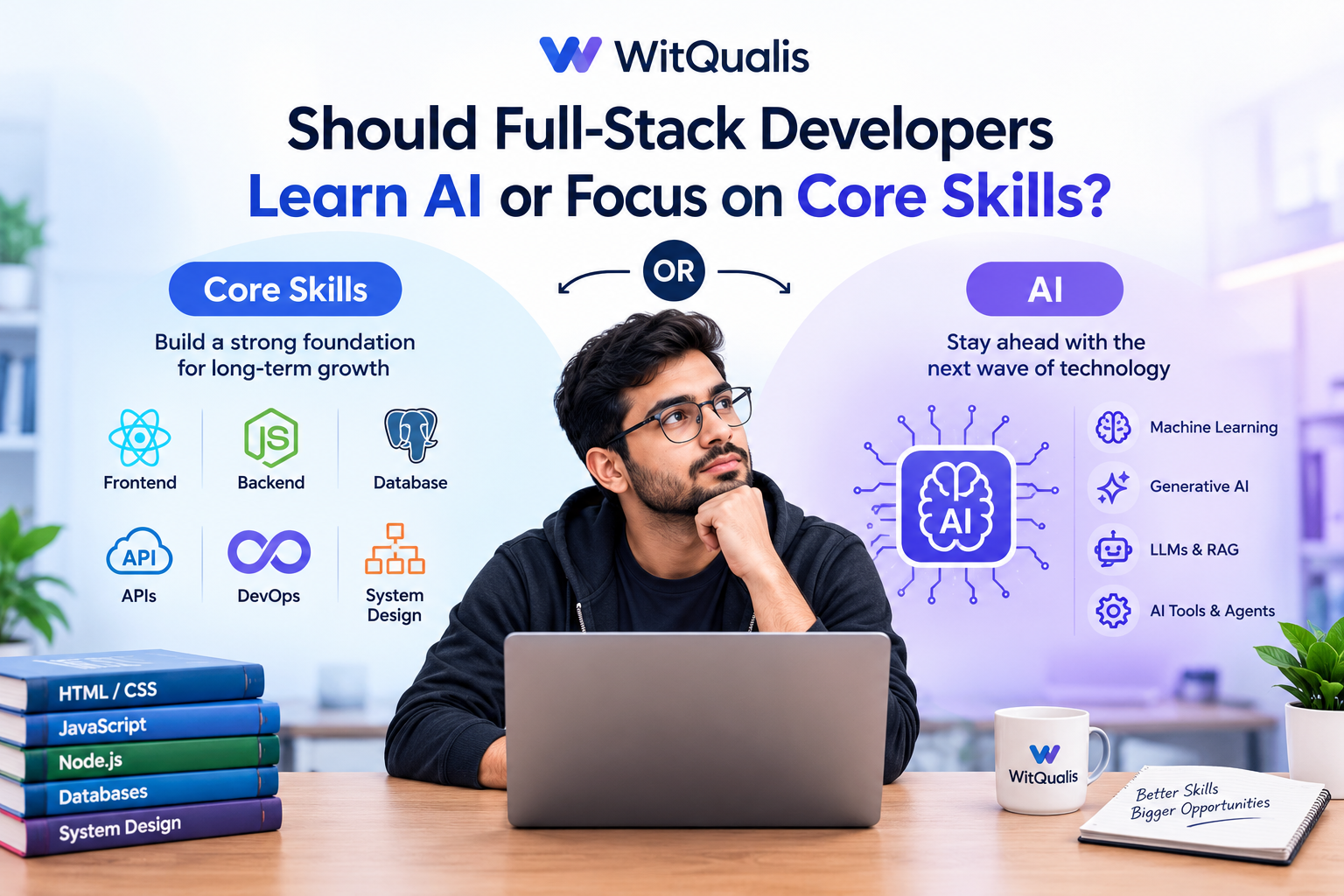
Should Full-Stack Developers Learn AI or Focus on Core Skills?
Yes, full-stack developers should learn AI—but they should not abandon the core skills that make them reliable software engineers.
The strongest developers in today’s market are not necessarily those who know the most AI terminology. They are developers who can build secure, maintainable applications and use AI where it creates real value. That may include integrating a language model into a product, building a retrieval-augmented generation (RAG) feature, automating repetitive engineering work, or helping a team decide whether an AI feature is appropriate in the first place.
The right approach is not AI instead of full-stack development. It is strong full-stack engineering enhanced by practical AI skills.
Key Takeaways•
Core skills such as JavaScript, APIs, databases, testing, security, and system design remain essential.
• Full-stack developers do not need to become machine learning researchers to build useful AI-powered products.
• The most valuable AI skills are practical: model APIs, prompt design, embeddings, RAG, evaluation, privacy, and production integration.
• Developers should learn AI in stages and apply each new skill to a real product or engineering problem.
Why should full-stack developers learn AI?
AI is becoming part of ordinary software products. Search experiences, support tools, document workflows, analytics dashboards, coding tools, recommendation systems, and internal business applications increasingly include AI-powered functionality.
This creates a new expectation for full-stack developers. They may not be responsible for training a foundation model, but they often need to connect AI capabilities to the rest of an application. That requires knowledge of both worlds:
• The user interface that captures a request and displays a response
• The backend that manages authentication, business logic, rate limits, and APIs
• The data layer that stores documents, permissions, feedback, and usage information
• The AI layer that handles prompts, models, retrieval, tools, and evaluation
• The deployment environment that keeps the feature secure, observable, and cost-controlled
A developer who understands only the AI API may create a convincing demo that fails under real user traffic. A developer who understands full-stack engineering and AI integration can build a feature that fits the product and can be maintained after launch.
The labour market also points toward continued demand for technology skills. The U.S. Bureau of Labor Statistics projects 10% employment growth for software developers, quality assurance analysts, and testers from 2025 to 2035. The World Economic Forum’s Future of Jobs Report 2025 lists AI and big data, networks and cybersecurity, and technological literacy among the fastest-growing skills.
These reports do not mean every developer must become an AI specialist. They do show why practical AI literacy is becoming a useful part of modern software engineering.
Should developers focus on core skills first?
Yes. Core skills should come first because AI does not replace the need for sound engineering decisions.
A full-stack developer still needs to understand how to:
• Design and consume REST or GraphQL APIs
• Build accessible and responsive user interfaces
• Model data and write reliable database queries
• Manage authentication, authorisation, and user permissions
• Write tests and debug production issues
• Handle errors, retries, queues, caching, and rate limits
• Review code and work with version control
• Deploy, monitor, and maintain applications
• Make sensible trade-offs between speed, cost, scalability, and complexity
AI can generate code, but it does not automatically understand a company’s security requirements, domain rules, data permissions, or long-term maintenance costs. Developers need core knowledge to judge whether generated code is correct and whether it belongs in production.
For example, an AI coding tool may produce a database query that works for a small test dataset but becomes slow at scale. It may suggest an authentication flow that exposes too much information. It may return a frontend component that looks correct but fails accessibility checks. Core engineering knowledge is what allows a developer to identify and fix those problems.
AI makes engineering judgement more important, not less important.
Which core skills should full-stack developers master?
Before building advanced AI features, developers should have a dependable foundation across the application stack.
Frontend development
Developers should understand component design, state management, accessibility, responsive layouts, performance, browser behaviour, and user experience. Whether an AI feature appears in a chat interface, search page, dashboard, or workflow tool, the frontend determines whether users can understand and trust the result.
Backend development
The backend needs to manage business rules, authentication, permissions, integrations, background jobs, logging, and failures. AI features often increase backend complexity because model calls can be slow, expensive, non-deterministic, or temporarily unavailable.
Databases and data modelling
AI applications still depend on structured data. Developers need to understand relational databases, document stores, indexing, data validation, migrations, and access control. When an AI application uses embeddings or vector search, developers also need to understand how those systems fit into the overall data architecture.
Testing and debugging
AI output can vary from one request to another, so testing requires more than checking whether a page loads. Developers need unit tests for deterministic code, integration tests for model and retrieval workflows, and evaluation cases for quality, safety, relevance, and refusal behaviour.
Security and privacy
AI features can introduce risks involving sensitive prompts, data leakage, insecure tools, prompt injection, excessive permissions, and unprotected logs. Full-stack developers should understand how data moves through the application and which users or services are allowed to access it.
System design and deployment
A production feature needs observability, cost controls, caching, retries, fallbacks, versioning, and a plan for change. These are system-design concerns whether the application uses AI or not.
Which AI skills should full-stack developers learn?
Full-stack developers do not need to learn every part of machine learning. They should prioritise the skills that help them build, integrate, and maintain AI-powered applications.
1. AI and machine learning fundamentals
Start with the basic concepts:
• What language models do well and where they fail
• Tokens, context windows, temperature, and structured output
• Training, fine-tuning, inference, and embeddings
• Classification, summarisation, extraction, and generation
• Hallucinations, bias, and uncertainty
• Model latency, usage limits, and cost
The goal is not to memorise every model architecture. It is to understand enough to make informed product and engineering decisions.
2. Working with model APIs
Developers should learn how to call model APIs securely from a backend service. Important topics include authentication, request validation, streaming responses, structured JSON output, retries, timeouts, rate limits, and error handling.
A simple model call can be useful for learning, but production applications require more structure. API keys should not be exposed in the browser. Prompts should be versioned where appropriate. Responses should be validated before the application uses them.
3. Prompt design and structured outputs
Prompt design is not only about writing clever instructions. It involves defining the task, supplying relevant context, specifying output requirements, and testing edge cases.
Full-stack developers should learn how to:
• Separate system instructions from user input
• Request structured outputs when the application needs predictable data
• Validate model responses against a schema
• Handle missing, ambiguous, or unsafe requests
• Create reusable prompts instead of scattering instructions throughout code
• Test prompts against representative examples
4. Embeddings and RAG
Retrieval-augmented generation allows an application to retrieve relevant information from a trusted data source and provide that context to a language model. This is useful for internal knowledge bases, support tools, documentation search, and enterprise workflows.
A developer learning RAG should understand the full pipeline:
1. Collect and clean source documents.
2. Split content into useful chunks.
3. Generate embeddings and store them in a suitable index.
4. Retrieve relevant passages for a user query.
5. Apply permissions and filters before sending context to a model.
6. Generate a response with citations or source references where appropriate.
7. Evaluate retrieval quality and answer quality separately.
RAG is not simply “connect a vector database to a chatbot.” The quality of the source data, chunking strategy, retrieval method, permissions, and evaluation process all affect the result.
5. AI evaluation and observability
A demo can appear successful even when an AI feature is unreliable. Developers should learn how to evaluate accuracy, relevance, completeness, latency, cost, refusal behaviour, and safety.
Useful practices include:
• Maintaining a test set of realistic questions
• Comparing responses against expected criteria
• Tracking failed or low-confidence interactions
• Monitoring token usage and response time
• Recording model and prompt versions
• Collecting user feedback responsibly
• Testing for prompt injection and data leakage
6. AI-assisted development
AI coding tools can help developers explore an unfamiliar codebase, generate test cases, explain errors, create documentation, and produce first drafts. They should be treated as development tools, not as a replacement for code review.
A professional workflow includes reviewing generated code, running tests, checking dependencies, scanning for security problems, and confirming that the output follows the project’s architecture and conventions.
What happens if developers ignore AI completely?
Developers who ignore AI may still produce good software, but they can miss opportunities to improve products and workflows. They may also find it harder to contribute to projects where AI is already part of the architecture.
Not every developer needs to specialise in AI. However, a basic understanding of model capabilities, limitations, API integration, data privacy, and evaluation can help developers participate in technical discussions and make better decisions.
AI literacy also helps developers assess AI-generated code. Even if a developer never builds a chatbot or RAG system, they may work in a team where AI tools are used for coding, testing, support, analytics, or automation.
A practical learning roadmap for full-stack developers
The best roadmap is incremental. Developers should connect each stage to a real application rather than collecting disconnected tutorials.
Stage 1: Strengthen full-stack fundamentals
Review frontend architecture, backend services, databases, authentication, testing, security, Git workflows, deployment, and monitoring. Identify the areas where you cannot yet diagnose a production problem confidently.
Stage 2: Build one small AI feature
Use a model API to add a focused capability such as text classification, structured extraction, summarisation, or an assistant for a narrow workflow. Keep the scope small enough to test properly.
Stage 3: Add reliable application controls
Move the model call behind a backend service. Add validation, rate limiting, logging, timeouts, error states, and a way to handle uncertain or invalid responses.
Stage 4: Learn retrieval and data grounding
Build a small RAG application using documents you are allowed to use. Focus on data cleaning, chunking, retrieval quality, access control, and source attribution.
Stage 5: Add evaluation and monitoring
Create a set of representative test cases. Measure answer quality, retrieval quality, latency, and cost. Test failure modes before expanding the feature.
Stage 6: Learn enough deployment and operations
Understand how the feature behaves in production. Study caching, queues, model fallback strategies, observability, secret management, and cost controls.
Stage 7: Go deeper only if your role requires it
If you want to become an ML engineer or AI specialist, continue into statistics, Python, data pipelines, model training, fine-tuning, MLOps, and machine learning theory. Full-stack developers do not need all of this to become effective AI application engineers.
How can companies build teams with both full-stack and AI skills?
Companies should avoid treating AI as a separate capability that no software engineer needs to understand. A modern product team may include full-stack developers, AI engineers, data specialists, cloud engineers, security professionals, and product leaders working together.
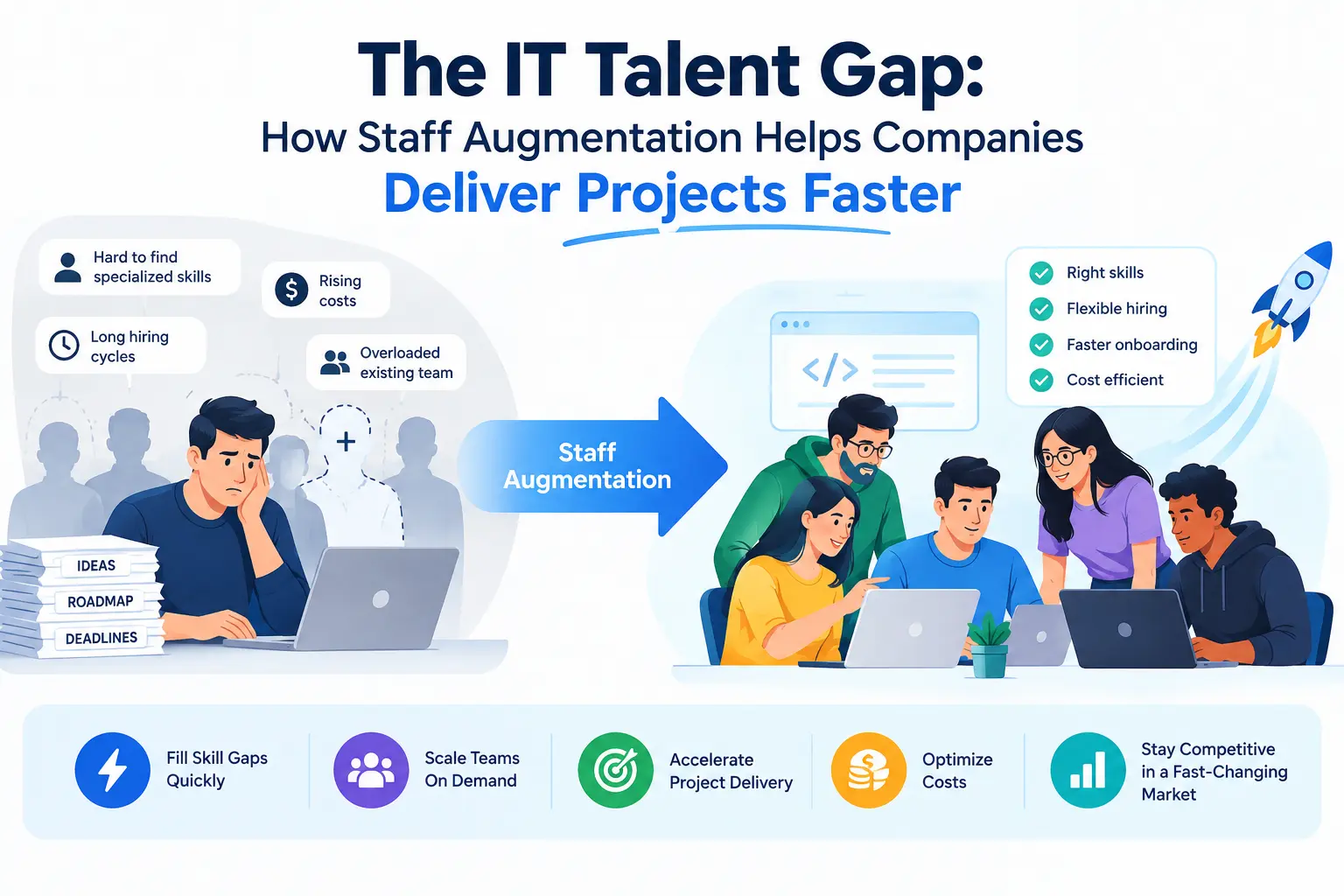
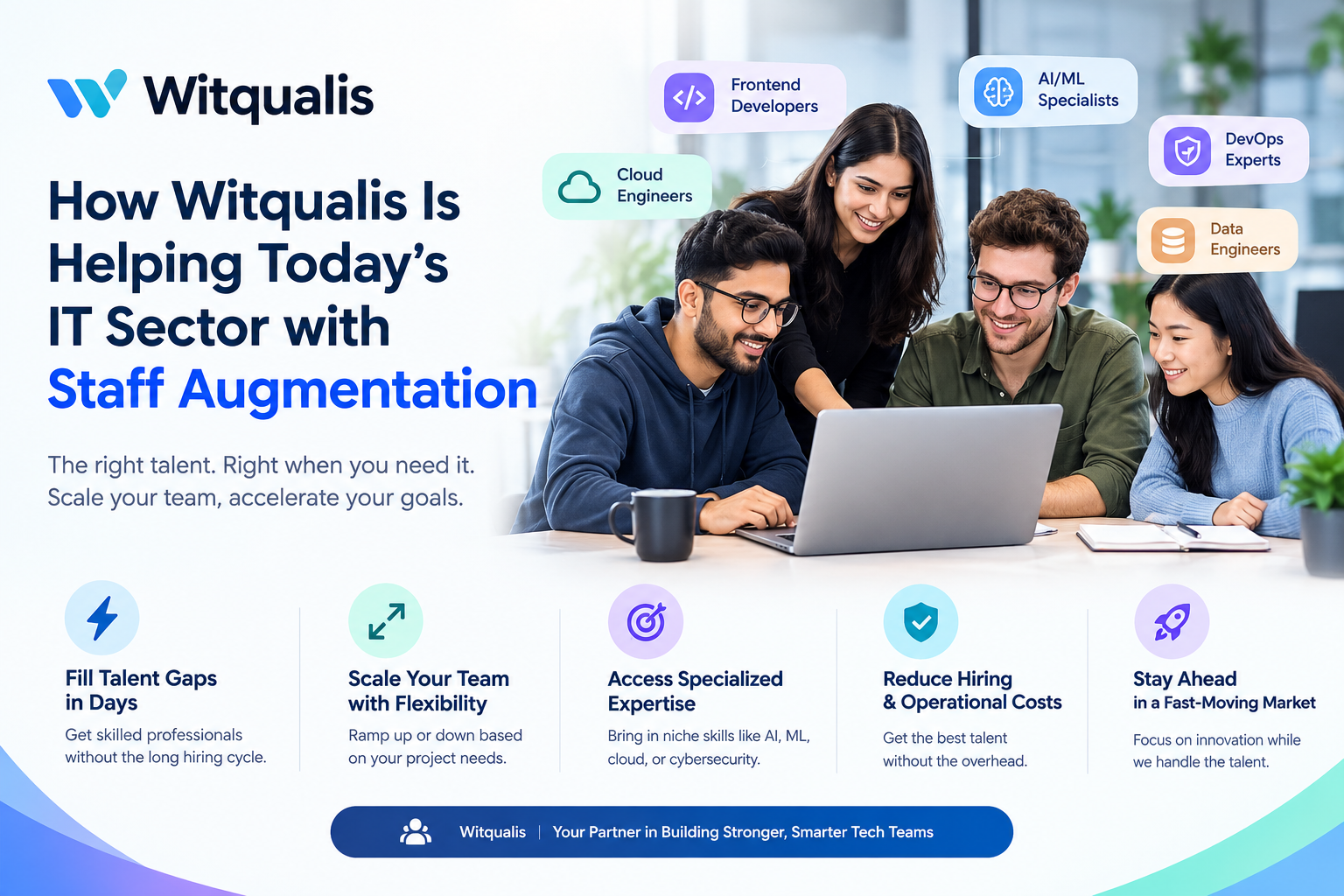
Some organisations build this capability internally. Others use IT staff augmentation services to add specialist developers for a defined project or delivery phase. Witqualis supports businesses with software development, AI and machine learning, cloud, mobile, QA automation, and DevOps talent through its engineering staffing model. Its dedicated developer offering is designed to match technical professionals to a client’s stack and workflow.
The right model depends on the product roadmap, internal expertise, security requirements, and expected duration of the work. A company may hire permanent AI specialists for a long-term platform while using full-stack staff augmentation to accelerate product integration.
Final answer: Should full-stack developers learn AI?
Full-stack developers should learn AI, but they should learn it in the right order.
Core skills remain the foundation. Developers need to understand software architecture, APIs, databases, testing, security, user experience, and deployment before they can build dependable AI-powered applications. AI knowledge then extends those capabilities by helping developers integrate model APIs, build RAG workflows, automate tasks, evaluate outputs, and create new product experiences.
The future does not belong only to AI specialists or only to traditional software engineers. It will favour developers who can combine strong engineering fundamentals with practical AI judgement.
For developers, the goal is not to chase every new AI tool. The goal is to understand where AI is useful, where it is risky, and how to build it into software that people can trust.
If your organisation needs additional full-stack, AI, cloud, or DevOps capacity, explore
Witqualis software development services or
dedicated developers and engineering squads.