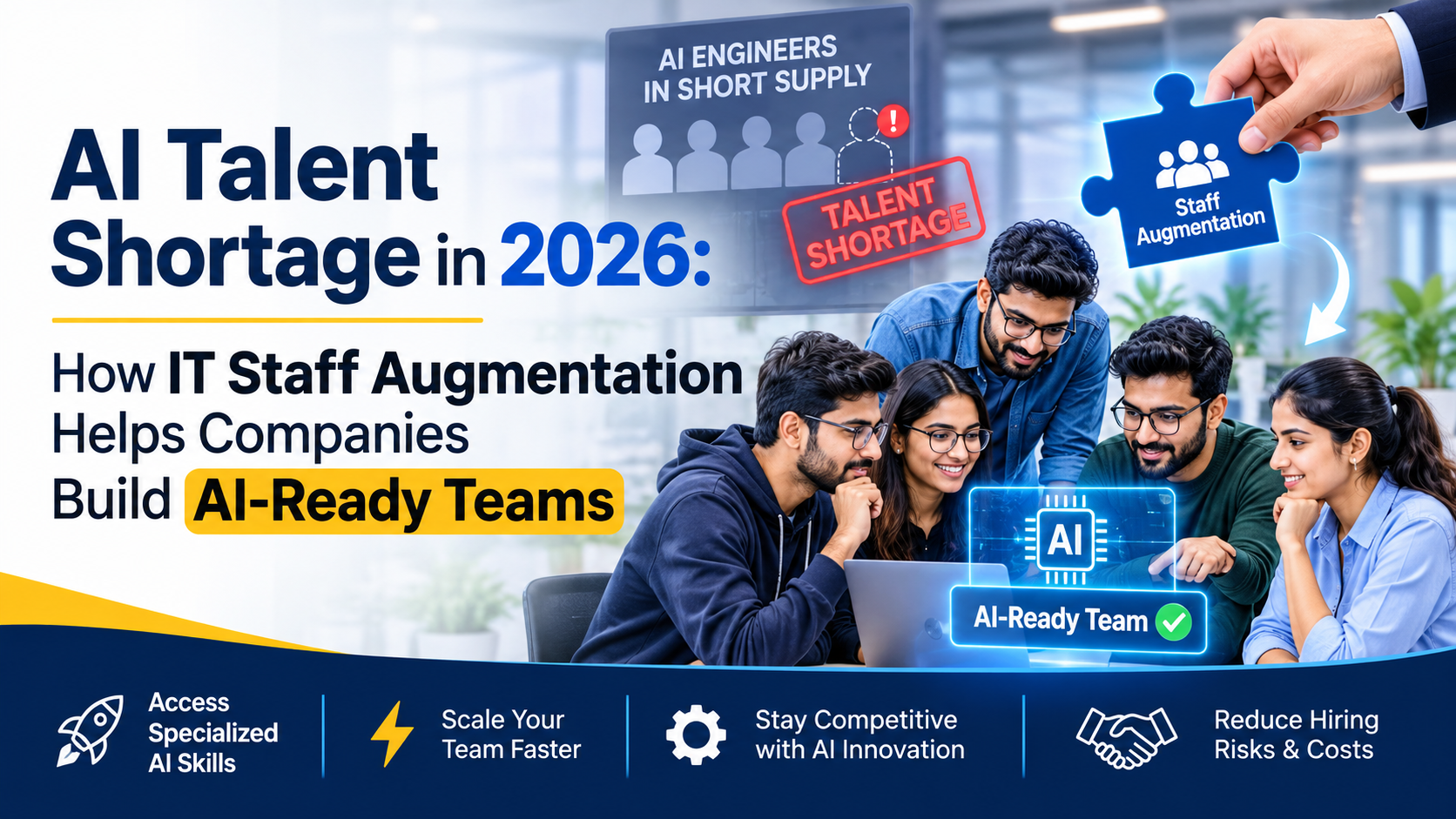
Artificial intelligence is becoming part of product development, customer service, analytics, cybersecurity, internal automation, and business operations. Companies want to build AI-powered products and use AI to improve efficiency, but many are struggling to find people with the right technical experience.
This challenge is creating a growing AI talent shortage. Businesses need professionals who understand software engineering, data, cloud infrastructure, machine learning, model integration, security, and product delivery. Finding all of those skills in one person can be difficult, especially when a project has an urgent deadline.
IT staff augmentation gives companies a practical way to respond. Instead of waiting to build a complete permanent AI department, a business can add experienced AI developers, machine learning engineers, data specialists, full-stack developers, or cloud professionals to its existing team for a defined project or delivery phase.
The objective is not simply to hire more people. It is to build the right AI capability for the business problem while keeping product ownership, technical direction, and long-term strategy inside the organisation.
What is the AI talent shortage?
The AI talent shortage is the gap between the number of businesses that need AI-related skills and the number of professionals available with practical experience in those skills.
This gap includes more than machine learning researchers. Companies may need people who can build AI applications, connect models to business systems, prepare and protect data, evaluate model outputs, deploy AI services, and create user experiences around AI features.
The shortage is also affected by the speed of change. Tools, models, frameworks, and best practices are evolving quickly. A candidate may have experience with one generation of AI tools but still need to learn how to apply newer systems in a secure production environment.
In February 2026, ManpowerGroup reported that 72% of employers in its survey of 39,000 organisations across 41 countries were having difficulty filling roles. Its survey identified AI model and application development and AI literacy among the hardest-to-find skills.
This shows why businesses are looking beyond traditional job titles. An organisation may not need a researcher who trains models from scratch. It may need a full-stack developer who can integrate a model into a product, a data engineer who can prepare reliable information, or an AI specialist who can build an evaluation process.
Why is AI talent difficult to find?
AI projects require a combination of skills that are often spread across several roles. A successful product may need data preparation, model selection, prompt design, backend engineering, frontend development, security, testing, deployment, monitoring, and product management.
Many professionals have depth in one area but not the complete set of skills needed to take an AI feature from an early idea to a reliable production service. A strong research background does not automatically mean someone can build scalable APIs. A skilled software engineer may need additional support with data pipelines or model evaluation.
Experience also matters. AI prototypes can be created quickly, but production systems require decisions about privacy, permissions, costs, response quality, failure handling, observability, and user trust. Companies often need professionals who have worked through these practical issues before.
Traditional hiring can add another challenge. A company may need AI expertise immediately, but permanent recruitment can involve sourcing, screening, interviews, notice periods, onboarding, and training. The business may not want to make a permanent hiring decision before it has validated the project’s scope.
What AI skills do companies need in 2026?
The right AI skills depend on the project. Some organisations need advanced machine learning development, while others need practical AI application engineering.
AI model and application development is important for companies building assistants, automation tools, intelligent search, recommendation systems, document workflows, and customer-facing AI features. These professionals need to understand model APIs, structured outputs, prompts, tools, testing, and application architecture.
Data engineering is essential because AI systems depend on the quality, availability, and governance of their data. Data engineers help build pipelines, clean information, manage storage, apply permissions, and prepare data for analytics or retrieval systems.
Machine learning engineering is relevant when a business needs model training, fine-tuning, experimentation, deployment, or specialised prediction systems. This work may require statistics, Python, model development, MLOps, and domain-specific knowledge.
Cloud and DevOps skills are important for deploying AI applications reliably. AI workloads may require scalable infrastructure, secure secrets management, monitoring, cost controls, containerisation, and automated release processes.
AI security and governance are becoming more important as applications handle sensitive information and interact with business systems. Teams need to consider data leakage, prompt injection, access controls, model abuse, privacy, auditability, and human review.
Full-stack development remains important because an AI capability must still be delivered through a usable and secure application. A model response has limited value if users cannot understand it, correct it, or access it through a reliable workflow.
Does every employee need advanced AI skills?
No. AI readiness does not mean every employee needs to become a machine learning engineer.
An OECD report published in 2026 states that fewer than 1% of workers need advanced AI-specific skills such as programming or model development. It also highlights the importance of broader digital skills, data use, problem-solving, creativity, innovation, and management capabilities.
This distinction is useful for workforce planning. A company may need a small group of advanced AI specialists supported by a much wider workforce that understands how to use AI tools responsibly and interpret their results.
For technology teams, this can mean building different levels of AI capability. Some developers may learn how to integrate model APIs. Data specialists may focus on retrieval and data quality. Security professionals may evaluate AI risks. Product leaders may define appropriate use cases and success measures.
The most effective AI teams are rarely made up of one job type. They combine technical depth with business context, engineering discipline, communication, and responsible decision-making.
How does AI staff augmentation help businesses?
AI staff augmentation allows a company to add external AI and technology professionals to its existing team for a defined period. The client usually maintains control over product priorities, technical decisions, workflows, and acceptance criteria.
This approach can help when the company has an AI idea but lacks the capability to execute it. An augmented team can support discovery, architecture, prototype development, data preparation, integration, testing, deployment, or ongoing improvement.
It can also help when the business already has AI specialists but lacks software engineering capacity. A full-stack developer or cloud engineer may be needed to turn an internal model into a reliable product feature.
The model is flexible because the team can be formed around the actual project requirements. A business may begin with an AI engineer and a backend developer, then add a data engineer or QA specialist as the project moves toward production.
IT staff augmentation can also reduce the pressure to make a permanent hiring decision too early. The company can validate the use case, understand the skills required, and decide later which capabilities should become part of the long-term internal team.
When should a company use AI staff augmentation?
AI staff augmentation can be useful when a business needs specialist skills for a specific initiative. This may include an AI assistant, knowledge search system, document automation workflow, recommendation feature, predictive model, or internal productivity tool.
It can support a company that is modernising an existing application. Many organisations do not need to build a new AI product from scratch. They need to add intelligent search, classification, extraction, summarisation, or automation to a platform they already operate.
It can also help during cloud or data transformation. AI projects often expose weaknesses in data quality, access control, infrastructure, and monitoring. External specialists can help the internal team address these requirements while maintaining progress.
The model is appropriate when the business has a clear internal owner who can guide the work. External professionals can contribute technical expertise, but the company still needs to define the user problem, data boundaries, security expectations, and business outcome.
What are the risks of solving the AI talent gap quickly?
Speed is valuable, but fast access to talent should not replace technical evaluation. A professional who understands AI terminology may not have experience building secure, maintainable systems.
The company should evaluate practical capability. It should understand how the candidate approaches data, model output, system design, testing, privacy, cost, and failure scenarios. A live technical discussion or work sample can provide more useful evidence than a résumé alone.
Security must also be considered before access is provided. AI projects may involve customer information, internal documents, source code, financial data, or proprietary business knowledge. The engagement should define repository permissions, data access, secrets management, logging, device policies, and offboarding.
The business should also avoid building a demonstration that cannot be operated in production. A production AI system needs evaluation, monitoring, quality controls, fallbacks, documentation, and a process for handling incorrect or unsafe responses.
How should businesses build an AI-ready team?
The first step is to define the business problem. A company should explain what it wants to improve, who will use the solution, what information is available, and how success will be measured.
The next step is to map the required skills. The project may need AI application development, data engineering, full-stack development, cloud infrastructure, security, QA, product management, or domain expertise. This skills map is more useful than a general request for an AI team.
The company should then decide which capabilities to build internally and which to access externally. Long-term product knowledge and strategic ownership often belong inside the company. Specialist delivery capacity can be added through staff augmentation while the organisation develops its permanent capability.
The team should begin with a controlled scope. A focused use case makes it easier to test the technology, understand costs, evaluate quality, and learn what skills are required for the next stage.
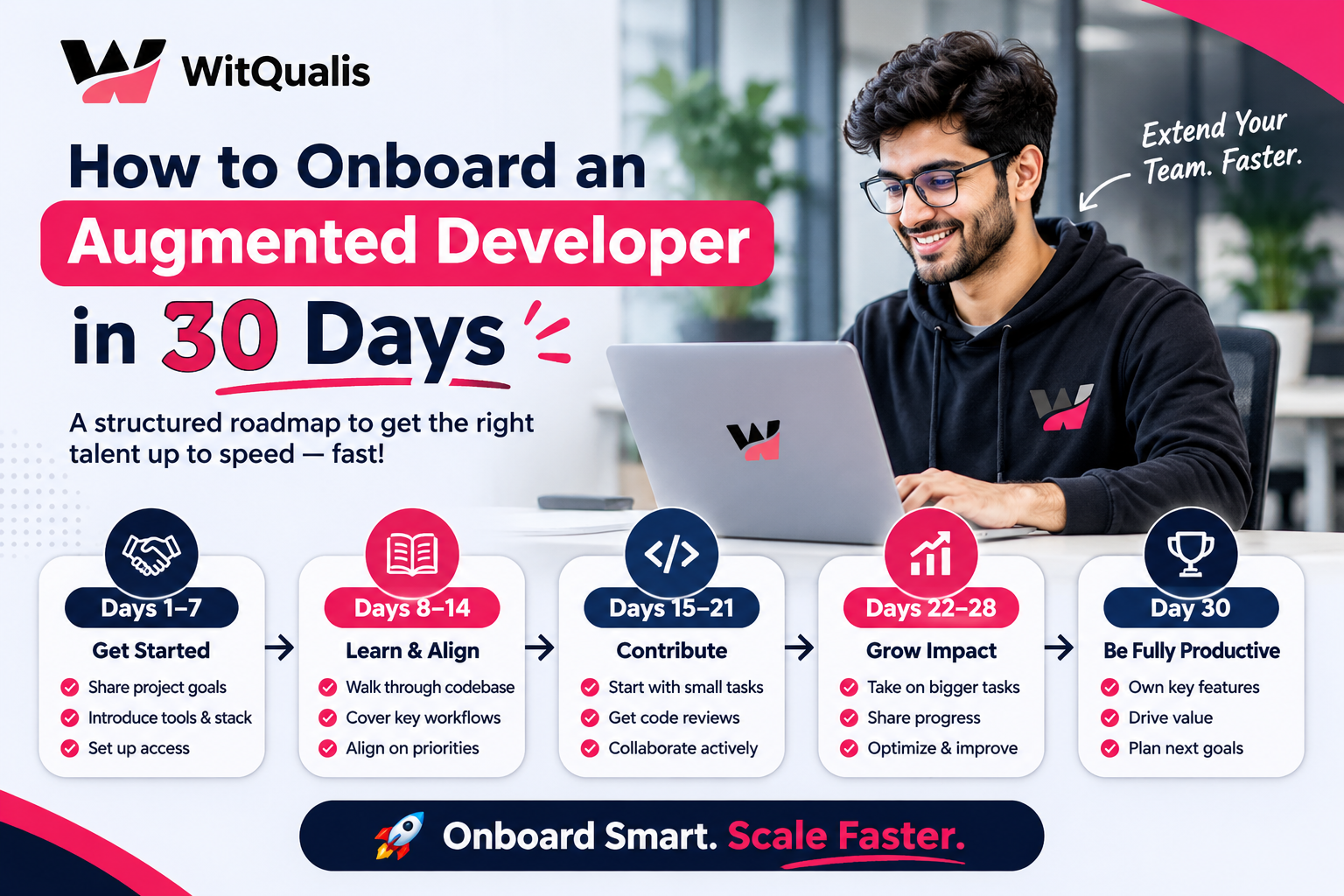
Finally, the business should document what it learns. AI projects create valuable knowledge about data quality, user behaviour, model performance, security, and operational requirements. Documentation and knowledge transfer help the organisation become more capable over time.
AI staff augmentation vs permanent AI hiring
Permanent hiring is appropriate when AI capability is central to the long-term business strategy. It creates internal continuity and allows the organisation to develop deep knowledge of its products, data, and customers.
However, permanent hiring may not be the best first step when the use case is still being validated or the required roles are unclear. A company may not yet know whether it needs an AI engineer, data engineer, full-stack developer, or platform specialist.
AI staff augmentation provides a flexible way to start. It can add the capabilities required for discovery or delivery while the company continues to define its long-term workforce plan.
Many businesses use both approaches. They hire permanent leaders and core engineers while using external specialists for urgent delivery, rare skills, or temporary project capacity.
How Witqualis helps build AI-ready teams
Witqualis provides IT staff augmentation support for businesses that need access to software development and AI-related technical talent. Its service offering includes AI and machine learning, full-stack development, cloud, DevOps, data, QA automation, web, and mobile development capabilities.
This allows companies to build teams around a specific AI project rather than hiring for a broad title without a clear scope. A business can identify the work it needs to complete and look for the combination of technical skills required to deliver it.
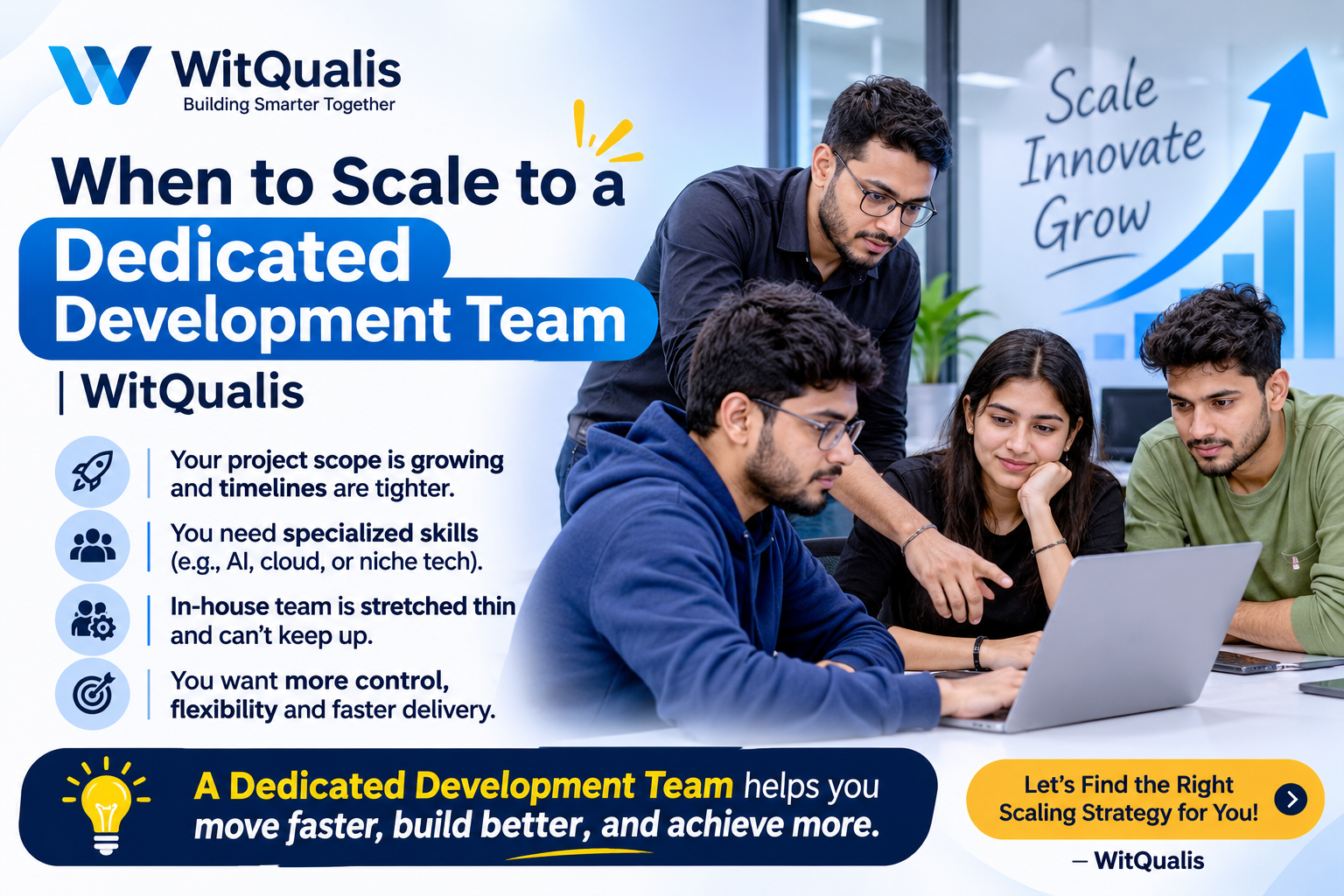
Witqualis also provides dedicated developers and engineering talent for organisations that need ongoing development capacity. The right structure depends on the company’s internal team, project stage, security requirements, technology stack, and expected duration.
A strong engagement should begin with a detailed skills brief. The brief should describe the business problem, the expected product or technical outcome, the data environment, the required tools, the working model, and the level of seniority needed.
Final thoughts
The AI talent shortage is not only a recruitment problem. It is a delivery and workforce-planning problem. Companies need to decide which AI capabilities are essential, which skills can be developed internally, and which specialists should be added for a defined project phase.
AI staff augmentation gives businesses a flexible way to access AI developers, machine learning engineers, data specialists, full-stack developers, cloud engineers, and DevOps professionals. It can help companies move from an AI idea to a tested and supportable product without waiting for a complete permanent team to be built.
The strongest approach combines technical expertise with clear scope, strong security, realistic evaluation, and knowledge transfer. AI-ready teams are not created by adding a single job title. They are built by bringing together the skills required to solve a real problem and deliver a reliable result.
If your business needs flexible access to AI and software engineering talent, explore Witqualis IT staff augmentation services or dedicated engineering talent.