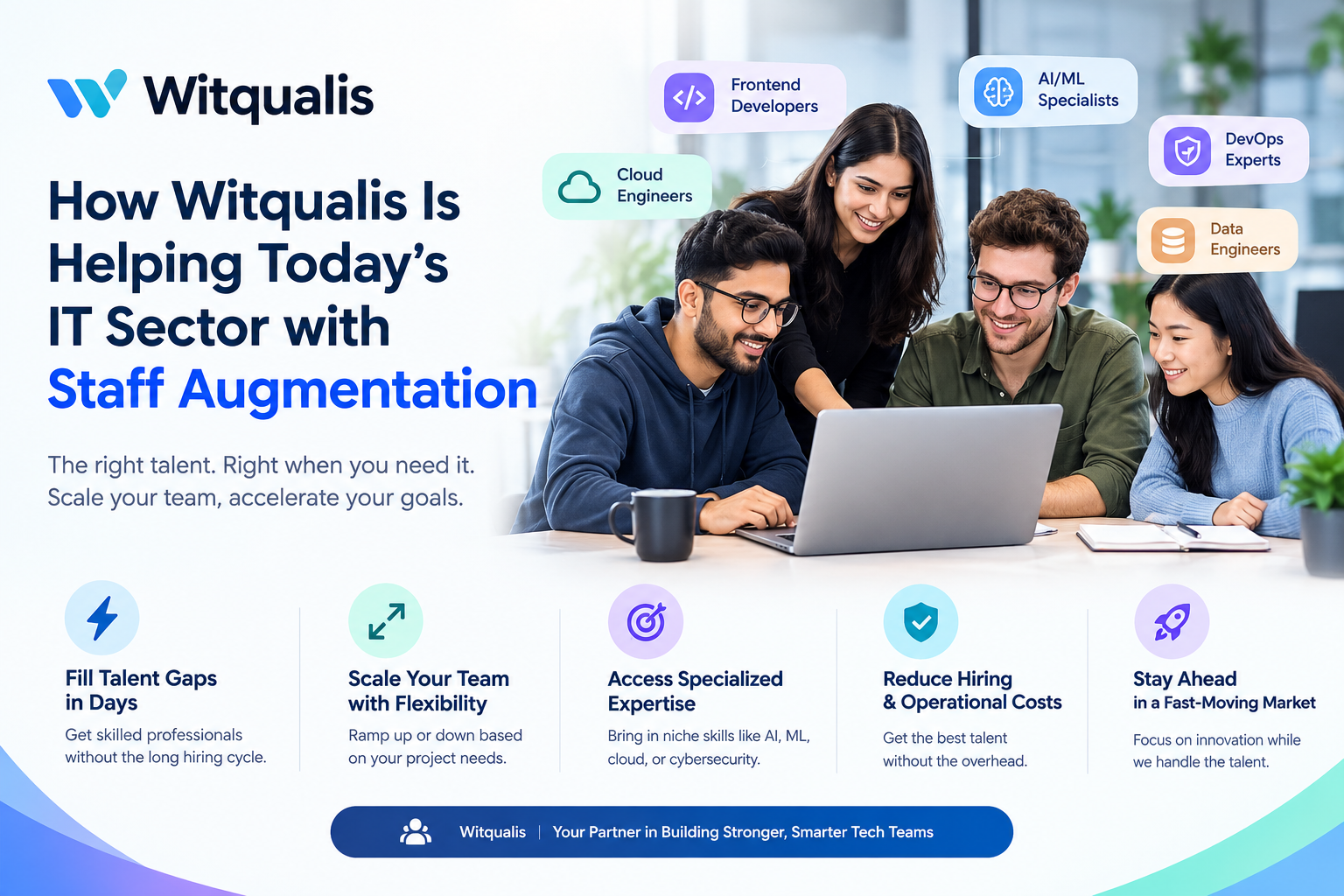
How Witqualis Is Helping Today’s IT Sector with Staff Augmentation
The IT sector is changing quickly. Companies are expected to modernize legacy systems, release software faster, adopt artificial intelligence, strengthen cybersecurity, and control technology costs at the same time. Finding people with the right experience for every project can be difficult, especially when a team needs a specialist for a specific technology or delivery phase.
That is where IT staff augmentation services can help. Instead of replacing an internal department or handing an entire project to an external vendor, a company adds qualified technical professionals to its existing team for a defined period. The client keeps control of priorities, architecture, processes, and product decisions while the additional engineers contribute to delivery.
Witqualis helps organizations use this model to access pre-vetted software engineers and dedicated engineering squads across software development, artificial intelligence, cloud, data, mobile development, QA automation, and DevOps. Its stated approach is to match developers to the client’s technology stack and allow a trial sprint before a longer engagement begins.
Key Takeaways•
IT staff augmentation helps companies add specialist capacity without rebuilding their permanent team for every project.
• The model works best when external engineers join existing workflows, repositories, stand-ups, and delivery standards.
• Witqualis focuses on pre-vetted developers, direct team integration, a reported 48-hour candidate matching process, and a seven-day trial sprint.
• The right partner should be evaluated on technical vetting, communication, security, ownership, and measurable delivery outcomes—not only hourly rates.
Why is staff augmentation important in today’s IT sector?
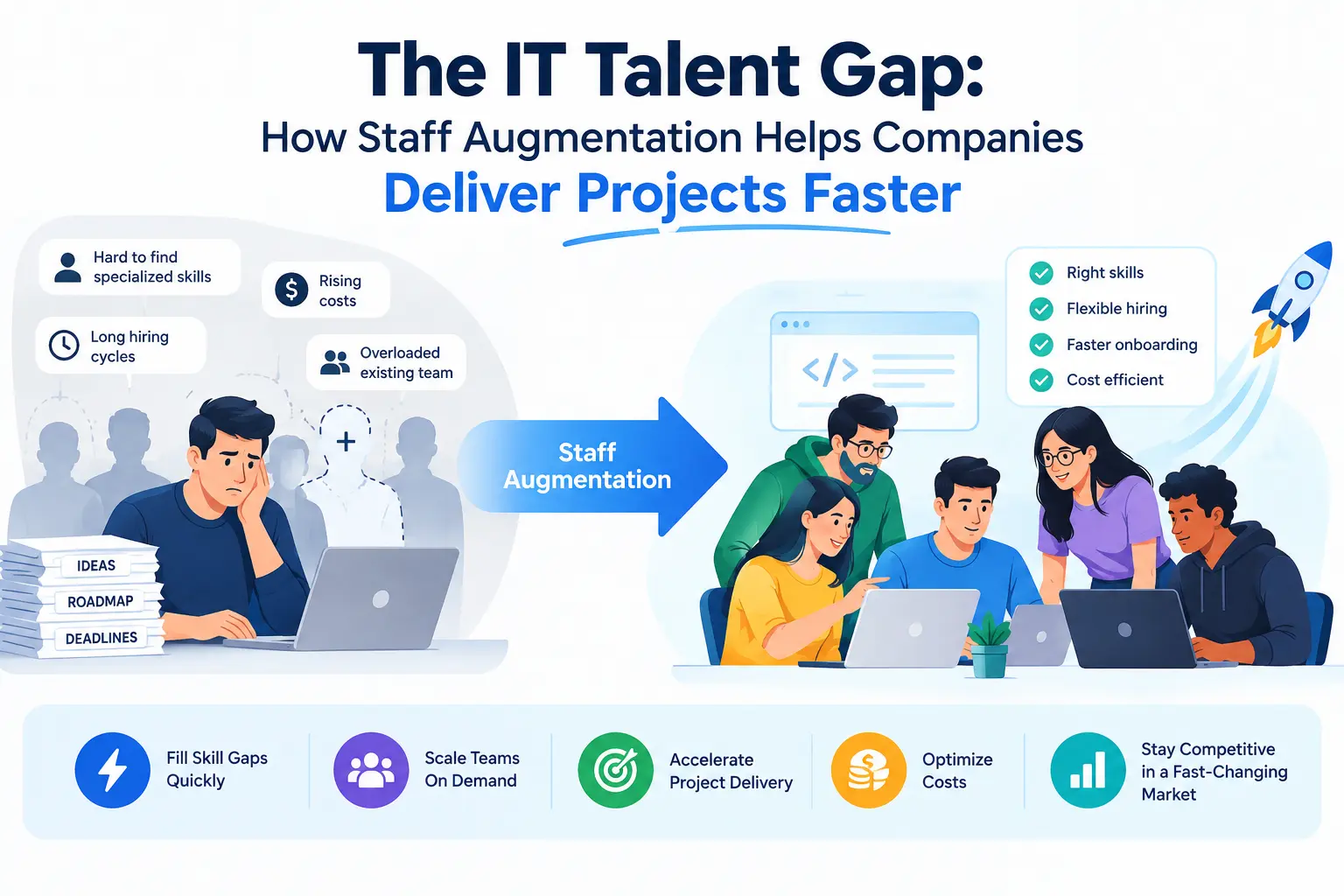
Staff augmentation has become useful because technology work is increasingly specialized. A product team may need a machine learning engineer for an AI feature, a Kubernetes specialist for a platform migration, or a QA automation engineer before a major release. Hiring each specialist permanently may not be practical, but delaying the work can also be expensive.
The demand for technical skills remains strong. The U.S. Bureau of Labor Statistics projects 10% employment growth for software developers, quality assurance analysts, and testers from 2025 to 2035, with about 106,100 openings each year on average. The World Economic Forum’s Future of Jobs Report 2025 identifies AI and big data, networks and cybersecurity, and technological literacy among the fastest-growing skills.
These trends create a capacity problem for many businesses. The question is not simply whether a company can hire a developer. It is whether the company can find the right person, validate their technical ability, onboard them into the team, and make them productive while the project still matters.
Staff augmentation addresses this gap by adding skills when they are needed, while allowing the internal team to retain product and delivery ownership.
What is IT staff augmentation?
IT staff augmentation is a delivery model in which external technology professionals work as an extension of a client’s internal team. The client usually defines the project priorities, manages the day-to-day work, and decides how the new team members fit into its engineering process.
A staff augmentation engagement can include:
• Software developers for web, mobile, backend, or full-stack delivery
• AI and machine learning engineers for production applications
• Cloud, DevOps, and site reliability specialists
• QA automation engineers
• Data engineers and analytics specialists
• UI/UX and product design professionals
• Technical leads or solution architects for a defined delivery phase
This differs from a fully managed project. In a managed-services model, the vendor generally owns more of the scope, project management, and delivery accountability. In staff augmentation, the client normally maintains greater control over the backlog, technical decisions, communication, and acceptance criteria.
For organizations with capable internal leadership but limited capacity, that distinction is important. They may not need another vendor to make product decisions. They may need experienced people who can contribute directly to the decisions and workflows already in place.
How is Witqualis helping IT teams scale engineering capacity?
Witqualis positions its software development staff augmentation service around direct integration with client engineering teams. Based on its service information, the company supports the following areas.
1. Adding specialized developers to existing teams
Witqualis offers access to developers across frameworks and technical disciplines, including React, Node.js, Python, Flutter, Angular, .NET, PHP, cloud platforms, AI/ML, QA automation, and DevOps. This allows a business to look for a skill profile that matches its current stack instead of hiring a generalist who needs significant retraining.
The practical benefit is context. A React developer joining a product team should understand the team’s state-management approach, accessibility expectations, testing standards, and release process. A cloud engineer should understand the existing infrastructure, observability requirements, and cost constraints. Matching should therefore consider more than a keyword on a résumé.
2. Supporting AI and data projects
AI projects often need multiple capabilities. A company may need data engineering, model integration, retrieval-augmented generation, evaluation, application development, and deployment expertise. One job title rarely covers all of these requirements.
Witqualis lists AI, machine learning, LLM, RAG, data analytics, and Python engineering capabilities among its available talent areas. This can help teams add focused expertise for a specific AI initiative while keeping business ownership and product context inside the client organization.
A responsible engagement should still define data access, security boundaries, model evaluation, intellectual property, and human review before work begins. Staff augmentation can add capacity, but it does not remove the need for clear AI governance.
3. Helping businesses modernize cloud and platform operations
Cloud migration and platform engineering require more than moving applications between hosting providers. Teams may need infrastructure as code, container orchestration, CI/CD pipelines, monitoring, security controls, and cost management.
Witqualis identifies Azure, Google Cloud, Kubernetes, Terraform, DevOps, and site reliability engineering among its technology areas. A business can use technical staff augmentation to add specialists during migration, release automation, reliability improvements, or platform standardization.
The strongest results come when the augmented engineer documents decisions and improves the internal team’s ability to operate the platform after the engagement. The objective should be increased delivery capability, not permanent dependence on an external resource.
4. Reducing the delay between requirement and delivery
Traditional recruitment can take time because companies must source candidates, screen them, schedule interviews, negotiate terms, and complete onboarding. That process may be appropriate for permanent strategic hires, but it can create a problem when a project has an immediate delivery deadline.
Witqualis states that it aims to present interview-ready candidates within 48 hours and offers a seven-day trial sprint. These are company-stated service claims, so buyers should validate the actual process, available time zones, technical screening method, and commercial terms during evaluation.
A rapid start is useful only when quality is maintained. Fast matching should be combined with technical interviews, reference checks where appropriate, secure repository access, and clearly defined sprint outcomes.
What makes Witqualis’s staff augmentation model different?
A staff augmentation provider is not only a source of résumés. It becomes part of the client’s delivery system. The quality of the model depends on how well the provider handles vetting, matching, communication, onboarding, and accountability.
Witqualis highlights several parts of its model:
These features should be evaluated in context. A trial sprint should have a defined scope, a fair assessment process, and appropriate access controls. Repository and IP terms should be reviewed by the client’s legal and security teams before work begins.
When should a company use developer staff augmentation?
Developer staff augmentation is usually a good fit when the company has internal technical leadership but needs more delivery capacity or specialist expertise. Typical situations include:
A product launch is approaching
A company may need additional frontend, backend, mobile, QA, or DevOps capacity to meet a release milestone. Temporary support can help the internal team complete the work without permanently increasing headcount before demand is proven.
A skill gap is blocking delivery
An existing team may be strong in product engineering but lack experience with Kubernetes, data platforms, security automation, or production AI. Adding a specialist can reduce the learning curve and help the team make better technical decisions.
A legacy platform needs modernization
Modernization often requires expertise that the permanent team does not use every day. Augmented engineers can support architecture assessment, migration planning, testing, and phased implementation while internal owners retain system knowledge.
A company needs to test a new capability
A business may want to validate an AI product, mobile application, or cloud platform before creating a permanent department. A time-bound engagement can provide useful evidence about scope, skills, and operating cost.
Internal hiring is taking longer than the roadmap allows
A company can continue its permanent hiring process while using staff augmentation to keep a critical initiative moving. The two approaches do not need to be mutually exclusive.
How should businesses choose an IT staff augmentation company?
Price is important, but it should not be the only selection criterion. Before choosing an IT staff augmentation company, ask the following questions.
Does the provider understand the required technology stack?
Ask for examples of similar work, relevant seniority, framework versions, deployment environments, and the type of technical problems the proposed engineer has solved. A technology label is not the same as relevant experience.
How are engineers vetted?
Find out whether the process includes live technical assessment, system design, code review, communication evaluation, and reference checks. Ask who performs the assessment and how the results are documented.
How will the engineer work with the internal team?
Clarify stand-up times, communication channels, project management tools, code review, documentation, escalation, and technical ownership. The operating model should be agreed before the first sprint.
What happens if the fit is not right?
Review replacement terms, trial arrangements, notice periods, minimum commitments, and payment obligations. A short evaluation period can reduce risk, but only if its rules are written clearly.
How are security and intellectual property handled?
Confirm access controls, confidentiality, repository permissions, device policies, secure development practices, ownership of code, and offboarding procedures. This is especially important for AI systems, customer data, regulated workloads, and production infrastructure.
Can the provider show evidence of delivery?
Look for relevant case studies, measurable outcomes, client references, and named technical expertise. Generic claims about a large talent pool are less useful than proof that the provider can support the type of work you need.
Witqualis and the future of flexible IT delivery
The IT sector does not have a single workforce problem. Different organisations need different combinations of permanent employees, contractors, specialist consultants, partners, and automation. Staff augmentation is one tool for managing that mix.
Witqualis’s role is to help companies add pre-vetted technical professionals to existing teams for software, AI, cloud, data, mobile, QA, and DevOps work. Its model is designed for organisations that want to keep control of their product and engineering process while increasing capacity.
The value of the model will ultimately depend on execution. The right engineer must be matched to the right problem, integrated into the right workflow, and supported by clear goals. When those conditions are in place, IT staff augmentation services can help businesses respond to changing technology demands without making every capability a permanent hiring commitment.
Final thoughts
Witqualis is helping address a practical challenge in today’s IT sector: companies need specialised engineering skills, but their delivery priorities and hiring timelines do not always align.
Through software development staff augmentation, dedicated developers, AI and machine learning specialists, cloud engineers, QA automation professionals, and DevOps talent, Witqualis gives businesses another way to expand technical capacity. Its stated use of technical vetting, direct workflow integration, a 48-hour matching target, and a seven-day trial sprint provides a structured starting point for evaluation.
For companies considering this approach, the best next step is to define the required skills, delivery outcomes, security constraints, communication model, and trial criteria before comparing providers. Businesses can then judge staff augmentation on the quality of delivery and collaboration—not simply the number of profiles available.
If your team needs additional engineering capacity, explore
Witqualis IT staff augmentation services or review the available
dedicated developers and engineering talent.