Machine Learning Development Services: From Data Strategy to Production-Ready Models
Organizations are using machine learning to forecast demand, identify risks, personalize experiences, automate decisions, and improve operational efficiency. But successful machine learning is not created by selecting a model and connecting it to a dataset. It requires a complete process that connects business goals, data quality, engineering, model evaluation, deployment, monitoring, and continuous improvement.
That is why the right machine learning development services should cover more than model training. A capable development partner should help you identify valuable use cases, assess data readiness, design the solution, build and test models, integrate them with business systems, and operate them reliably after launch.
This guide explains what machine learning development services include, which use cases are suitable for custom ML, how the development lifecycle works, what to look for in a provider, and how to prepare your organization for a successful engagement.
Key Takeaways•
Machine learning development is a full product lifecycle, not a one-time model-building exercise.
•
The best projects begin with a measurable business outcome and a realistic data-readiness assessment.
•
Production ML requires model evaluation, secure integration, monitoring, retraining, and clear ownership.
•
Choose a partner that combines data science, machine learning engineering, software development, cloud, MLOps, and product expertise.
What Are Machine Learning Development Services?
Machine learning development services help organizations design, build, deploy, and maintain software systems that learn from data and generate predictions, classifications, recommendations, or other outputs.
Depending on the business problem, a machine learning development partner may provide:
•
ML strategy and use-case discovery.
•
Data assessment, preparation, and pipeline development.
•
Exploratory data analysis and feature engineering.
•
Predictive and classification model development.
•
Recommendation and personalization systems.
•
Natural-language and computer-vision solutions.
•
Model APIs and application integration.
•
Cloud deployment and infrastructure design.
•
MLOps automation, monitoring, and model governance.
•
Performance optimization and post-launch support.
A complete solution usually combines machine learning with conventional software. Business rules, APIs, databases, identity controls, user interfaces, workflow automation, and human review remain important even when a model is central to the product.
Google's machine learning guidance emphasizes that production ML involves more than the model itself. Data collection, feature engineering, validation, serving, monitoring, and system reliability all affect the outcome . This is why vendor evaluation should focus on the full system rather than a demo or isolated accuracy number.
Which Business Problems Are Suitable for Machine Learning?
Machine learning is most useful when a business has a repeatable decision or pattern that can be informed by historical or continuously collected data.
Predictive analytics and forecasting
Predictive models can estimate future outcomes such as demand, customer churn, sales volume, delivery delays, equipment failure, or resource requirements.
A forecasting project should define the prediction horizon, the business action that follows the prediction, and the cost of incorrect predictions. A model is valuable only when its output improves a decision or workflow.
Recommendation and personalization
Recommendation systems can help users discover products, content, services, or next-best actions. They may use historical behavior, product attributes, context, or explicit preferences.
The development team should consider cold-start users, changing preferences, feedback loops, explainability, and business constraints. A recommendation that maximizes clicks but reduces customer trust may not be a successful product outcome.
Classification and risk scoring
Classification models can categorize documents, tickets, leads, transactions, images, or user activity. Risk-scoring models can prioritize cases for review or identify unusual behavior.
These systems require careful attention to false positives, false negatives, threshold selection, bias, and human oversight. A model should not be deployed into a high-impact workflow without defining what happens when confidence is low or the input falls outside the training data.
Document and text intelligence
Machine learning can extract fields from documents, route support requests, summarize information, identify topics, and improve search. Modern systems may combine language models with retrieval, rules, and structured validation.
The development team should define how source data is selected, how sensitive information is protected, and how users can verify or correct outputs.
Computer vision
Computer vision systems can inspect images, identify objects, classify defects, read documents, or support medical, industrial, retail, and logistics workflows.
A reliable vision project needs representative images, consistent labeling, defined acceptance criteria, and testing across lighting, devices, environments, and edge cases.
Anomaly detection and monitoring
Anomaly-detection systems can identify unusual transactions, operational behavior, sensor patterns, network activity, or system performance. These systems are useful when the definition of a normal pattern is more practical than labeling every possible failure.
Because normal behavior can change, monitoring and threshold management are essential. The team should plan how alerts will be triaged and how feedback will improve future detection.
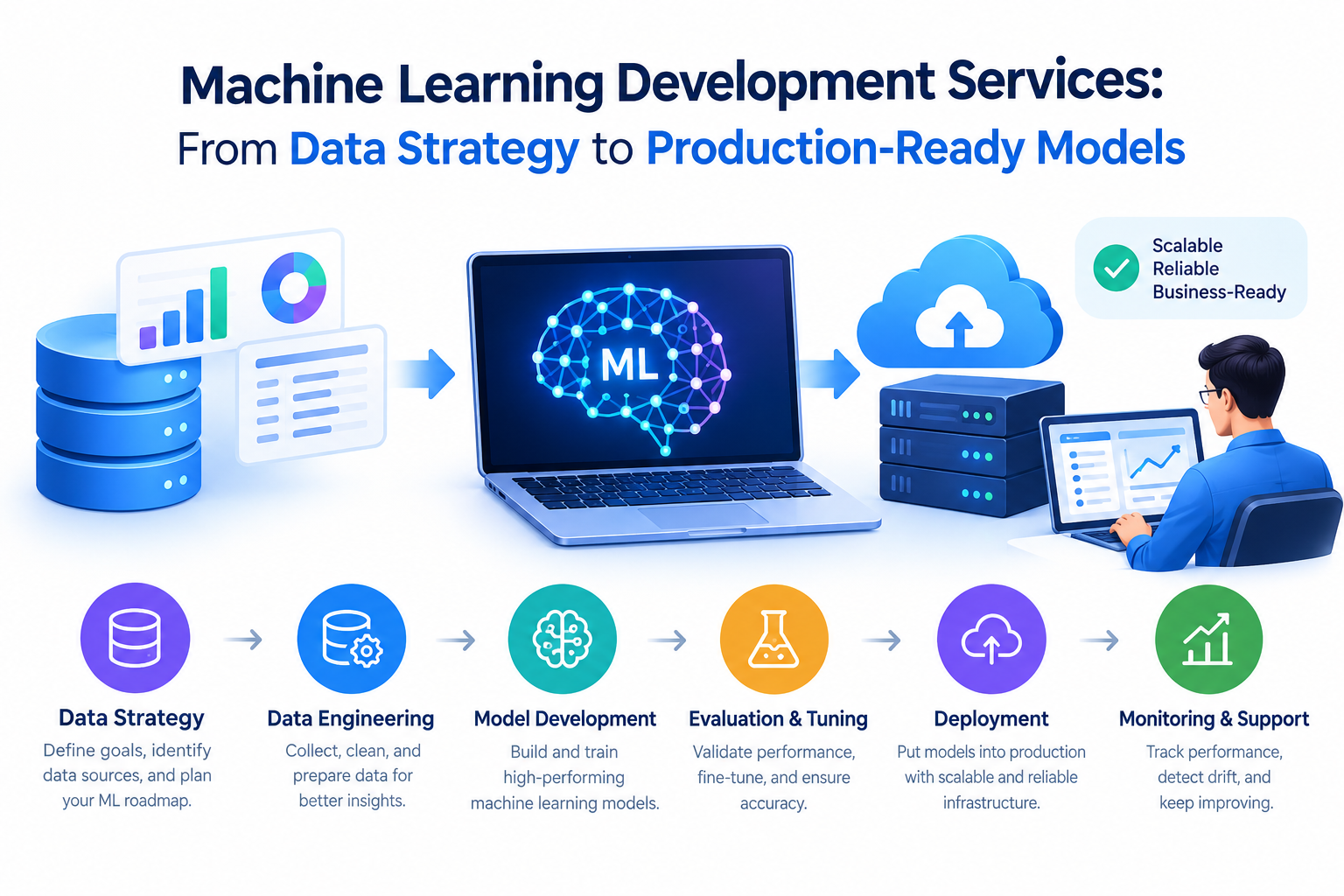
What Is Included in the Machine Learning Development Lifecycle?
A reliable ML engagement moves through connected phases. The stages may overlap, but skipping one usually creates risk later.
1. Discovery and use-case definition
The first step is clarifying the business problem, users, workflow, constraints, and measurable outcome. The team should document what decision the model will support, what data will be available, and how the output will be used.
A good discovery phase answers:
•
What is the current process?
•
Where do delays, errors, or costs occur?
•
What would improve if the model worked well?
•
What is the cost of a false positive or false negative?
•
Which users will trust, review, or act on the output?
•
What technical, security, privacy, and compliance constraints apply?
This phase may show that machine learning is not the best solution. A deterministic rule, better search, workflow redesign, or improved data collection may solve the problem more effectively.
2. Data assessment and preparation
The team identifies relevant data sources and assesses quality, availability, ownership, representativeness, and legal or contractual use.
This may include:
•
Data profiling and quality checks.
•
Cleaning and normalization.
•
Label creation and validation.
•
Feature engineering.
•
Handling missing, duplicate, or inconsistent records.
•
Protecting personal and confidential information.
•
Designing repeatable ingestion and transformation pipelines.
•
Splitting data correctly for training, validation, and testing.
Data preparation is often one of the most important parts of a machine learning project. A sophisticated model cannot compensate for incomplete labels, leakage, biased samples, or a dataset that does not reflect real production conditions.
3. Model design and development
The team selects a baseline and compares candidate approaches against the business requirements. Depending on the use case, this may involve statistical models, tree-based models, neural networks, language models, computer-vision models, or a combination of models and rules.
The development process should record:
•
Why the selected approach is appropriate.
•
Which assumptions the model makes.
•
What features or inputs it uses.
•
Which metrics define success.
•
What limitations are known.
•
How cost, latency, explainability, and maintainability affect the choice.
A baseline is useful because it gives the team something concrete to improve. The most complex model is not always the best production model if a simpler approach is easier to explain, cheaper to run, or more stable.
4. Evaluation and validation
Model evaluation should reflect how the system will be used. Accuracy alone may be insufficient. Depending on the problem, evaluation may include precision, recall, F1 score, calibration, ranking quality, mean absolute error, latency, cost, coverage, or business-process metrics.
The team should test:
•
Typical inputs.
•
Difficult and rare cases.
•
Missing or corrupted data.
•
Changes in user or market behavior.
•
Different segments, regions, languages, or device types.
•
Inputs outside the training distribution.
•
Security and abuse scenarios.
For high-impact decisions, include human review and explainability requirements. NIST's AI Risk Management Framework provides a structured approach to managing AI risks across governance, mapping, measurement, and management .
5. Integration and product development
A model becomes useful when it fits into a product or operational workflow. The team may expose it through an API, integrate it into a web or mobile application, connect it to internal systems, or embed it in an automated process.
Integration work should define:
•
Input and output formats.
•
Authentication and authorization.
•
Service-level expectations.
•
Error and timeout behavior.
•
Human review and override paths.
•
Logging and audit requirements.
•
Versioning and backward compatibility.
•
Data retention and deletion.
This is where product design matters. Users should understand what the system is recommending or predicting, what information influenced the result, and how to respond when the output is uncertain or incorrect.
6. Deployment and MLOps
MLOps applies engineering and operational practices to machine-learning systems. Google Cloud describes MLOps as supporting continuous integration, continuous delivery, and automation for ML workflows .
Production MLOps may include:
•
Reproducible training pipelines.
•
Dataset, feature, and model versioning.
•
Automated testing and validation gates.
•
Model registries and approval workflows.
•
Secure deployment to cloud or private infrastructure.
•
Monitoring for quality, drift, latency, availability, and cost.
•
Retraining and release procedures.
•
Rollback and incident-response plans.
You may not need a complex platform for an early proof of concept. You do need an operating plan before the model becomes business-critical.
7. Monitoring and continuous improvement
A model can degrade even when the application is still running. Customer behavior, market conditions, product offerings, data pipelines, and upstream systems may change.
Monitoring should track both technical and business signals, such as:
•
Input-data quality and distribution.
•
Prediction distribution and confidence.
•
Model performance when labels become available.
•
Error rates and response times.
•
Infrastructure availability.
•
Cost per prediction or transaction.
•
User corrections, overrides, and acceptance.
•
Business outcomes influenced by the model.
The team should define what triggers investigation, retraining, rollback, or human review. Continuous improvement should be planned before launch rather than treated as an emergency response.
Why Data Readiness Matters More Than Model Hype
Data readiness is one of the strongest predictors of project feasibility. Before selecting a machine learning development company, assess whether the organization has the data and operational access required to build and evaluate the proposed system.
Ask these questions:
•
Does the relevant data exist in a usable form?
•
Is the data accessible to the project team?
•
Who owns the data and approves its use?
•
Are historical outcomes or labels available?
•
Does the data represent current users and operating conditions?
•
Are there legal, privacy, or contractual restrictions?
•
Can the organization continue collecting data after launch?
•
Can domain experts validate labels and predictions?
If the answer to several questions is no, start with a data-readiness assessment or data-collection plan. A responsible provider should identify constraints early and adjust the roadmap rather than promising an unrealistic model outcome.
How to Choose a Machine Learning Development Company
Selecting a provider is a technical and business decision. Look for a partner that can connect strategy, engineering, and operations.
Evaluate end-to-end capability
Ask whether the company can support discovery, data engineering, model development, software integration, cloud deployment, testing, security, and maintenance. If capabilities are distributed across subcontractors, clarify who owns delivery quality and communication.
Review comparable experience
Request case studies or technical walkthroughs related to your industry, data type, use case, or deployment environment. You do not need an identical project. You do need evidence that the provider has solved comparable technical and operational problems.
Ask what happened after launch. A project that reached a demo but was never adopted provides less evidence than a system that operates in a real workflow.
Assess technical judgment
Ask the provider to compare several possible approaches. The explanation should consider data, model quality, cost, latency, privacy, integration, explainability, and maintenance.
Be cautious if the provider recommends the same model or architecture for every problem. Good machine learning development is requirement-led.
Confirm security and privacy practices
Ask how data is protected during development, training, evaluation, deployment, logging, and support. Clarify how access is granted, monitored, and removed. If third-party model or cloud providers are used, understand the data-processing terms and retention behavior.
Confirm ownership and handover
Your agreement should address ownership of source code, datasets, labels, features, model configurations, infrastructure, dashboards, documentation, and cloud accounts. Require enough documentation for your internal team or a future provider to operate the system.
For broader AI programs that combine machine learning with generative AI, automation, or intelligent products, explore
Witqualis AI development services. For strategy, feasibility, and roadmap support, review
AI consulting services.
Machine Learning Development Services Scorecard
Use a consistent scorecard when comparing providers.
Evaluation area
Questions to ask
Evidence to request
Business understanding
Can the team connect ML work to a measurable outcome?
Discovery plan and success metrics
Data capability
Can it assess, prepare, govern, and monitor data?
Data-readiness assessment
Model development
Can it select and evaluate appropriate approaches?
Model decision record and evaluation plan
Software engineering
Can it build secure, maintainable integrations?
Architecture diagram and code example
MLOps
Can it deploy, monitor, version, and roll back models?
Pipeline diagram and operating runbook
Product experience
Can users understand and act on outputs?
User flow or prototype
Security
Can it protect data and control access?
Threat model and data-flow diagram
Communication
Can it explain limitations and trade-offs clearly?
Technical walkthrough and references
Ownership
Will your organization retain control?
Contract and handover checklist
Support
Can it maintain the system after launch?
Service levels and maintenance plan
Weight each category according to your project. A regulated system may prioritize governance, auditability, and human review. A real-time recommendation product may place more weight on latency, experimentation, and monitoring. A prototype may prioritize discovery and rapid validation.
Common Machine Learning Development Mistakes
Starting with a model instead of a problem
A model is not a business strategy. Define the decision, user, workflow, and measurable outcome first.
Treating historical data as automatically reliable
Historical data may contain bias, missing records, inconsistent definitions, or behavior that no longer reflects the market. Assess it before using it for training.
Measuring only offline accuracy
A strong test score does not guarantee adoption, business impact, or safe operation. Include workflow, user, technical, and business metrics.
Ignoring the cost of predictions
Inference, storage, monitoring, labeling, and retraining can affect the economics of a solution. Estimate operating cost before launch.
Leaving MLOps until the end
Deployment and monitoring constraints can change the model design. Plan the operating environment early enough to influence architecture.
Failing to define human oversight
For important decisions, define who reviews outputs, when the system must defer, and how users can challenge or correct predictions.
Keeping ownership unclear
If a partner controls the repository, cloud account, model artifacts, or critical data pipeline, your long-term options may be limited. Clarify ownership before development starts.
Frequently Asked Questions
What do machine learning development services include?
They may include ML strategy, use-case discovery, data preparation, feature engineering, model development, predictive analytics, recommendations, natural-language or computer-vision solutions, API integration, cloud deployment, MLOps, monitoring, and maintenance. The exact scope depends on the project and should be defined in the statement of work.
How much do machine learning development services cost?
Cost depends on data readiness, project complexity, integrations, model requirements, security, infrastructure, user volume, evaluation depth, and ongoing support. A discovery or feasibility phase usually provides a more reliable estimate than a quote based on a short project description.
What is the difference between AI development and machine learning development?
AI development is a broad category that may include rule-based automation, generative AI, computer vision, speech, robotics, and machine learning. Machine learning development focuses on systems that learn patterns from data to generate predictions, classifications, recommendations, or other outputs. The two areas overlap, and many modern products use both.
How long does it take to build a machine learning solution?
The timeline depends on the use case, data condition, integration scope, evaluation requirements, and deployment environment. A proof of concept may be completed faster than a production system. Production delivery also requires security, monitoring, documentation, user testing, and operational readiness.
Should we build machine learning capabilities in-house or hire a development partner?
In-house development may be appropriate when ML is central to your long-term strategy and you can support data, product, engineering, security, and operations roles. A development partner can accelerate discovery and delivery when specialist skills are limited or the organization wants to validate an opportunity before building a permanent team. A hybrid model is also common.
What should be included in a machine learning development contract?
Define the scope, data responsibilities, deliverables, evaluation criteria, security controls, access, intellectual-property ownership, model and infrastructure ownership, documentation, acceptance process, support levels, maintenance, and handover requirements. Include a change-control process because data and evaluation findings may refine the solution during delivery.
Conclusion: Invest in the Complete ML System
Machine learning development services are most valuable when they connect a measurable business problem to a reliable production system. The model is only one part of that system. Data quality, software architecture, security, user experience, evaluation, deployment, monitoring, and ownership determine whether the solution creates durable value.
Before choosing a provider, define the outcome you want, assess your data readiness, identify the right technical approach, and decide how the solution will be operated after launch. Then evaluate providers on evidence of end-to-end delivery rather than on demos or buzzwords.
Witqualis helps organizations explore, design, build, and improve intelligent software solutions. Learn more about
Witqualis machine learning development services or visit the
Witqualis website to discuss your requirements.