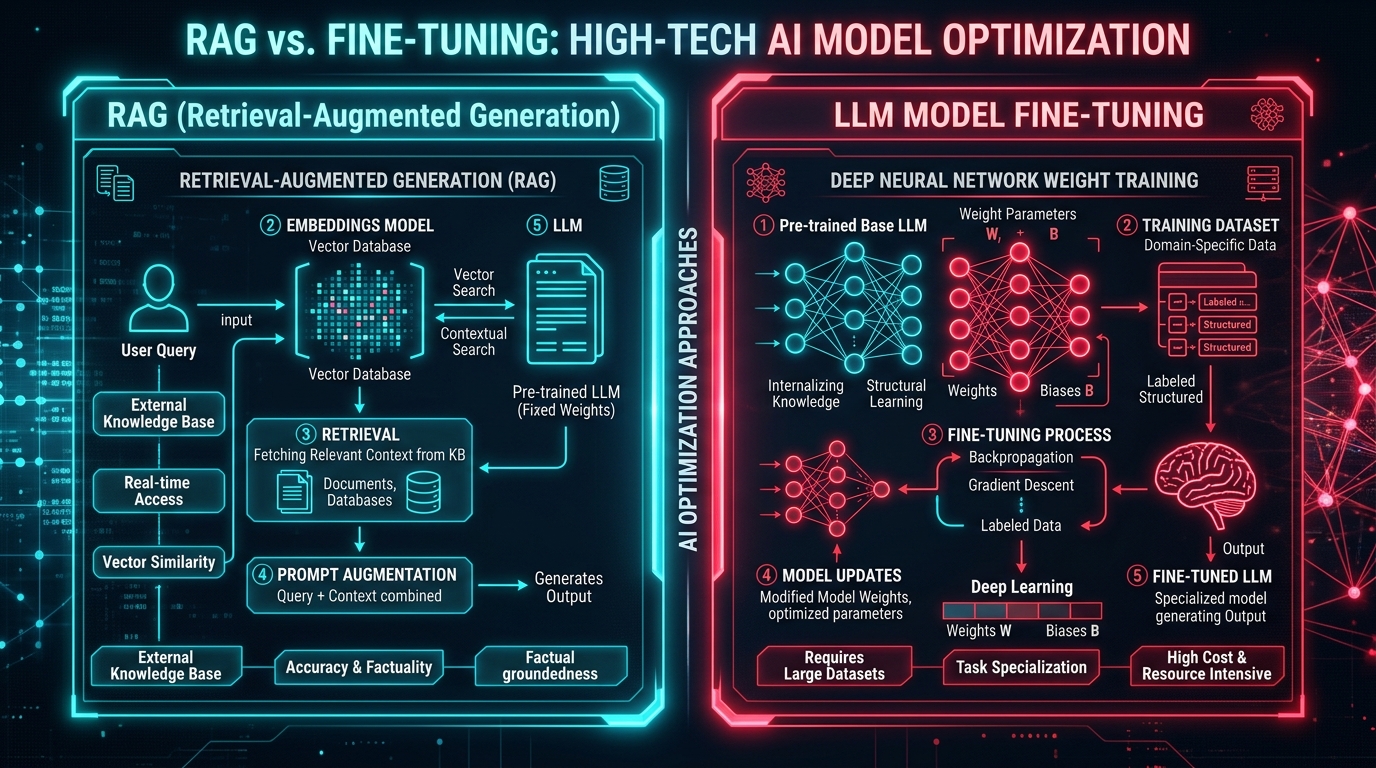
RAG (retrieval-augmented generation) is usually the right first move because it keeps your proprietary data separate from the model weights — you can update, audit, and remove information without retraining anything. When you add a new document to your knowledge base, it is available to the model on the next query, not after a multi-hour or multi-day retraining cycle. This makes RAG the natural fit for any use case where the underlying facts change regularly.
Fine-tuning earns its cost when you need the model to consistently follow a narrow behavior, tone, or output format, not when you need it to know more facts. Confusing these two goals is the most common reason AI features underperform: teams fine-tune a model hoping it will “know” their product catalog, when what they actually needed was a retrieval system feeding that catalog into the prompt at query time.
Think of it this way — RAG changes what the model has access to; fine-tuning changes how the model behaves with what it already has access to. A customer support assistant that needs to answer questions about your specific, frequently-updated product line is a RAG problem. A model that needs to consistently respond in a very specific structured format, or follow a narrow set of business rules regardless of the input, leans more toward fine-tuning — or often, a combination of both.
Most production AI systems end up using both: a fine-tuned (or carefully prompt-engineered) model for tone and task-following, with RAG supplying the facts that change faster than any retraining cycle could keep up with. This hybrid approach is now the default architecture we recommend for most enterprise knowledge-assistant use cases.
Evaluate vector database indexing latency and search quality before committing to an architecture. Popular options include Pinecone, Qdrant, Milvus, and pgvector (an extension for PostgreSQL, useful if you want to keep vector search inside your existing relational database rather than standing up a separate system). Hybrid search — combining sparse keyword matching with dense vector similarity — consistently outperforms pure vector search alone for retrieval accuracy, particularly for queries involving specific product names, codes, or exact terminology.
Chunking strategy matters more than most teams expect. How you split source documents into retrievable chunks — by paragraph, by fixed token count, or by semantic section — directly affects retrieval quality. Chunks that are too small lose context; chunks that are too large dilute the relevance signal and waste context window on irrelevant text. This is usually the first thing worth tuning when a RAG system underperforms in testing.
Consider the cost and maintenance profile of each approach honestly. Fine-tuning has an upfront training cost and typically a per-inference cost for hosting a custom model. RAG has an ongoing cost for embedding new documents and running vector search, plus the token cost of including retrieved context in every prompt — which can add up on high-volume features. Model the cost at your expected query volume before choosing an architecture, not after.
Do not overlook evaluation. Whichever approach you choose, build a test set of representative queries with known-good answers, and re-run it whenever you change the retrieval pipeline, the prompt, or the underlying model. Without this, you are making architecture decisions based on a handful of manual spot-checks, which is not a reliable signal at production scale.
If your use case is genuinely narrow — a small, stable set of facts and a simple task — sometimes neither RAG nor fine-tuning is necessary, and a well-constructed prompt with the relevant facts included directly is enough. Reach for the more complex architecture only once you have evidence that the simpler approach falls short, not by default.